
A radiography supervisor must repeat a noisy portable abdomen on a 90-kg patient, wants diagnostic density with the lowest dose, and can adjust kVp, mAs, and AEC within the department protocol. Which exposure factor strategy best balances image quality and patient dose?
Select an answer to reveal the explanation.
Short Explanation
You want the same brightness with a cheaper electric bill. A smarter beam paired with less quantity holds exposure steady for less dose.
Full Explanation
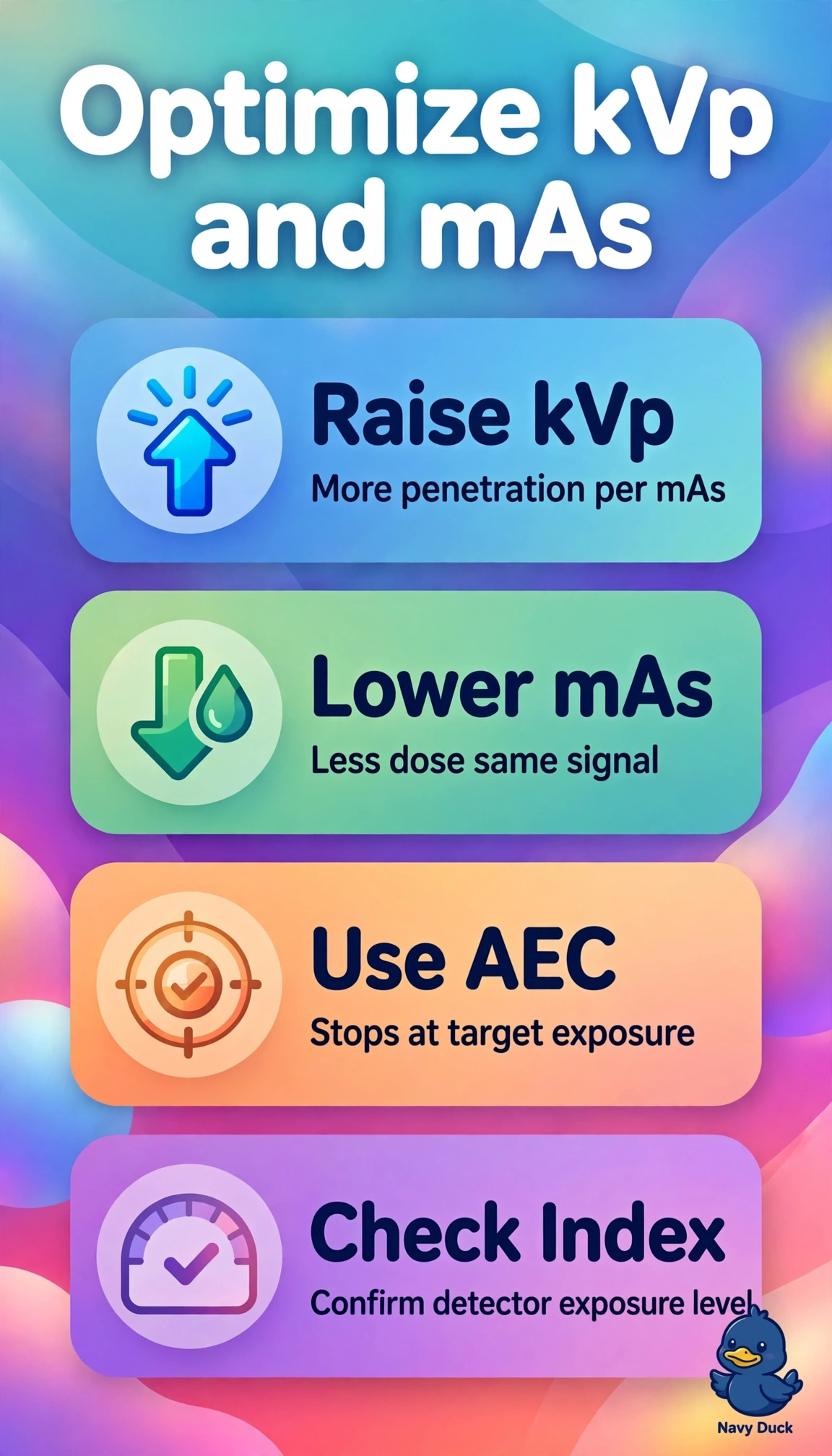
Raising kVp within the optimal range increases beam penetrability and detector signal per unit mAs, so mAs can be reduced to maintain exposure index and contrast acceptable for the task while entrance dose falls, and AEC helps terminate exposure at the target detector dose when chambers are selected and centered correctly. Raising mAs at low kVp does lower quantum noise but dose rises linearly with mAs and low penetration wastes dose in tissue absorption. Lowering both kVp and mAs together underexposes the detector, increasing quantum noise and risking repeats that ultimately increase cumulative dose. Disabling AEC for fixed high mAs ignores body habitus, overexposes smaller patients, and forfeits dose optimization without guaranteeing better diagnostic quality. Exam caveat: stay within protocol kVp ranges to preserve contrast and avoid excessive scatter. Practical check: select correct AEC chambers, confirm positioning, review exposure index, and adjust for size.