
A radiographer increases kVp from 70 to 90 while proportionally lowering mAs to maintain detector exposure for an adult abdomen projection. Tissue thickness and filtration are unchanged. Which photon interaction shift best explains the change in tissue attenuation and image contrast?
Select an answer to reveal the explanation.
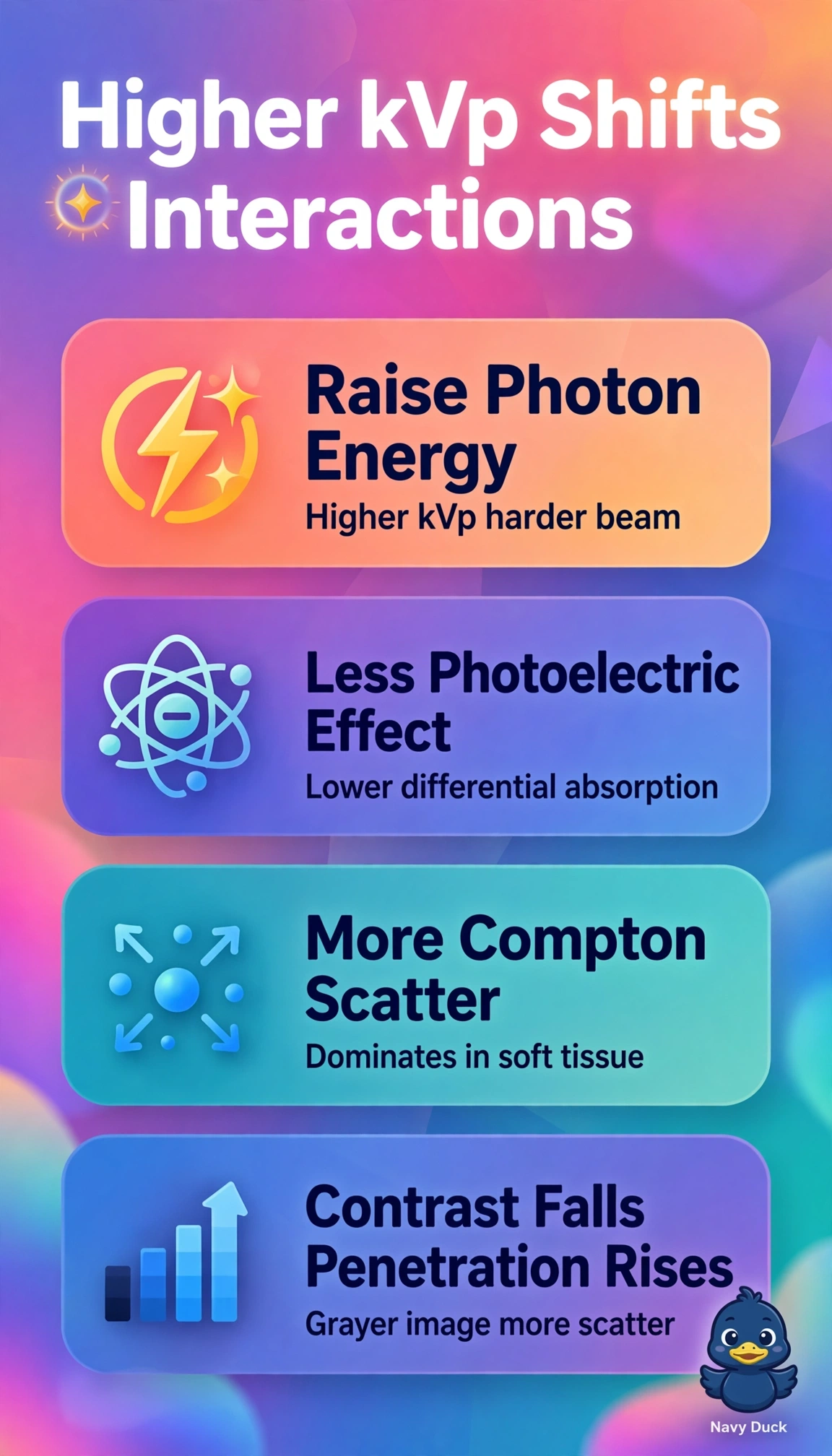
Short Explanation
You're trading contrast for punch-through with that higher kVp. More Compton and less photoelectric means grayer bones but easier penetration, a classic contrast-penetration tradeoff.
Full Explanation
Photon energy determines interaction probability: photoelectric absorption varies steeply with energy and atomic number and creates high subject contrast, while Compton scatter becomes dominant at higher kVp in soft tissue, increasing penetration and scatter but reducing differential attenuation and subject contrast. The photoelectric-predominance explanation reverses the energy dependence because raising kVp decreases photoelectric probability relative to Compton, so contrast falls rather than rises and penetration rises. The coherent-predominance explanation overstates a minor interaction because coherent scatter causes small-angle deflection without ionization, contributes little to image formation or dose, and never dominates diagnostic contrast. The no-change explanation denies physics because higher-energy photons are less attenuated, so more photons traverse tissue and subject contrast necessarily decreases even when detector exposure is maintained. Exam caveat: ARRT links higher kVp to more Compton, lower contrast, and wider latitude, and practical check: increase kVp only when penetration is needed and collimate closely to limit scatter fog.