
A clinic installs a new review workstation near a bright window where technologists check images before sending to radiology, and midday glare washes out subtle fractures. Which display and viewing adjustment should the supervisor implement to ensure consistent diagnostic image review?
Select an answer to reveal the explanation.
Short Explanation
You're dealing with glare, not brightness alone. Ambient light control helps preserve the contrast your monitor is meant to show.
Full Explanation
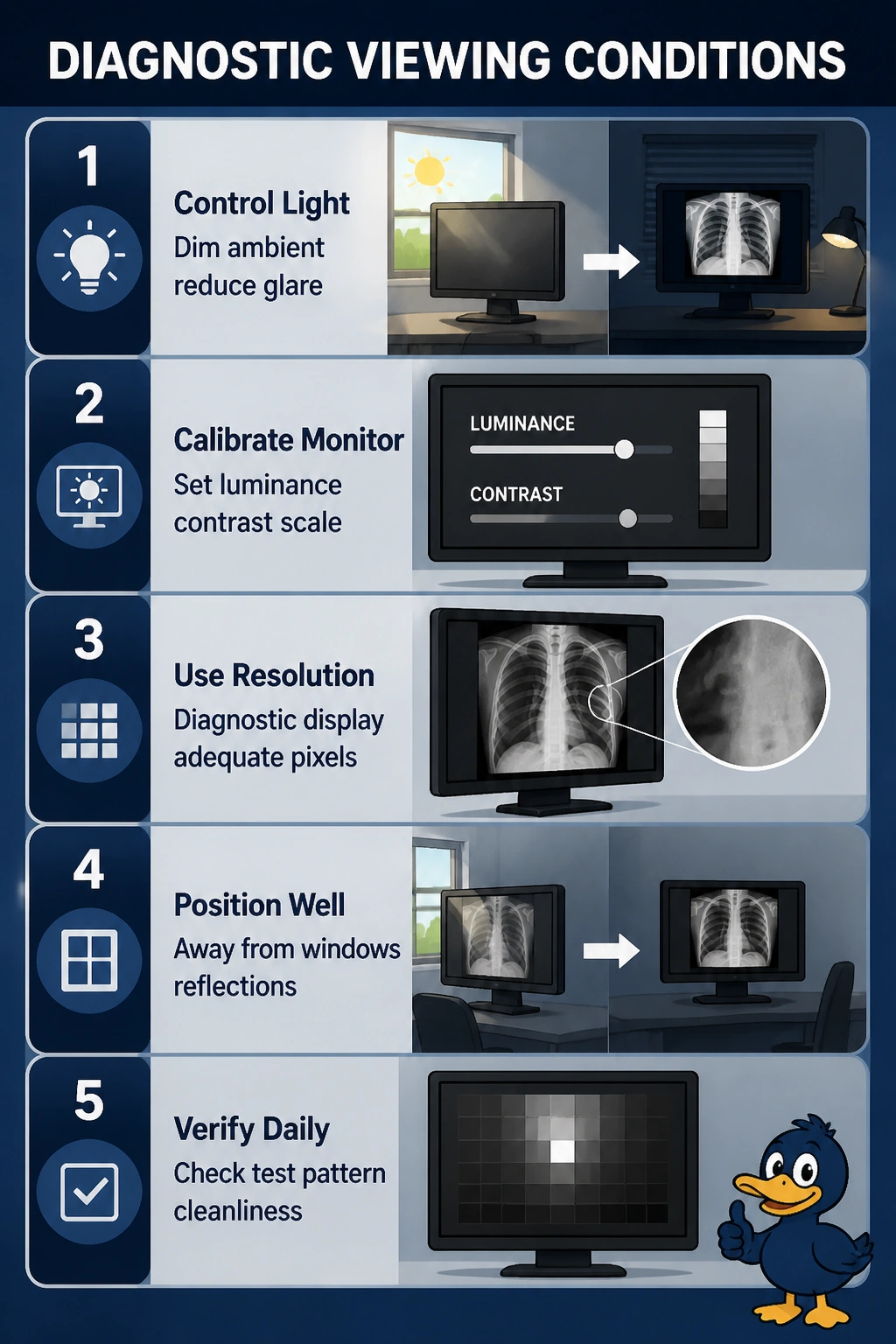
Relocating or shading the monitor, dimming ambient light, calibrating luminance, and using a high-resolution diagnostic display work together to support consistent review: reducing veiling glare preserves subtle fracture contrast, calibration maintains consistent grayscale presentation, and a diagnostic display provides the luminance, uniformity, and detail needed for reliable interpretation. Calibrating the existing display and increasing brightness while keeping it beside a bright window does not fully recover contrast lost to diffuse or specular glare, and midday sun can make visibility vary. Dim lighting and calibration paired with a standard high-resolution office monitor address the room but not display suitability; such monitors often lack the diagnostic luminance, contrast, uniformity, and stability needed to detect subtle fractures. Shading the window and using a calibrated diagnostic display still leaves review inconsistent if ambient lighting varies and overhead glare remains unshielded. An exam caveat: do not treat technologist quality review as non-diagnostic viewing when a missed fracture is possible; diagnostic conditions are needed. As a practical check, dim the room, verify calibration with a test pattern, and confirm fracture visibility during midday conditions.