
An interventional staff member receives a one-time 3-Gy whole-body exposure from an equipment malfunction, develops nausea within hours, and the medical physicist asks the radiography team about expected biologic classification. Which deterministic versus stochastic and acute syndrome concept best predicts the clinical course?
Select an answer to reveal the explanation.
Short Explanation
You are watching a predictable sunburn, not a random lightning strike. High whole-body dose triggers threshold prodromal illness with dose-dependent severity and timing.
Full Explanation
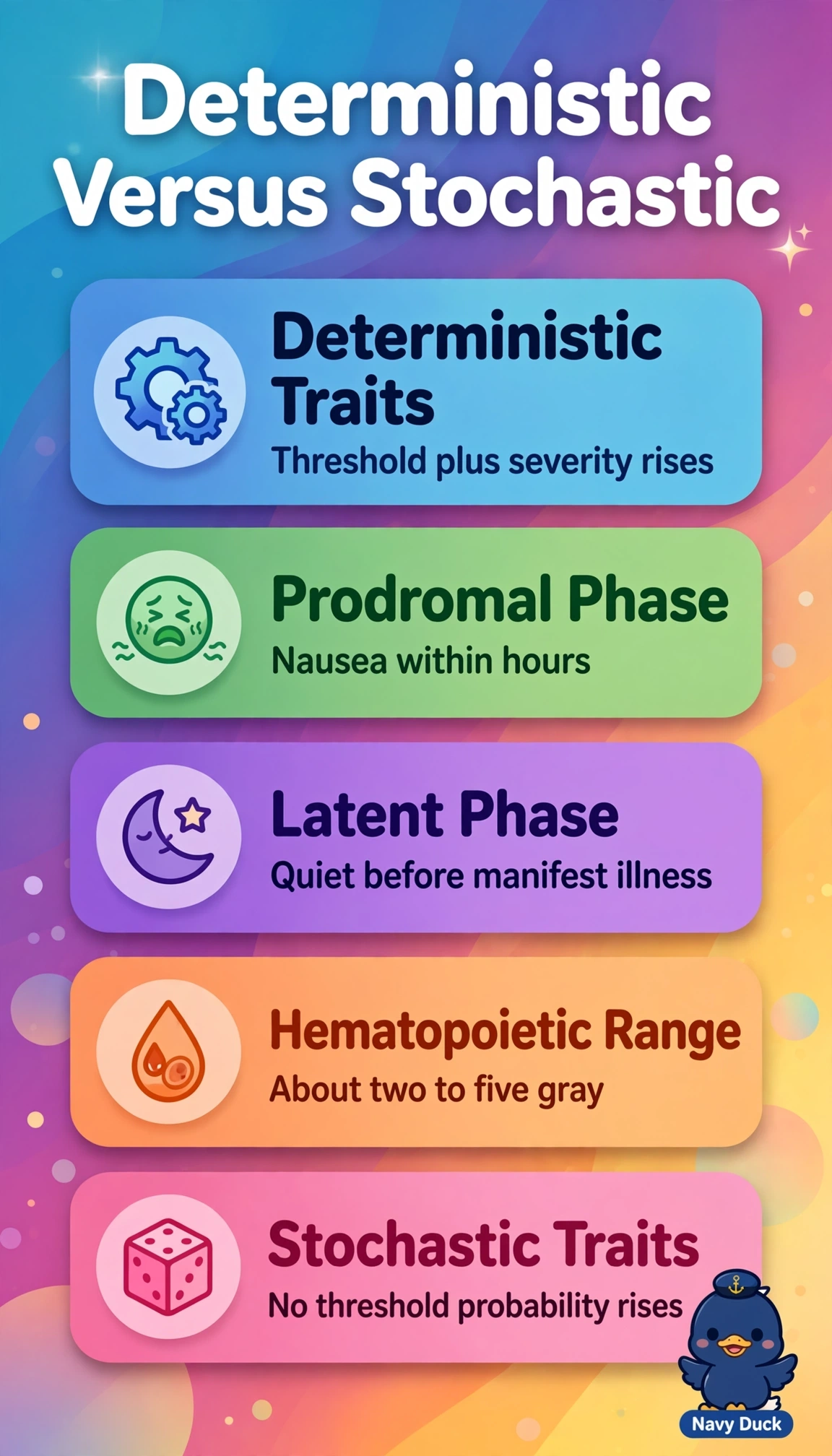
The 3-Gy single whole-body exposure with nausea within hours fits a threshold deterministic effect with a prodromal phase, latent period, then manifest hematopoietic illness from marrow depletion that may progress to recovery or death with supportive care, which is why the correct statement links threshold, prodrome, latency, and hematopoietic syndrome at this mid-lethal dose range. A description invoking gastrointestinal syndrome correctly uses threshold deterministic prodromal logic but fails on dose-syndrome assignment because frank gastrointestinal syndrome with massive mucosal denudation typically requires about 6-10 Gy or higher, not 3 Gy, though vomiting can overlap early. A description invoking cerebrovascular syndrome also correctly uses threshold deterministic reasoning but fails even more markedly on dose because disorientation, collapse, and death within days to hours imply tens of gray, often above 20-30 Gy, far beyond the stated exposure. A description invoking nonthreshold stochastic late carcinogenesis is radiobiologically sound for long-term follow-up after 3 Gy, since probability but not severity increases with dose, yet it fails to answer the asked acute clinical course with prodrome and latency. Exam caveat is to separate acute radiation syndrome dose bands and deterministic threshold severity from stochastic probability models that govern cancer risk questions. Practical check is to confirm estimated whole-body dose, time to emesis, serial lymphocyte counts, and early hematology referral rather than assuming gastrointestinal or neurologic lethal syndromes or focusing only on lifetime cancer risk.