
An emergency department prepares a 55-year-old with prior hives after ionic contrast for a contrast-enhanced abdomen study and a separate outpatient scheduled for a small-bowel follow-through with suspected perforation risk. Pharmacy asks for the safest contrast choice for each case. Which contrast media selection best reflects ionic versus non-ionic and barium properties?
Select an answer to reveal the explanation.
Short Explanation
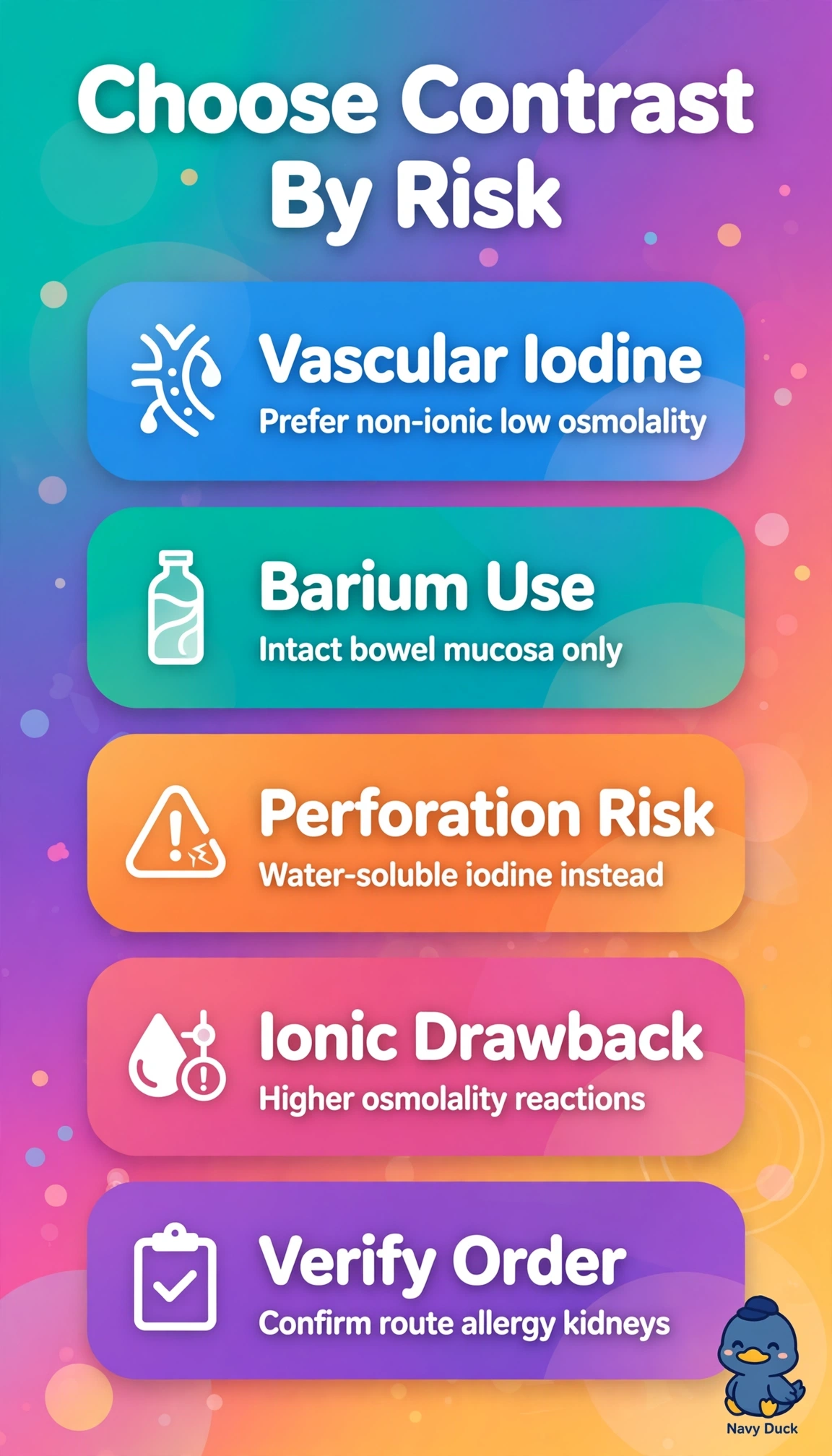
You’re matching contrast to both the route and the risk. Low-osmolality non-ionic contrast suits the vascular study, and suspected bowel leakage calls for water-soluble iodine rather than barium.
Full Explanation
Use low-osmolality non-ionic iodinated contrast intravenously for the patient with prior hives after ionic contrast, and a water-soluble iodinated enteric agent when perforation is suspected. Non-ionic agents have lower osmolality and lower hypersensitivity and chemotoxic reaction rates than high-osmolality ionic agents, an important advantage in a prior reactor. Water-soluble diatrizoate or iohexol solutions are absorbed if they leak, whereas insoluble barium sulfate persists and can cause barium peritonitis, mediastinitis, fibrosis, and granulomatosis. Low-density barium may provide superior mucosal coating, but that detail does not outweigh the risk of peritoneal contamination when leakage is possible. High-osmolality ionic contrast with steroid premedication is also unsuitable: premedication only attenuates risk and does not equalize it, so prior hives favor non-ionic media with observation. Unenhanced CT avoids contrast reactions but fails the ordered contrast-enhanced study when safe enhancement is available. Exam caveat: distinguish allergy and kidney-injury considerations from extravasation-related peritonitis, and remember the aspiration risk of hypertonic water-soluble agents. Practical check: confirm allergy severity, renal function, suspected perforation, route labeling, hydration, and resuscitation readiness with radiology and pharmacy.