
A 24-year-old patient at 3 weeks gestation needs an elective lumbar spine series after a lifting injury, has no urgent neurologic signs, and the ordering provider asks about fetal risk from radiosensitive tissues. Which tissue radiosensitivity and embryo effect principle should guide the scheduling decision?
Select an answer to reveal the explanation.
Short Explanation
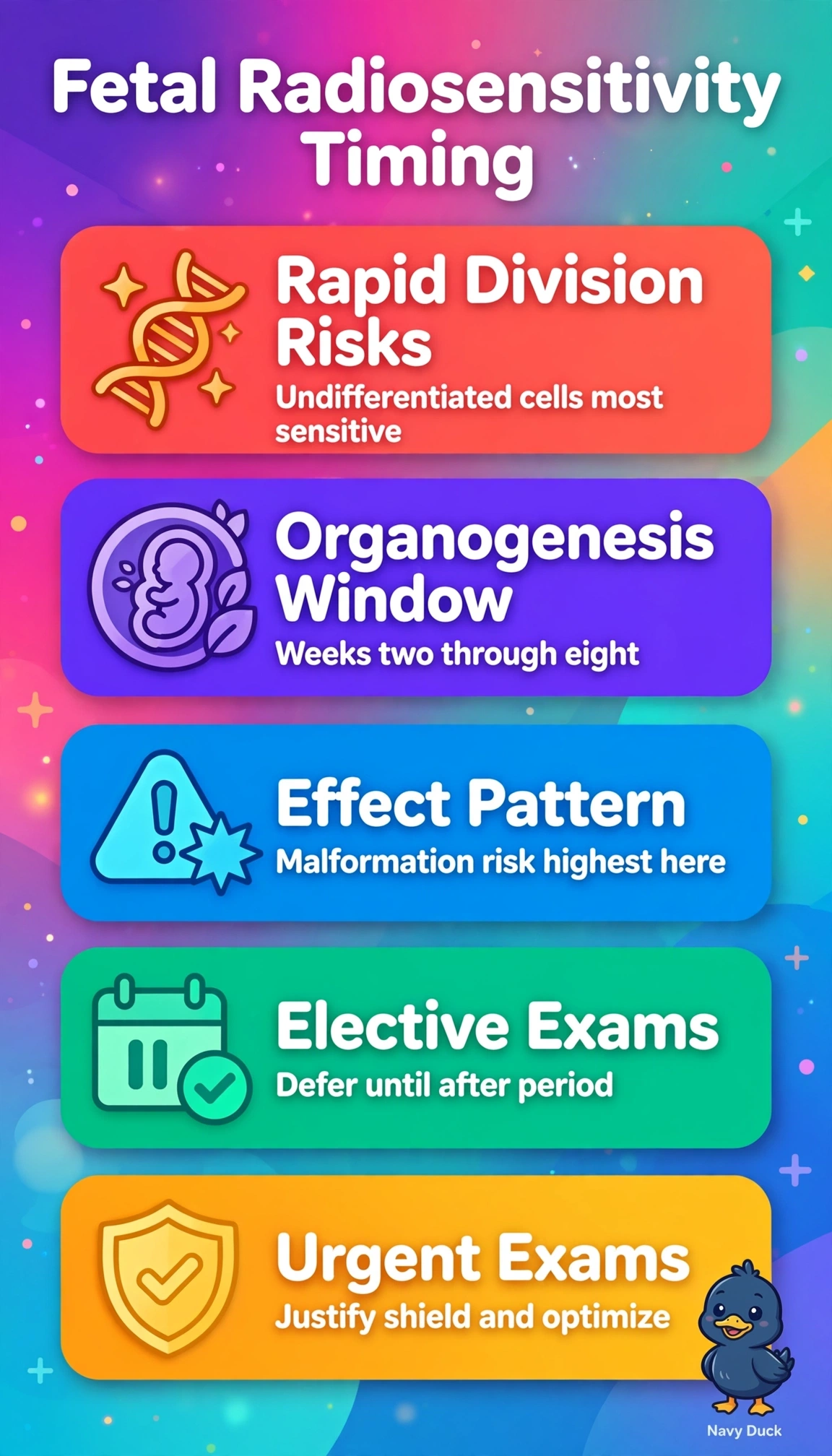
You’re protecting a construction site while the framing is going up, not after the paint dries. Because rapidly dividing, undifferentiated cells are most vulnerable during organogenesis, postponing an elective exam until after that period protects against peak radiosensitivity.
Full Explanation
Elective lumbar spine radiography can expose the conceptus to dose from beam proximity and internal scatter, which gonadal shielding cannot fully prevent. With no urgent neurologic deficit at 3 weeks gestation, defer the study until after organogenesis: under Bergonie-Tribondeau principles, undifferentiated, rapidly dividing cells with a long proliferative future are most radiosensitive and face the greatest risk of major malformation and growth disturbance. Proceeding now with ALARA collimation invokes a real dose-reduction principle, and deterministic effects have thresholds, but neither justifies elective exposure when postponement or non-ionizing evaluation such as MRI is feasible; stochastic risk also remains. Delaying until the first trimester ends correctly favors postponement but wrongly assigns greatest risk to slowly dividing, differentiated cells, which are relatively radioresistant. Waiting until term confuses stages: the preimplantation all-or-none period is associated classically with implantation failure or early loss, not peak malformation risk, so deferral to term is excessive; waiting until after organogenesis addresses the vulnerable period. Exam caveat: distinguish LMP-based gestational age from post-conception age, and deterministic thresholds from stochastic linear-no-threshold risk in pregnancy vignettes. Practical check: confirm dating and urgency, document counseling, consult radiology about MRI or timed deferral, and, if imaging later becomes urgent, obtain informed consent and formal fetal dose estimation.