
A 58-year-old outpatient waits for a routine chest radiograph, then collapses in the hallway, is unresponsive with no normal breathing and no palpable carotid pulse, and a wall-mounted AED is within reach while two staff members respond. The clinic has no code team on site and EMS has just been called. Which cardiac arrest response sequence should the radiographer initiate first using CPR and the AED?
Select an answer to reveal the explanation.
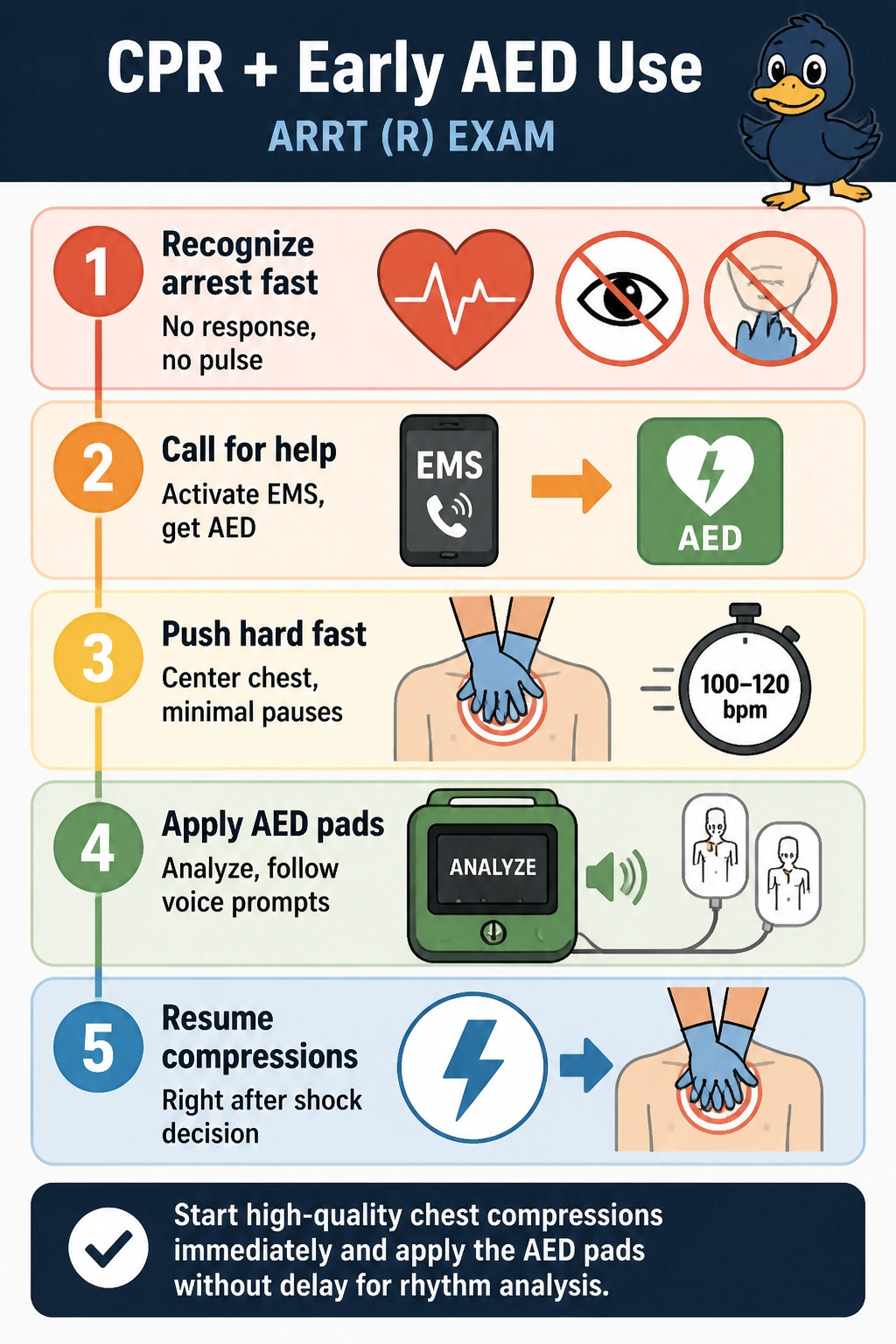
Short Explanation
You have got seconds, not minutes, when there is no pulse. Early defibrillation paired with nonstop compressions gives that heart its best shot at restarting.
Full Explanation
The correct response reflects cardiac arrest defined by unresponsiveness with absent normal breathing and absent carotid pulse, which requires immediate high-quality compressions with minimal interruption plus earliest possible defibrillation, and with two rescuers present and a wall-mounted AED within reach parallel action is feasible and required because early CPR preserves coronary and cerebral perfusion while immediate analysis shortens time to shock for shockable rhythms when no code team is present and EMS is still en route. One distractor fails by airway-first concept, prioritizing rescue breaths and airway securing before AED use, an approach suited to respiratory arrest but harmful here because it delays perfusion and defibrillation and reverses the circulation-first priority for cardiac arrest. Another distractor fails by assessment concept, adding an extended pulse recheck after pulselessness is already established, which repeats a completed step and wastes the critical early minutes when survival declines without CPR and shock. The remaining distractor fails by analysis-timing concept, attaching pads promptly but postponing rhythm analysis until after two minutes of continuous CPR, which confuses delayed-AED protocols where bridging CPR is appropriate with this immediate-access situation where guidelines require analysis without delay. As an exam caveat, distinguish immediately available AED management from delayed-access or advanced-team scenarios and do not import manual-defibrillator or airway-team rules into a clinic without a code team where automatic AED function must be used. As a practical check, expose the chest, ensure anterolateral pad contact, clear for analysis and shock, then resume compressions within seconds with correct rate, depth, full recoil, and compressor switch every two minutes.