
An adult presents to urgent care after a direct blow to the anterior chest with focal sternal tenderness and stable vitals, and the physician suspects a sternal fracture without rib displacement. The technologist must select sternal views that avoid overlapping the thoracic spine. Which sternal projection set and breathing technique best profiles the sternum for this anterior trauma case?
Select an answer to reveal the explanation.
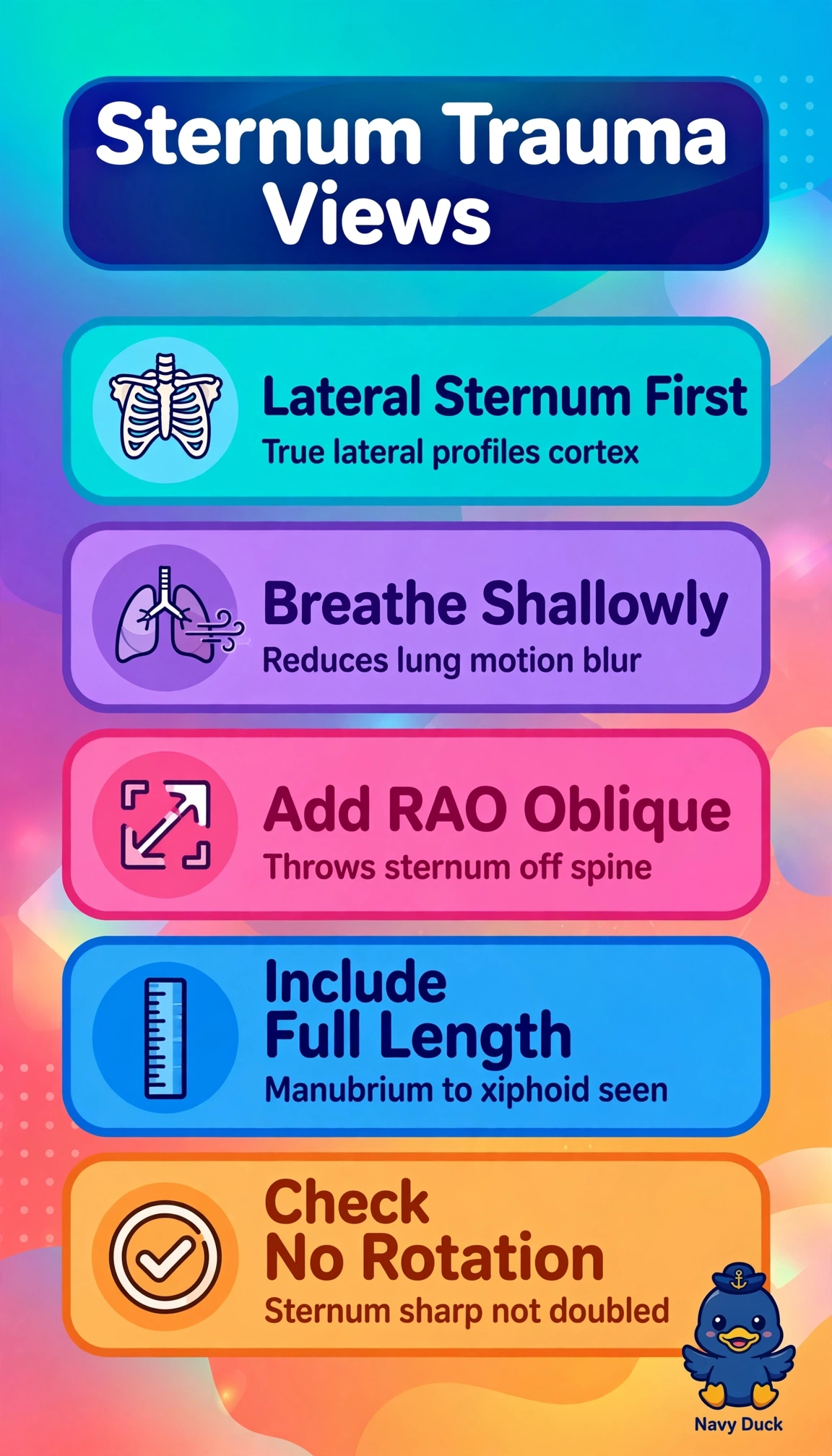
Short Explanation
You free the sternum from the spine by turning it sideways and keeping it still. A lateral sternum with shallow breathing plus an RAO moves the bone off the vertebrae, like sliding paper off a stack, so you can profile it.
Full Explanation
The sternum is a midline anterior structure that is superimposed by the thoracic spine on frontal projections. For suspected sternal trauma, a lateral sternum with shallow breathing reduces lung markings and motion, while an RAO rotates the sternum away from the spine and reduces heart overlap, profiling the bone for assessment. A lateral chest with clavicle views is not suitable because chest technique and clavicle centering optimize the lungs and clavicles rather than sternal cortical detail and positioning. An AP ribs series with a PA chest emphasizes the ribs, and the frontal projection leaves the sternum obscured by the vertebrae. SC joint serendipity views are angled to align the medial clavicles, while an AP sternum remains superimposed over the spine. Exam caveat: choose the lateral and RAO combination when the question asks for sternal views that separate the sternum from the spine; do not substitute projections centered on the ribs, clavicles, or SC joints. As a practical check, confirm shallow respiration, appropriate rotation, and coverage from the manubrium through the xiphoid.