
A clinic reading room has bright windows behind the monitors, residents complain of missed subtle fractures, and the new 3-megapixel displays look washed out. Which monitor viewing condition and resolution adjustment best restores diagnostic image quality in this room?
Select an answer to reveal the explanation.
Short Explanation
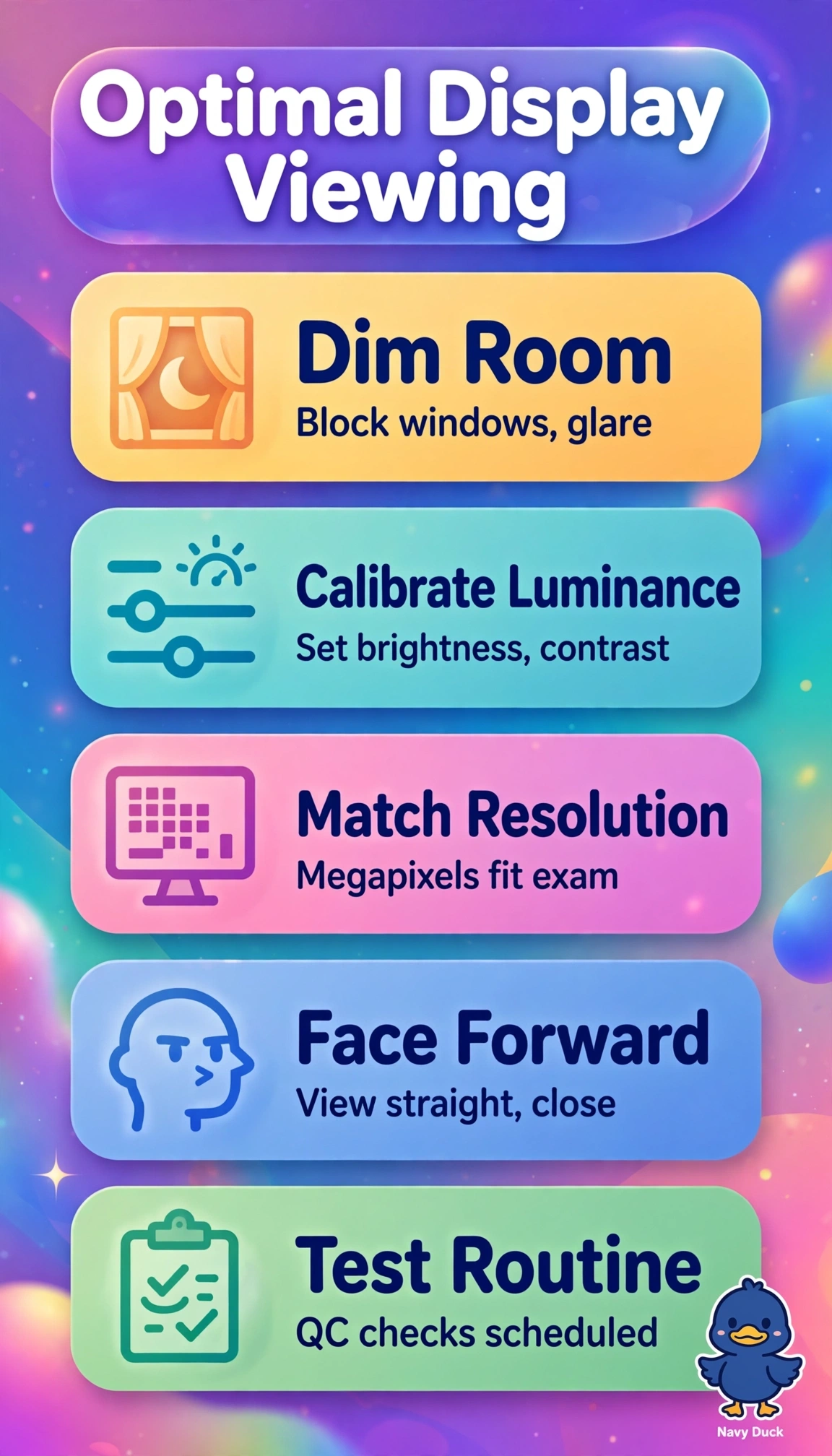
You’re turning a glare-filled room into a more comfortable place to read images. Shielding bright windows, calibrating luminance, and choosing modality-matched high resolution help faint fracture lines stand out again.
Full Explanation
The correct setup restores the viewing chain: shields block bright windows that cause veiling glare and washed-out contrast; DICOM luminance calibration restores perceptually uniform grayscale and low-contrast detectability; and modality-matched high resolution preserves the fine cortical and trabecular detail needed to see subtle fractures. Using shielded, high-resolution, modality-matched monitors but leaving factory luminance uncalibrated fails on photometric consistency: backlight drift and an improper Lmax-Lmin ratio can compress subtle grays even with good lighting and sharp pixels. Calibrating DICOM luminance and using matched high resolution while leaving bright windows uncovered fails on ambient illumination: added faceplate luminance lowers effective contrast ratio and reintroduces washout despite ideal monitor performance. Shielding the room and calibrating luminance but using standard-resolution monitors for fracture reading fails on spatial resolution: larger pixel pitch and undersampling blur fine fracture lines that windowing cannot recover. Exam caveat: stems may combine lighting, calibration, and resolution, so an approach that gets two of these three right remains incorrect; don’t confuse primary diagnostic displays with acceptable ward review displays. Practical check: dim lights as used, measure ambient illuminance at the screen, confirm GSDF calibration with a TG18 pattern and luminance meter, and verify that megapixel assignment matches modality guidance.