
A digital chest unit shows smooth shading across a uniform phantom and noisy low-signal edges. Service suspects preprocessing calibration drift rather than detector failure. Which preprocessing step best corrects gain variation and signal conversion before histogram display?
Select an answer to reveal the explanation.
Short Explanation
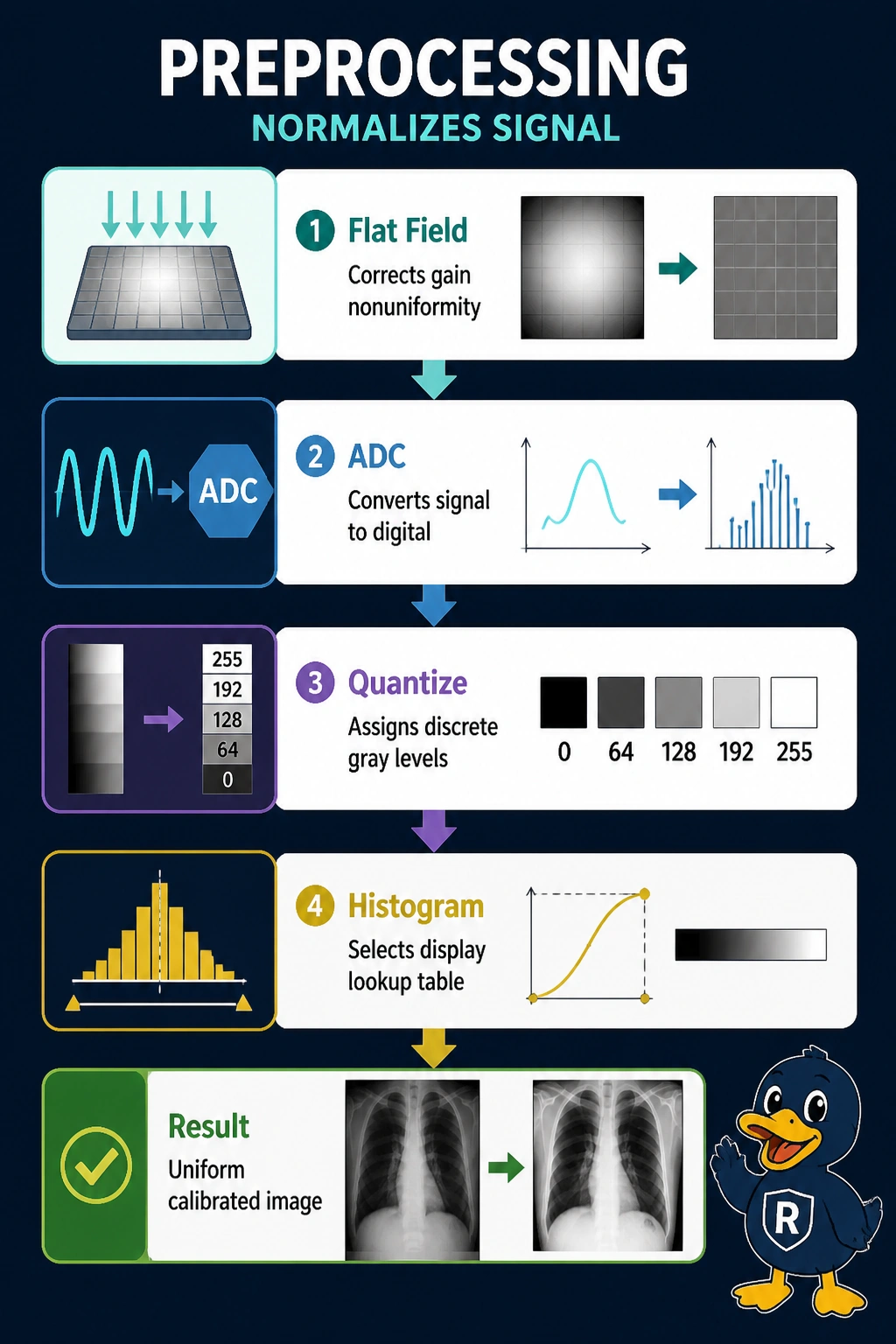
You’re tuning the sensor before the image is displayed. Flat-fielding is your level table, correcting gain variation before ADC conversion and histogram analysis.
Full Explanation
Flat-fielding, ADC conversion, and histogram analysis address the suspected calibration drift: flat-fielding corrects pixel-to-pixel gain and sensitivity differences that cause smooth shading on a uniform phantom, ADC conversion maps the calibrated signal into digital values, and histogram analysis prepares those values for display. Flat-fielding, smoothing, and histogram analysis may seem helpful for noisy edges, but smoothing suppresses noise rather than correcting gain variation or providing calibrated signal conversion. Offset correction, ADC conversion, and histogram analysis can address dark current or electronic bias, but subtracting an additive pedestal does not correct multiplicative gain differences. Flat-fielding, ADC conversion, and edge enhancement calibrate detector response, but edge enhancement is post-processing rather than histogram analysis; it can amplify residual noise and does not establish appropriate histogram segmentation. On an exam, distinguish additive offset drift from multiplicative gain drift, and signal conversion from display windowing. As a practical check, repeat a uniform phantom exposure after recalibration and verify a flat profile, linear exposure response, and stable histogram peaks before resuming clinical use.