
A frightened 4-year-old needs a forearm series in a busy clinic, squirming and crying despite a parent present and foam sponges available. The student suggests taping the arm to the board and having the parent hold the child tightly without a request. Which ethical and legal approach best distinguishes proper positioning aids from improper restraint use?
Select an answer to reveal the explanation.
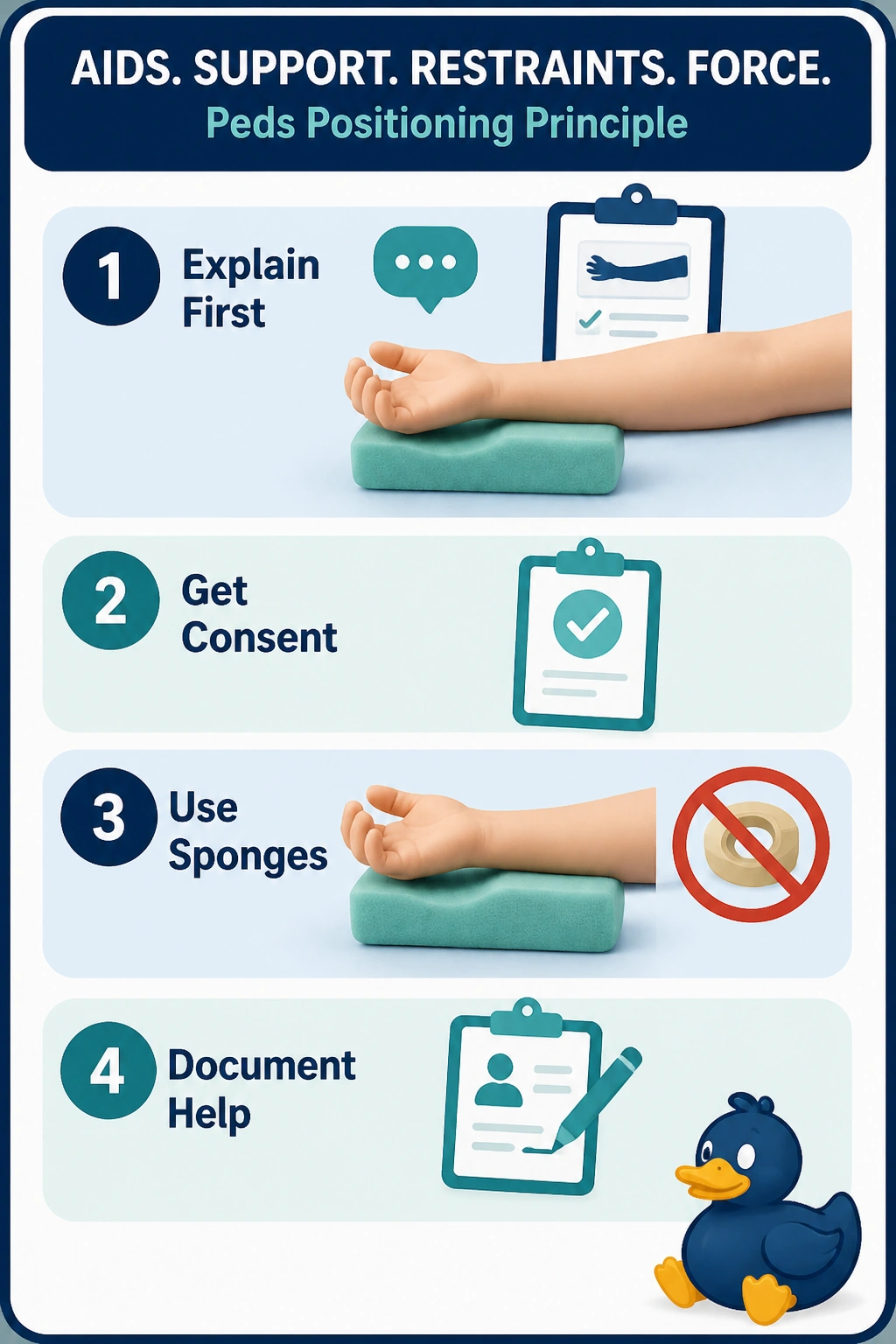
Short Explanation
You are protecting both comfort and consent here. Gentle positioning aids with permission keep you safe, effective, and kind.
Full Explanation
The correct approach is right because it maintains the ethical and legal distinction between positioning aids and restraint: foam sponges support and guide the forearm without force, while parental holding is permissible only as gentle steadying after developmentally appropriate explanation to the child and parent and explicit consent, which preserves autonomy, minimizes fear, and provides legal authorization, and it deliberately avoids tape because tape to limit motion in a squirming child functions as restraint rather than positioning and requires a different legal justification. The choice that adds light tape to prevent repeats fails by concept of restraint classification, since intent to improve sharpness or avoid repeats in a busy clinic does not convert tape into a positioning aid and busyness never authorizes restraint. The choice that uses sponges and holding with explanation but omits consent fails by concept of informed participation, since explanation without permission does not satisfy the ethical duty to respect persons or the legal need for voluntary agreement, especially with a frightened preschooler. The choice that relies on parental holding alone for comfort fails by concept of least-restrictive care and resource use, since omitting the available foam sponges discards the primary non-force positioning aid and forces greater reliance on human holding, increasing distress and motion risk. An exam caveat is that questions often make restraint seem justified by image quality, dose reduction, or throughput, but those benefits do not override consent and proper classification. A practical check is to narrate each step, obtain explicit parental agreement and child assent when possible, use the least force, position sponges first, and stop and re-explain if crying or squirming escalates.