
A teen athlete with recurrent patellar dislocation needs a Merchant view, plus evaluation of the intercondylar notch after a twisting knee injury, while an elderly patient needs a distal femur fracture series. Which positioning and beam-angle combination best demonstrates the patellofemoral joint, intercondylar fossa, and distal femur?
Select an answer to reveal the explanation.
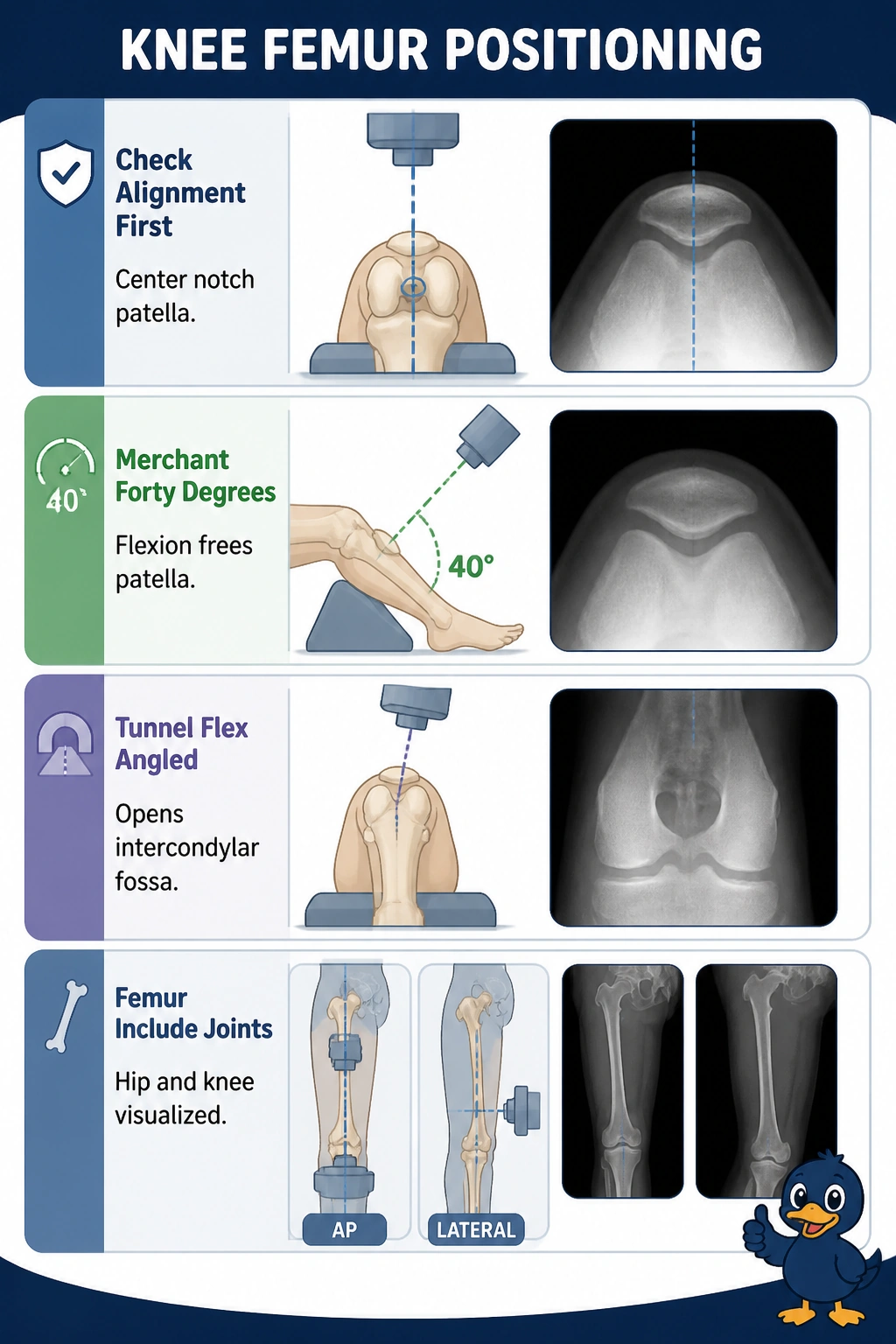
Short Explanation
You are lining up tricky angles with confidence. Merchant magic happens when flexion and beam angle team up to float the patella free.
Full Explanation
The Merchant or tangential patellofemoral view is obtained with the knee flexed about 40 degrees over the table end and the beam angled to project the patella free of the femur, showing patellar tilt, subluxation, and joint spaces; the Settegast is a related tangential variant with greater flexion. The intercondylar fossa is demonstrated by tunnel views such as the Camp-Coventry (prone, knee flexed 40 to 50 degrees, central ray angled caudad about 40 to 50 degrees so it is perpendicular to the lower leg), revealing osteochondral lesions and loose bodies. A complete femur series must include both hip and knee joints on AP and lateral projections to avoid missing articular extension. Routine extended AP knees superimpose the patella on the femur, an unfixed lateral patella without flexion fails to profile the notch, and a single midshaft AP femur excludes the joints where fractures propagate. Exam caveat: Merchant needs bilateral comparison when possible and correct flexion plus caudal angle. Practical check: confirm flexion angle with a goniometer, include both joints for femur trauma, and ensure the intercondylar eminence is centered in the notch on tunnel views.