
A small community hospital portable unit is imaging a 110-kg abdomen in a ward with significant scatter, and the grid cabinet has 8:1 and 12:1 grids available. The technologist considers removing the grid to lower exposure but must preserve contrast. Which grid and beam choice best balances scatter cleanup and patient dose for this abdomen?
Select an answer to reveal the explanation.
Short Explanation
You tamed scatter without cooking the patient. Collimation tightens the win like closing curtains to darken a room.
Full Explanation
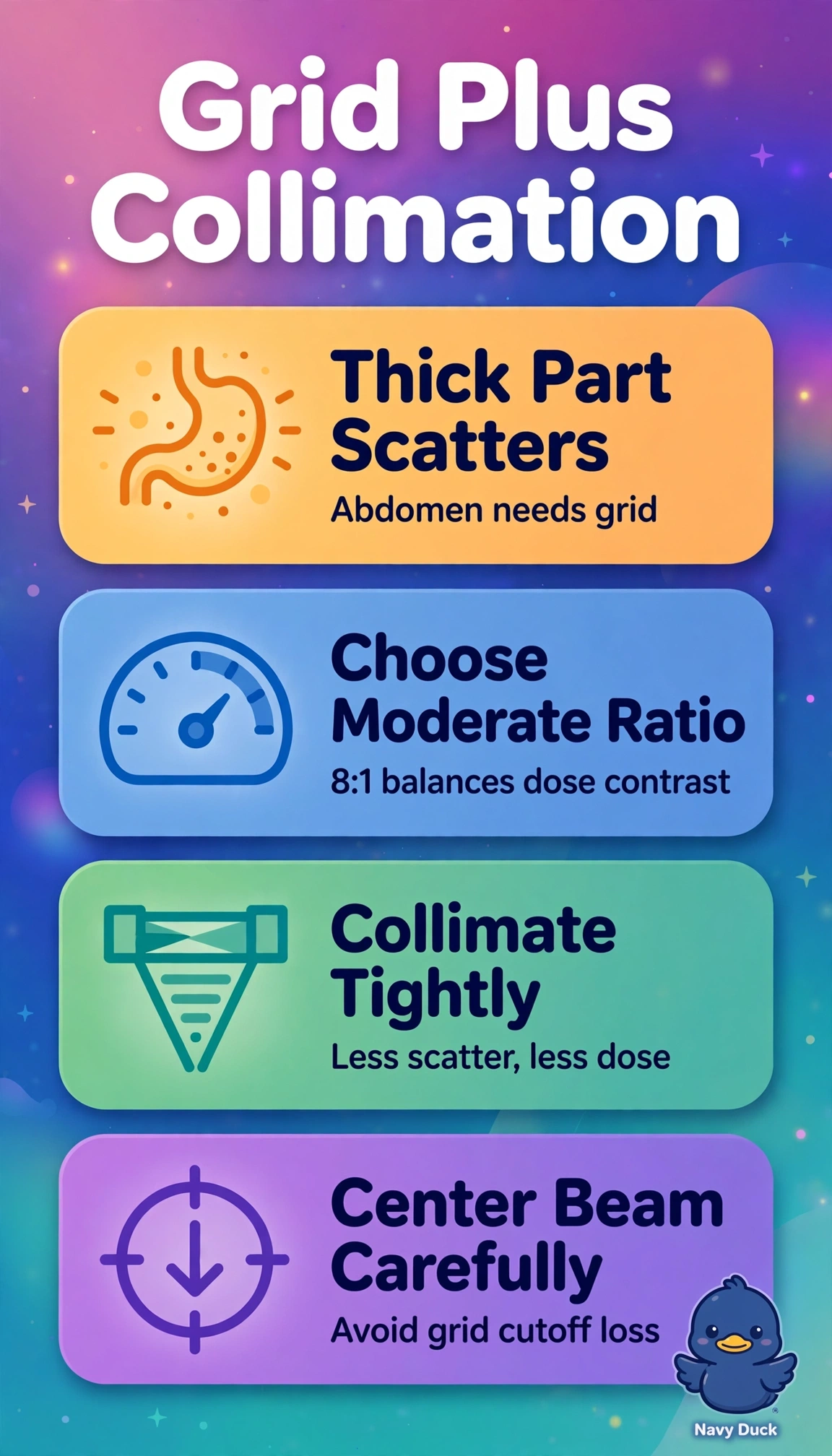
For a 110-kg abdomen imaged portable in high scatter, some grid is essential to preserve contrast, and the 8:1 grid offers adequate cleanup for this thickness without the large mAs penalty of a higher ratio, keeping exposure manageable within portable limits, while tight collimation restricts irradiated volume and scatter production and exact centering aligns the beam with the grid lamellae to avoid cutoff and maintain uniform density. The 12:1 tightly collimated centered technique is standard in fixed-room high-kVp work needing maximum cleanup but fails here on dose balance because greater selectivity absorbs more useful beam and demands substantially higher exposure for little added benefit when 8:1 suffices. The 8:1 centered technique with open collimation is routine when broad coverage is prioritized but fails here on scatter control because a larger field creates more scatter and fog that directly defeats required contrast preservation. The 8:1 tightly collimated laterally decentered technique is useful for including eccentric anatomy but fails here on alignment because an off-center ray strikes focused strips obliquely and produces cutoff with density loss. Exam caveat is that higher ratio does not automatically mean better quality because dose, Bucky factor, and centering tolerance must be matched to habitus and equipment. Practical check is to verify grid ratio and focus range, center precisely, collimate tightly, and adjust mAs for grid conversion while monitoring the exposure index.