
A fixed radiographic room fails morning QC: the HVL measures below department standard at 80 kVp, the light field and X-ray field misalign by 2.5 cm, and the console intermittently blocks exposure with a long rotor buzz. Service notes pitting on the anode track. Which tube, filtration, and console relationship best explains the required corrective actions?
Select an answer to reveal the explanation.
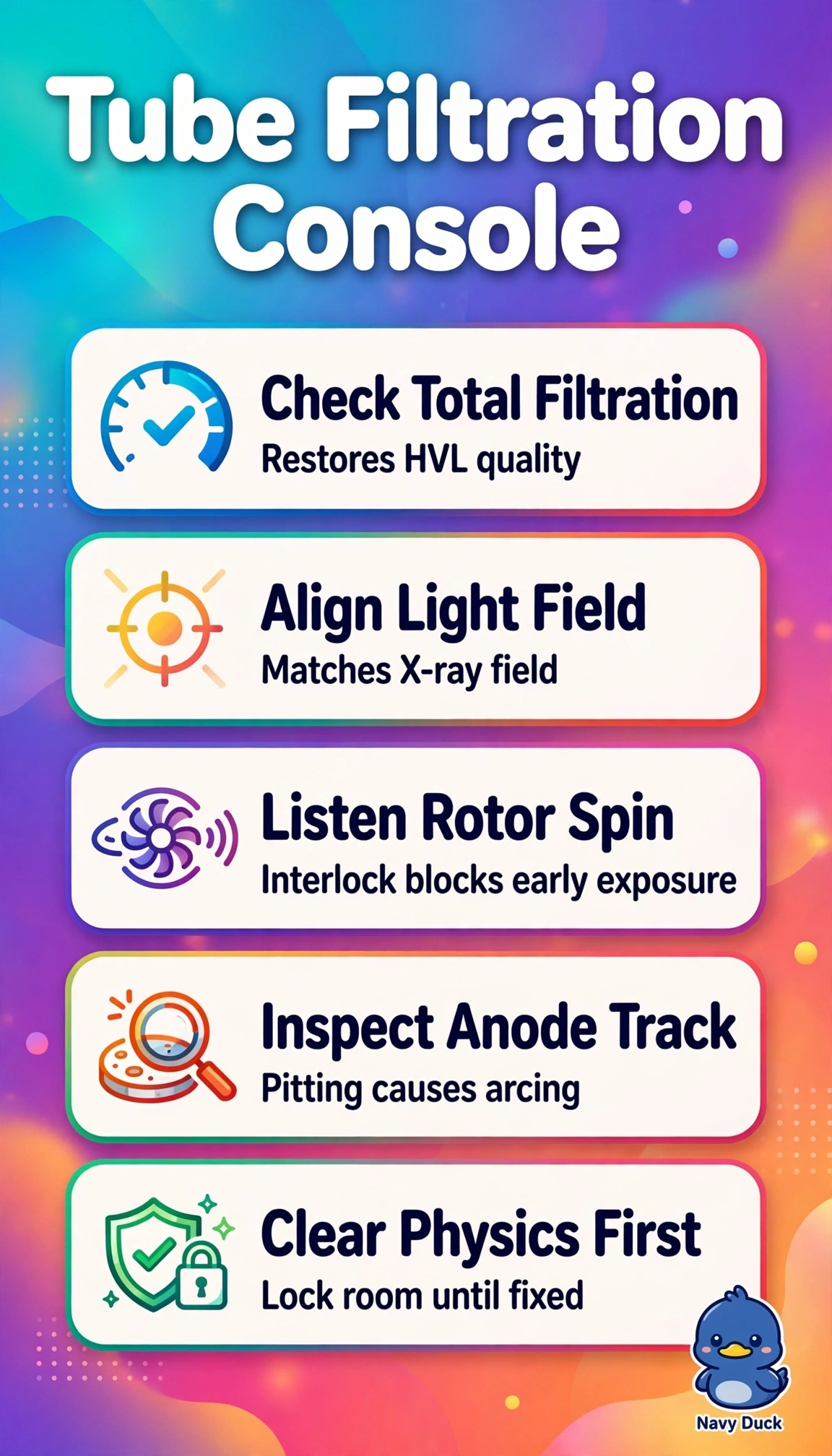
Short Explanation
You spotted three linked failures at once. Restoring filtration fixes beam quality, alignment fixes collimation, and the rotor interlock protects the pitted anode.
Full Explanation
The correct relationship holds because low HVL at 80 kVp signals deficient added filtration and beam hardening, so replacing filtration restores HVL and patient dose compliance, 2.5 cm light-X-ray mismatch exceeds the 2% SID limit and requires collimator realignment with field congruence verification, and prolonged rotor buzz with exposure block indicates the console rotor interlock properly inhibiting exposure until synchronous anode speed is reached, with anode track pitting explaining drag and noise so the drive and interlock need service. The seasoning-centered approach addresses filtration and alignment yet fails because tube warm-up (seasoning) protects a cold anode from thermal shock after idle periods and cannot correct bearing drag, synchronous speed failure, or interlock inhibition from a pitted track. The timer-centered approach addresses filtration and rotor protection yet fails because recalibrating generator timer linearity improves exposure consistency but provides no geometric correction of shutter-mirror misalignment. The kVp-centered approach addresses alignment and rotor protection yet fails because raising kVp to harden a soft beam changes contrast and dose without restoring required aluminum-equivalent filtration and standardized HVL. Exam caveat is that higher kVp nominally raises measured HVL but never substitutes for missing filtration, and collimator tolerance is absolute regardless of output adjustments. Practical check is to remeasure HVL at 80 kVp, repeat coin field test at 100 cm SID, and document rotor boost time and interlock function before clinical release.