
In a small clinic you repeat a portable chest that was underexposed at 80 kVp, 4 mAs, 40-inch SID with 6-inch OID due to a blanket. The radiologist wants similar contrast with adequate receptor exposure and less magnification. Air gap is large and grid is unavailable. Which exposure and geometry adjustment best improves receptor exposure while preserving contrast?
Select an answer to reveal the explanation.
Short Explanation
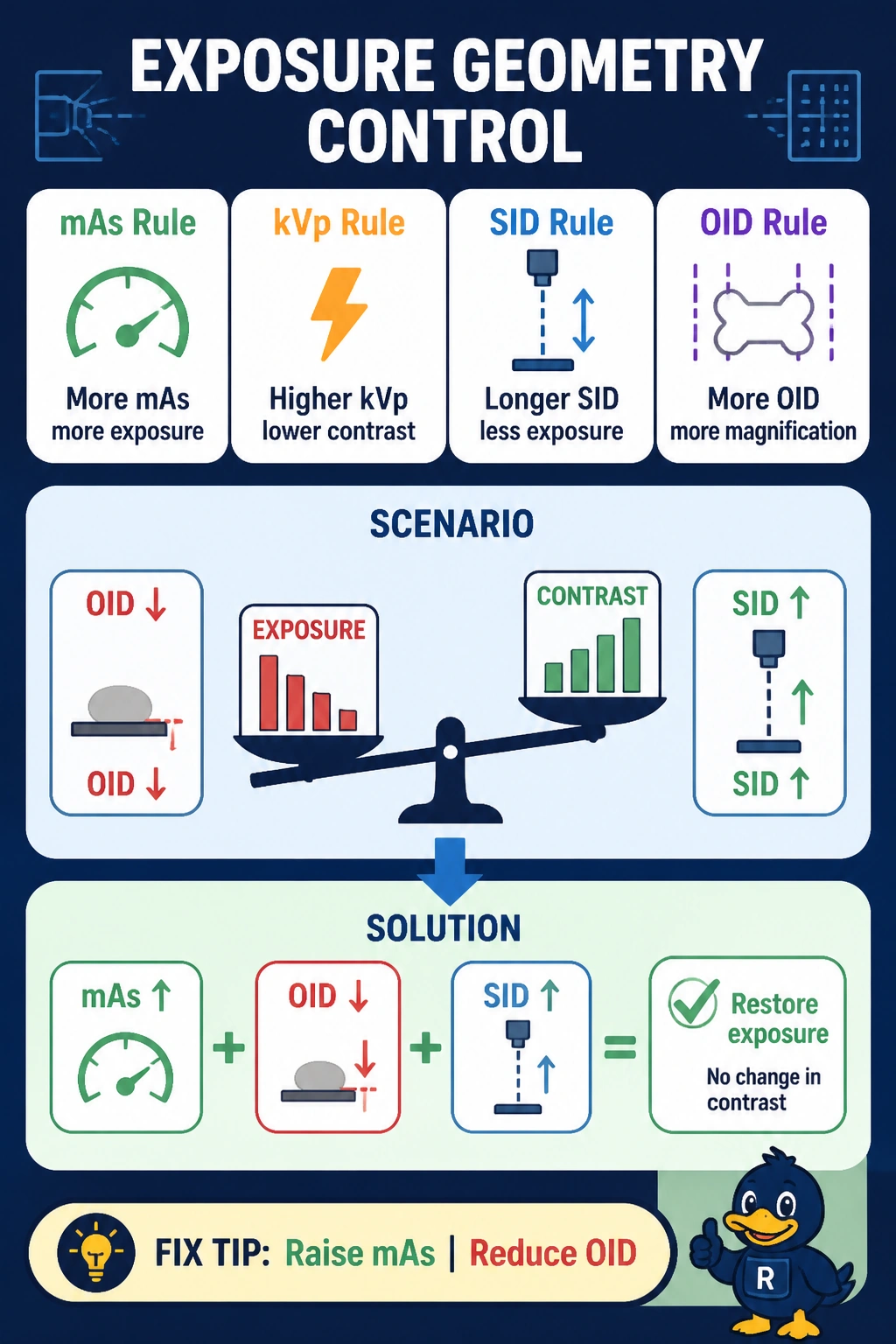
You're feeding the receptor more photons without repainting the palette. Boost mAs and tighten geometry to keep contrast steady.
Full Explanation
The correct adjustment works because mAs controls photon quantity and receptor exposure linearly without changing beam energy, so increasing mAs compensates blanket attenuation while preserving kVp-dependent contrast, and reducing OID while lengthening SID reduces magnification by increasing source-to-object distance and decreasing divergence, with extra mAs also overcoming inverse-square loss from longer SID. The kVp-based adjustment fails by contrast principle because higher kVp raises penetration and scatter and lowers subject contrast despite correctly improving exposure and reducing magnification through geometry. The unchanged-geometry adjustment fails by magnification principle because higher mAs with identical SID and OID correctly restores exposure and preserves contrast but leaves magnification factor unchanged. The reduced-mAs adjustment fails by exposure principle because lower mAs plus longer SID decreases intensity by inverse-square law and worsens the original underexposure despite correctly preserving contrast and reducing magnification. Exam caveat is that large OID acts as air-gap scatter cleanup without a grid, so reducing OID slightly lowers that effect and must not be confused with adding a grid, and longer SID alone never increases exposure. Practical check is to measure new SID and OID, calculate required mAs with inverse-square law while holding kVp constant, and confirm exposure index and anatomic size on the repeat.