
A 22-year-old clinic patient with anterior knee pain needs a Merchant view to evaluate the patellofemoral joint after standard AP and lateral knee images. The room has a Merchant board, the patient is mobile, and the surgeon wants both patellae with joint spaces open. Which positioning setup best demonstrates the patellofemoral joint using the Merchant method?
Select an answer to reveal the explanation.
Short Explanation
You are peeking under a tilted awning at just the right crouch. That 40-degree Merchant bend opens the groove so the kneecap floats clear.
Full Explanation
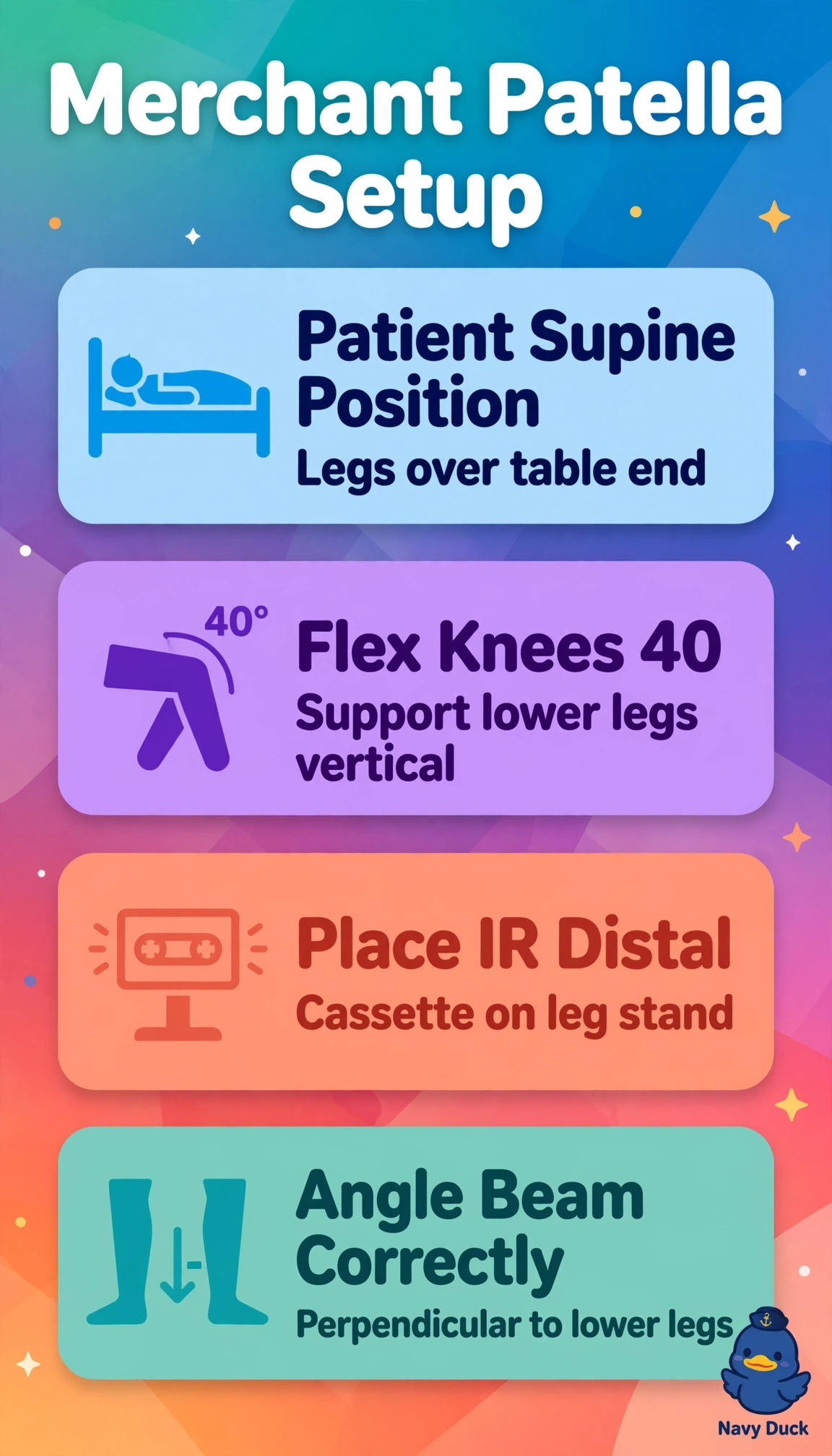
The correct setup is right because the Merchant method is a bilateral inferosuperior axial projection done supine with both knees flexed 40 degrees over the table end on a Merchant board and the beam angled to match the joint, which frees both patellae from femoral overlap with open spaces for direct comparison in anterior knee pain after AP and lateral views. The prone 55-degree tangential setup is a sound Hughston method for unilateral imaging, but it fails by concept because prone geometry prevents simultaneous bilateral Merchant comparison on the board. The supine 90-degree over-end setup is a sound Settegast sunrise method, but it fails by concept because deep flexion seats the patella firmly in the groove and tightens the quadriceps, masking subluxation and missing the 40-degree requirement. The supine 40-degree on-table setup for one patella is a sound unilateral axial method, but it fails by concept because without both legs over the end together it loses required bilateral symmetry and comparative opening. An exam caveat is to link Merchant to supine bilateral 40 degrees over end, Hughston to prone unilateral 50 to 60 degrees, and Settegast to 90 to 115 degrees, since questions often change only flexion or recumbency. A practical check is to goniometer 40 degrees flexion, center both patellae on the board, verify symmetric open spaces in the light field, then match tube angle to the joint before exposure.