
An anxious outpatient scheduled for a knee radiograph asks why the doctor did not order MRI instead, saying a friend told her MRI shows ligaments better and has no radiation. She wants advice on which test is right for her torn ligament concern. Which response best answers her question about other imaging modalities within the radiographer scope?
Select an answer to reveal the explanation.
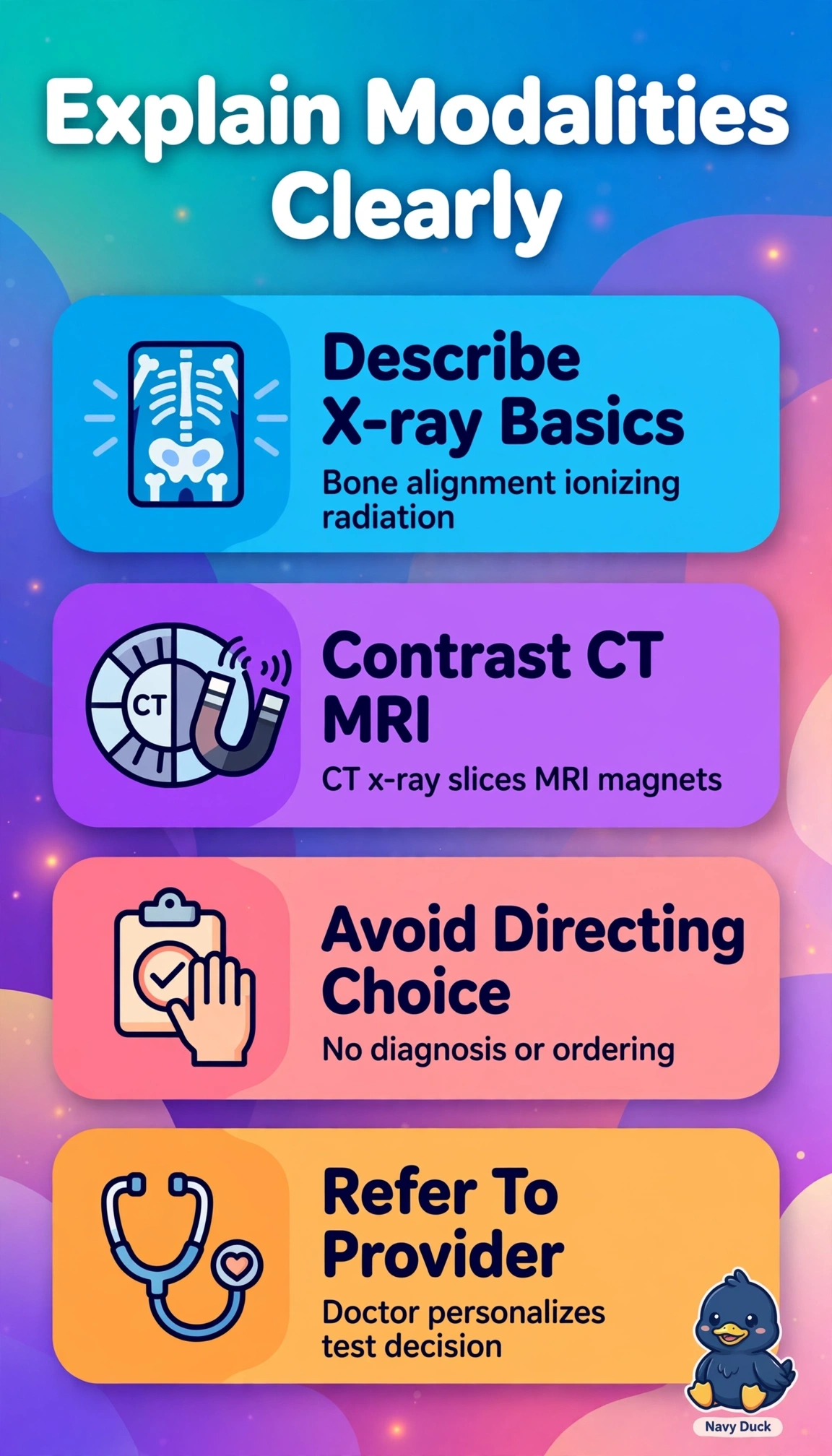
Short Explanation
You are a friendly translator, not the decider. Sharing clear modality basics plus a referral keeps you helpful, accurate, and inside your lane.
Full Explanation
The correct response reflects scope permitting general modality education while leaving test selection to ordering provider, reducing anxiety without giving specific medical advice. Generally radiography and CT use ionizing radiation for bony detail with CT adding cross-sectional detail at higher dose and cost, while MRI uses magnetic fields without ionizing radiation and offers superior ligament and soft-tissue contrast but requires longer time, higher cost, and safety screening, which validates the friend's partly correct point and explains why radiographs are often ordered first for fracture, alignment, and joint space. The response explaining differences but recommending MRI for her tear fails by exceeding scope because endorsing a specific examination for a suspected diagnosis is ordering-provider decision-making. The response validating anxiety and referring without additional information fails by omission because it withholds allowed general education that supports informed discussion. The response stating radiography shows ligaments as clearly as MRI fails on factual accuracy because radiographs poorly delineate cruciate and collateral ligaments compared with MRI. An exam caveat is to separate allowed general information from prohibited patient-specific advice, diagnosis, or order justification. A practical check is to use teach-back, invite questions for the provider, offer approved handouts, and document education and referral.