
A frail 84-year-old woman arrives by wheelchair after a fall with severe right hip pain, marked kyphosis, and inability to straighten her legs or transfer to the table. The order is AP pelvis and trauma lateral hip, and she cannot tolerate log-rolling. Which adaptation correctly modifies positioning for habitus, trauma, and limited mobility?
Select an answer to reveal the explanation.
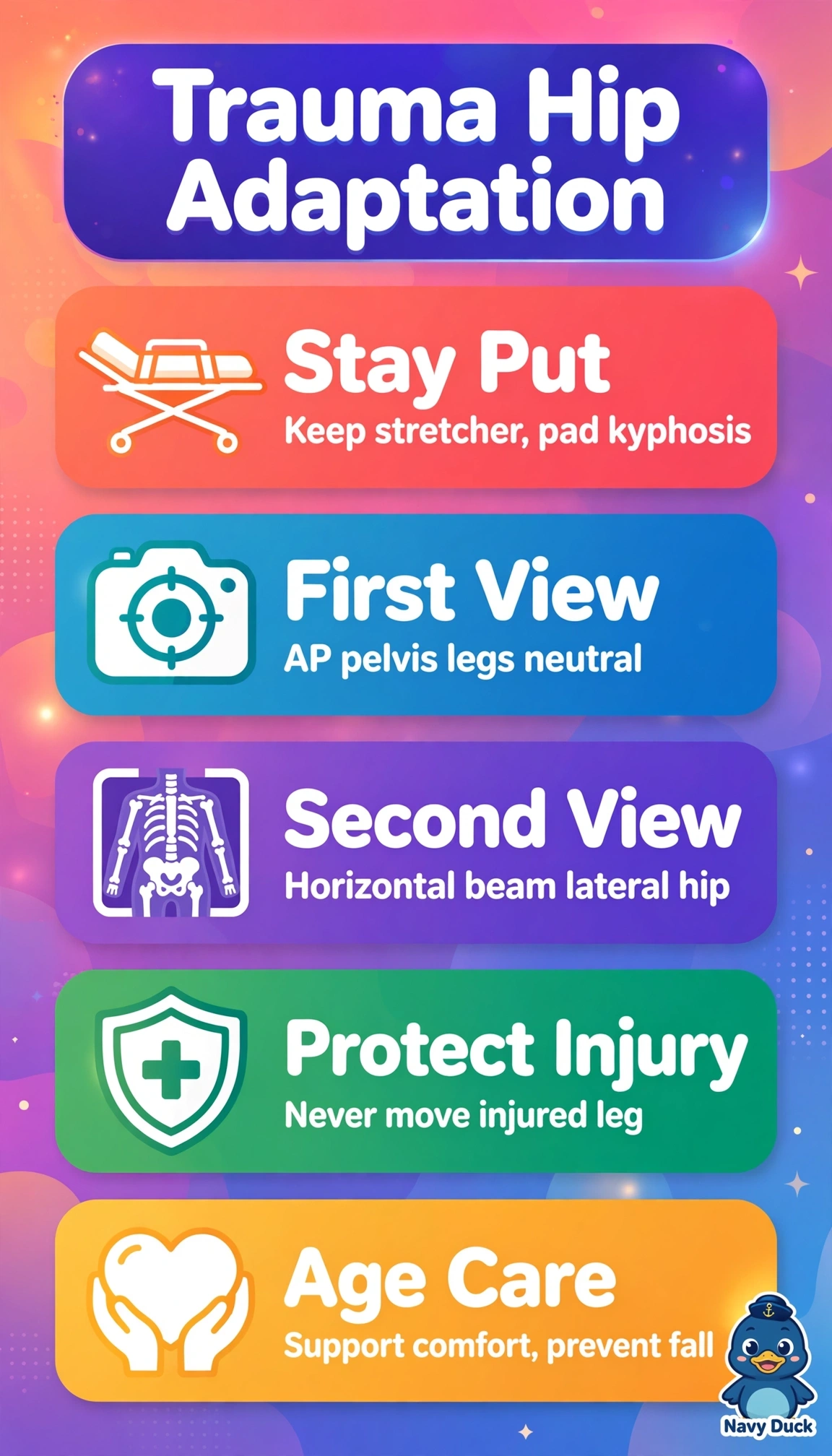
Short Explanation
You’re bringing the exam to her instead of forcing her to the exam. Keeping the injured leg still while using horizontal beam protects bone and still delivers alignment for diagnosis.
Full Explanation
The correct approach keeps her supine on the stretcher with padding for kyphosis and flexed knees, avoiding transfer or forced extension while preserving AP pelvis alignment, then uses horizontal-beam lateral with the unaffected leg lifted and the injured leg undisturbed, which satisfies trauma immobilization and limited mobility. The approach adding slight abduction of the injured leg for the lateral fails trauma care because moving the suspected fracture can displace fragments and worsen pain, whereas abduction or frog-leg laterals suit only nontraumatic routine hips. The approach using careful log-roll onto the uninjured side fails tolerance because rolling demands coordinated trunk rotation and weight shift that she cannot tolerate and risks fracture motion, even though decubitus rolling is common for routine laterals. The approach moving her to the table for sharper images fails mobility preservation because assisted transfer still requires lifting and pivoting despite support when transfer is contraindicated, although the table is normally preferred for detail. Exam caveat is to separate routine hip technique from trauma hip technique by cues like severe pain after fall, do not move the leg, cannot transfer or roll, kyphosis and flexion. Practical check is to lock wheels, support head and knees without straightening, keep pelvis unrotated, clear the unaffected limb from the beam path, and confirm markers and collimation.