
A student shadows you after a high-dose interventional case and asks why the patient developed reddened skin within days but staff worry about cancer years later. The patient received a large localized skin dose, staff received tiny scattered doses. No whole-body prodromal symptoms occurred. Which radiobiology distinction best explains deterministic versus stochastic effects in this exposure?
Select an answer to reveal the explanation.
Short Explanation
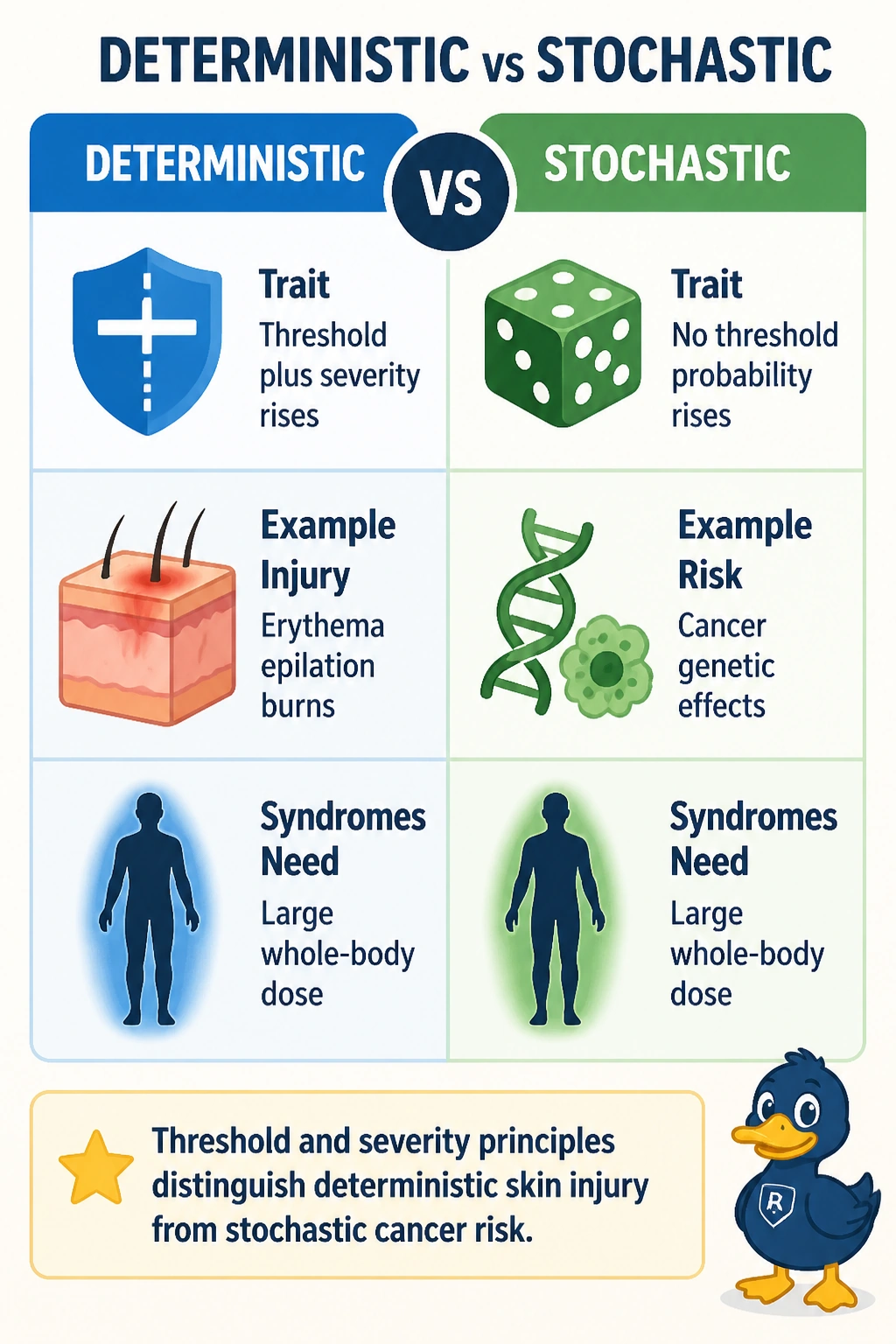
You're separating certainty from chance here. Threshold severity rises with dose, while cancer probability lingers without a safe cutoff.
Full Explanation
The correct principle contrasts threshold-dependent severity with probabilistic occurrence because deterministic erythema requires massive cell killing beyond a skin threshold with severity rising with dose, matching large localized patient dose and reddening within days, while stochastic cancer reflects probabilistic DNA injury with no safe threshold where dose raises probability not severity, matching tiny scattered staff doses and worry years later. The linear no-threshold description usefully estimates staff stochastic probability but fails completeness because it omits deterministic threshold and severity scaling needed for the patient lesion. The repair kinetic description usefully explains erythema timing via depletion and inflammation but fails completeness because it addresses only deterministic healing without contrasting stochastic probability. The whole-body prodromal description usefully stages diffuse syndrome with nausea and vomiting but fails factually because the stem specifies localized exposure without prodromal symptoms. An exam caveat is that latency overlaps, so decide by threshold and severity-versus-probability, not timing alone. A practical check is to compare patient peak skin dose to reaction thresholds for counseling while tracking staff effective dose for stochastic surveillance.