
On the third fraction of a prostate treatment, today's image shows the same small offset of the target from the reference image that appeared on fractions one and two. The therapist is ready to treat and wants to keep the session moving. Which image-guidance check must be completed before beam-on for this fraction?
Select an answer to reveal the explanation.
Short Explanation
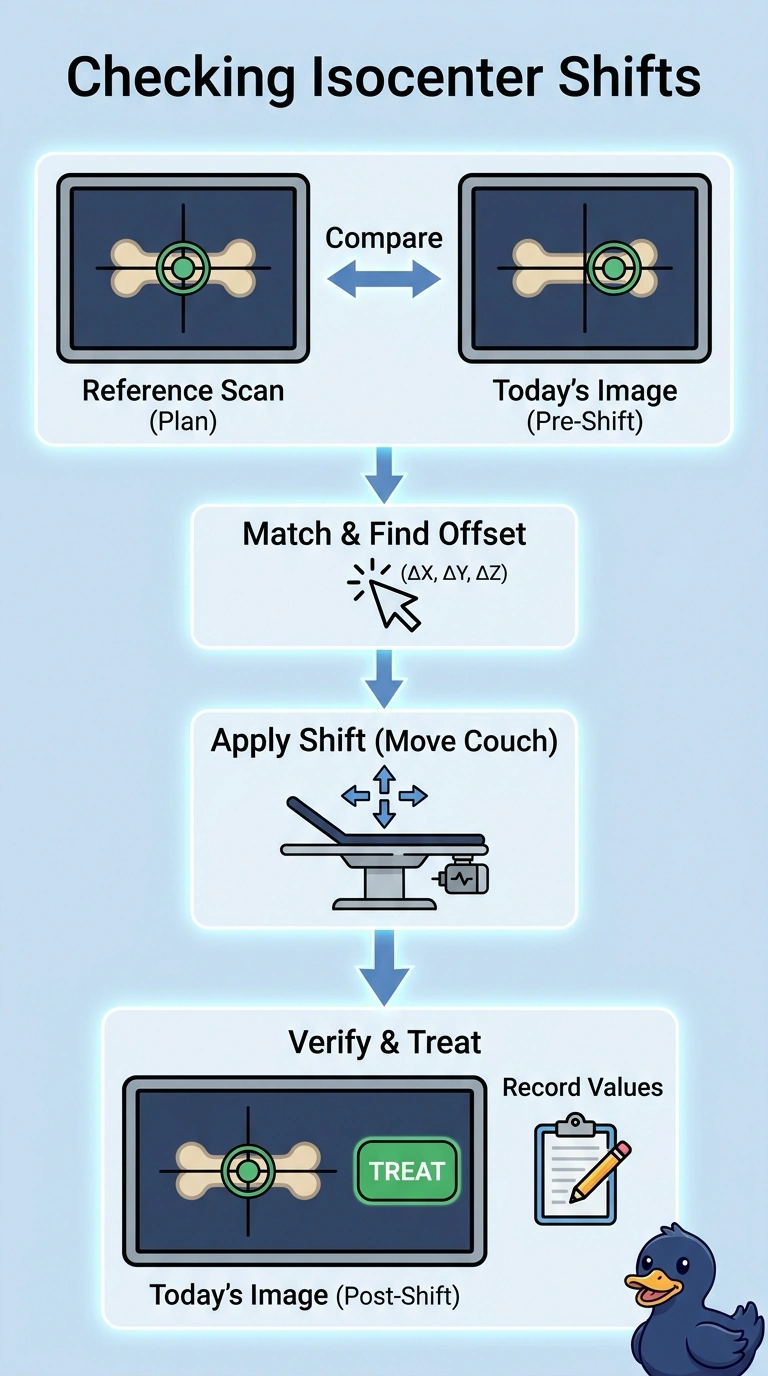
You’re right to keep the check tied to this fraction: a repeated trend does not confirm today’s correction. Before beam-on, use today’s post-shift image to verify the target is at the isocenter. Yesterday’s numbers can’t tell you where the target sits now.
Full Explanation
Before beam-on, today’s image must confirm that applying the shift places the target at the isocenter. A recurring offset can inform setup, but it does not prove that today’s correction was applied accurately or that the target is now correctly positioned. Applying today’s calculated shift and checking the couch readout is a useful delivery check, but the readout does not directly verify the target’s post-shift position. Registering today’s image, applying the calculated shift, and relying on validated couch coordinates includes sound workflow steps, but validated coordinates cannot replace confirmation that the target is at isocenter after this fraction’s correction. Confirming the offset on the initial image, applying the planned correction, and checking the couch readout still leaves the final target position unverified: the initial image is pre-shift, and the readout reports couch motion rather than target alignment. Exam caveat: follow the site’s approved imaging and verification protocol; a protocol may specify a particular verification image or tolerance, but a repeated offset alone does not authorize skipping the required check. Practical check: before beam-on, review the post-shift image against the reference and confirm the target is at isocenter within the department’s defined tolerance.