
A patient at eleven weeks of pregnancy is referred for palliative radiation to a single bone metastasis. She asks what the exposure could mean for the baby now and whether effects could surface years later. The team has reviewed fetal dose limits and gestational timing. Which statement best describes the stage-specific fetal risk at this point?
Select an answer to reveal the explanation.
Short Explanation
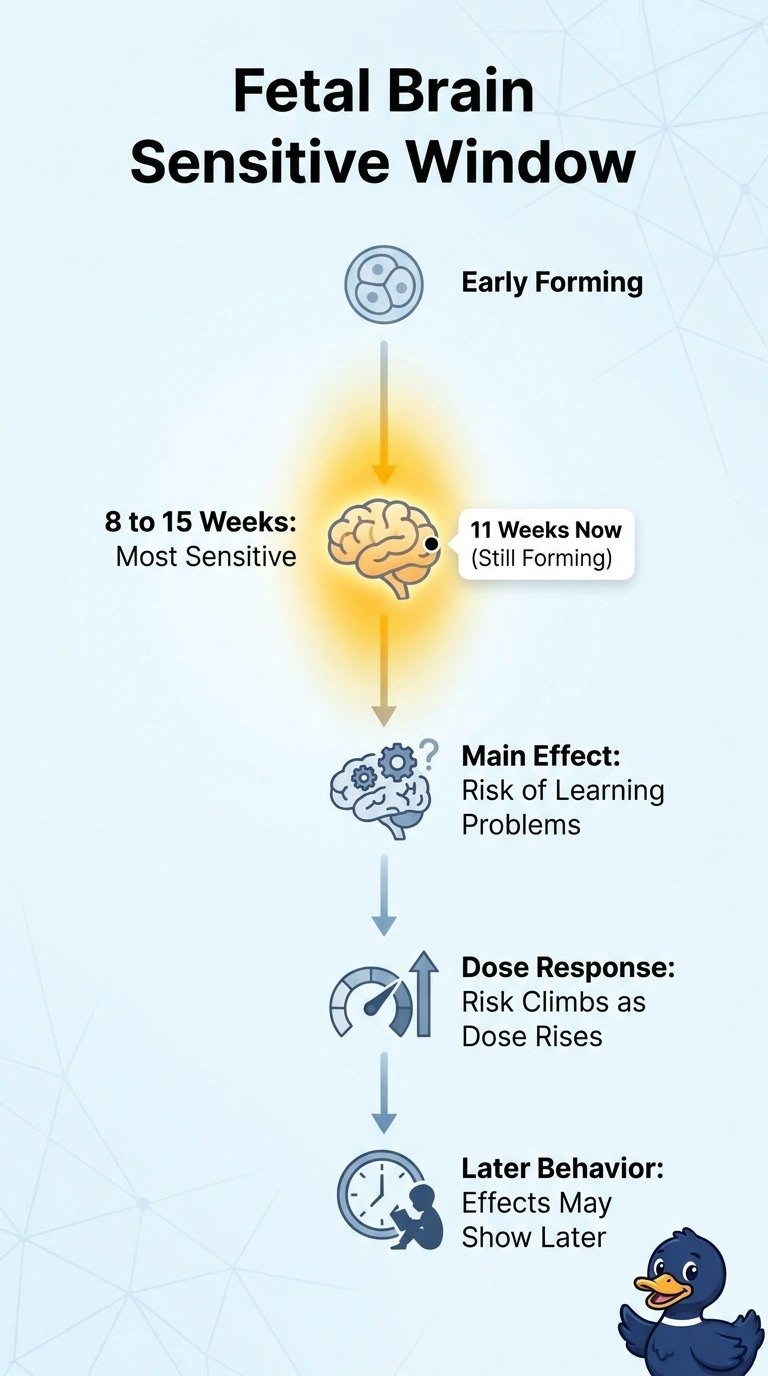
At eleven weeks you're inside the window when the fetal brain is most vulnerable, so that is the effect you counsel about. The stage and the effect have to match, because swapping them changes the whole message for the patient. Risk schedules run by weeks, not by trimesters.
Full Explanation
Fetal sensitivity follows the developmental clock, and the eight to fifteen week period is when the cerebral cortex is forming through rapid cell division and migration. Neurons that are mid-migration are easily disrupted, so a dose in this window raises the likelihood of intellectual impairment and later behavioral effects, which is the stage-effect pairing being tested. Invoking the all-or-nothing principle fails the timing requirement, because that rule applies only to the first two weeks after fertilization and does not describe eleven weeks. Pairing this window with an induced childhood cancer fails the effect requirement, since cancer risk is weighed across all of childhood while nervous system effects dominate these weeks of brain development. Highlighting heritable damage fails the biology requirement, because hereditary effects from prenatal exposure have not been demonstrated in humans and counseling therefore stays focused on the individual fetus. Exam caveat: the estimate always pairs fetal dose with gestational age, and no threshold guarantees an absence of effect. Practical check: confirm gestational age from dating, obtain a fetal dose estimate from the medical physicist, and document the counseling given to the patient and the referring physician.