
A patient arrives for a contrast-enhanced CT of the chest. The intake form records moderate hives and wheezing after iodinated contrast two years ago, normal kidney function today, and clear breathing between events. Emergency drugs and airway equipment are in the room, but the schedule is tight. Which contrast management approach best fits this patient's risk profile?
Select an answer to reveal the explanation.
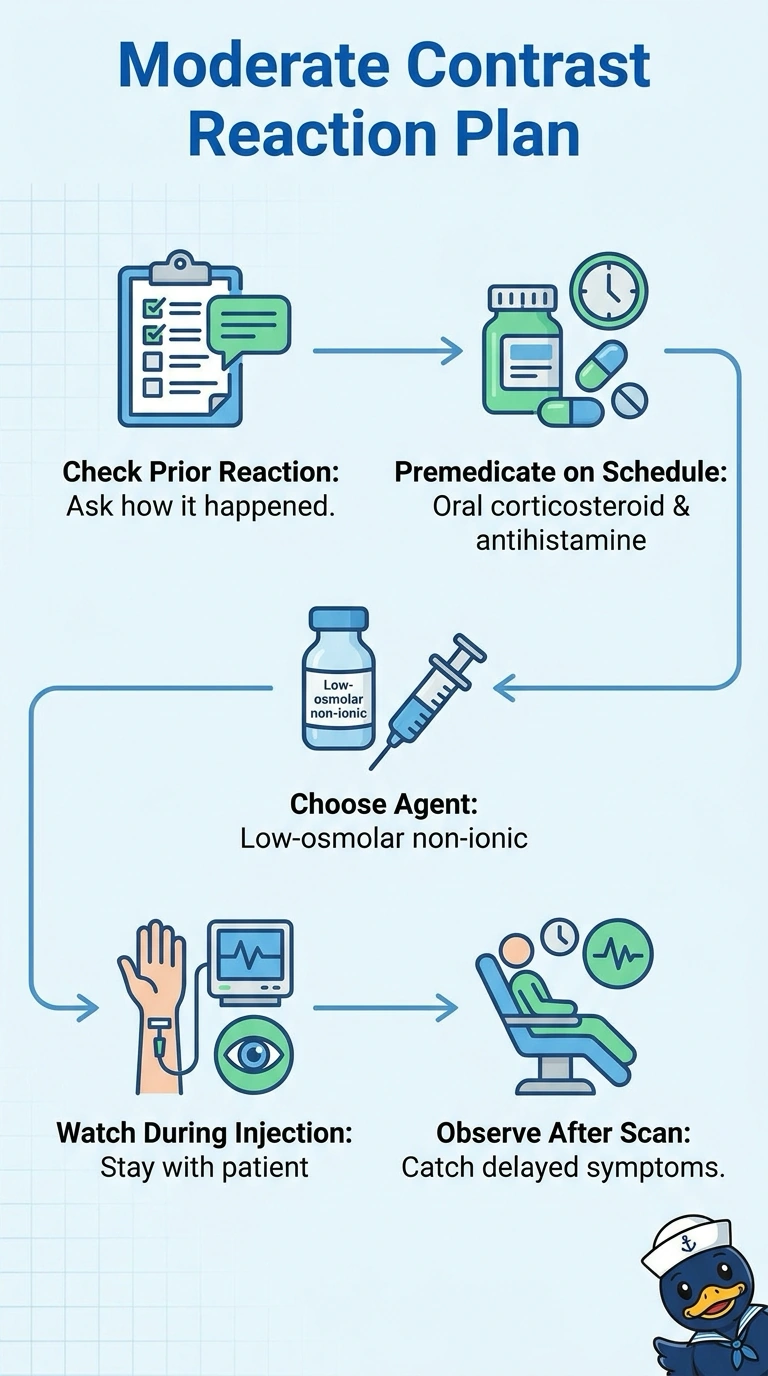
Short Explanation
With a moderate prior reaction you're layering protection before contrast ever reaches the vein. The steroid, the antihistamine, the agent choice and the observation all have to be in place. It's the seatbelt you buckle before the trip, not after the first bump.
Full Explanation
Prior contrast reactions are managed by risk category, and a cutaneous and respiratory reaction such as hives with wheezing places the patient in the group that receives prophylaxis rather than simple monitoring. An oral corticosteroid taken on a timed schedule before the scan, together with an antihistamine, dampens the immune mediated release of histamine, while a low-osmolar non-ionic agent minimizes the chemotoxic stimulus that drives direct mast cell degranulation; observation then catches delayed or breakthrough reactions. Withholding the corticosteroid leaves the later phase of the reaction uncovered, so antihistamine-only coverage fails the prophylaxis requirement. Releasing the patient immediately after injection fails the monitoring requirement, because reactions can recur once the immediate phase passes. Observing without premedication fails the risk-matching requirement, since observation limits harm but does not lower the chance of a reaction occurring. Exam caveat: even full premedication cannot guarantee a reaction will be avoided, so it never replaces emergency drugs and airway equipment in the room. Practical check: verify the dosing schedule timing, confirm the agent is low-osmolar and non-ionic, and make sure epinephrine and a working suction setup are within reach before injection.