
A patient finishing treatment asks whether the radiation could cause a second cancer years later, whether it could affect a future pregnancy or her future children, and why her skin reacted only during the weeks of treatment. Which explanation best distinguishes these radiation effects?
Select an answer to reveal the explanation.
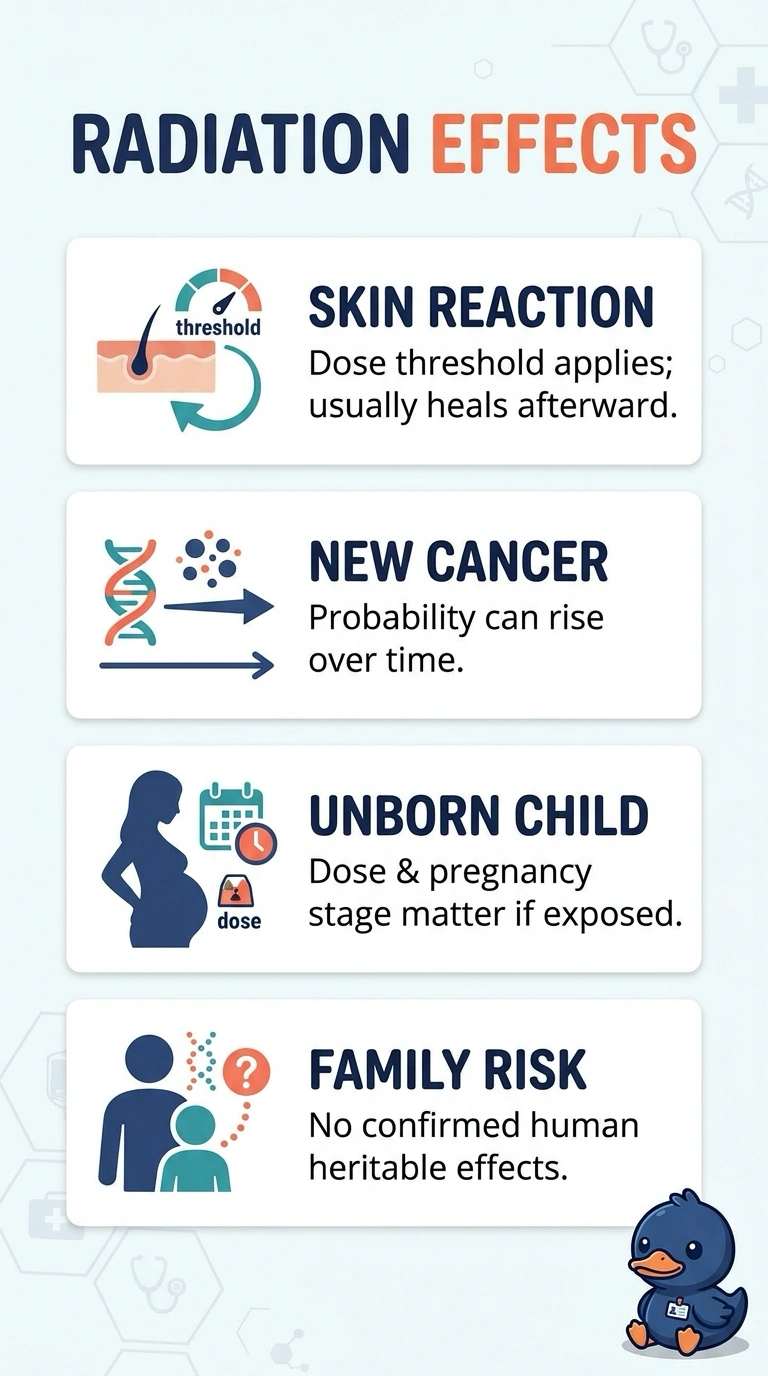
Short Explanation
You can separate these effects by how dose influences them and when they occur. A threshold applies to deterministic skin reactions, while stochastic cancer risk concerns the chance of occurrence, and fetal effects depend on dose and gestational age.
Full Explanation
The correct distinction reflects how these effects behave. Skin reactions are deterministic tissue effects: they have a threshold, their severity generally increases with dose, and they usually heal after treatment. A radiation-induced second cancer is stochastic: exposure can increase the probability that it occurs, but does not determine the severity of a cancer that develops. Fetal effects are relevant if the fetus receives radiation, and their likelihood and nature depend on both dose and gestational age. Although heritable effects have been observed in some experimental settings, they have not been confirmed in humans. The claim that both the likelihood and severity of a second cancer increase with dose incorrectly applies dose-related severity to a stochastic outcome; dose affects its probability, not the severity of a cancer that develops. The claim that fetal risk no longer depends on dose once exposure occurs is also incorrect, since dose is essential to assessing risk. The claim that radiation-related heritable effects in humans are established overstates the evidence. Exam caveat: “not confirmed in humans” does not mean fetal exposure is harmless or that reproductive questions can be answered without considering dose and timing. Practical check: establish whether the uterus or a future pregnancy was in the treatment field, and review the treatment plan and estimated fetal or gonadal dose with the radiation oncology team before giving individualized reassurance.