
A patient with a localized tumor asks the radiation therapist during setup how radiation differs from the surgery the oncologist mentioned and the systemic therapy other patients receive. The therapist keeps the answer accurate and general, centered on how each treatment reaches the tumor and the rest of the body. Which comparison correctly describes how each option acts on the disease?
Select an answer to reveal the explanation.
Short Explanation
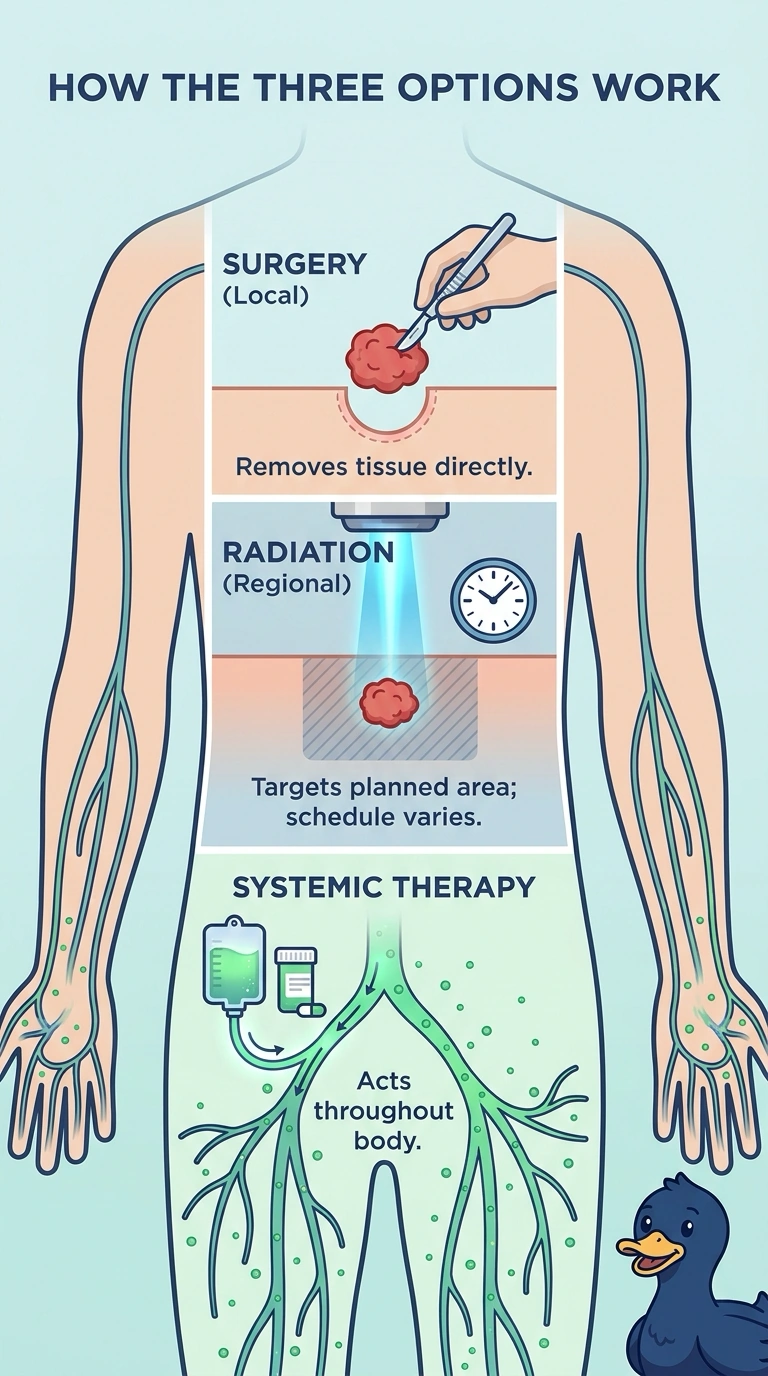
You can picture the difference as removing a lump, aiming treatment at one spot, or sending treatment throughout the body: surgery removes the tumor, radiation usually treats a targeted area, and systemic therapy can act throughout the body. Your care team can explain how these general patterns fit your situation.
Full Explanation
The usual reach of each modality is different: surgery physically removes tumor tissue, radiation delivers treatment to a planned target region, and systemic therapy travels through the body and can affect cancer cells at multiple sites. These are general descriptions, not promises about a particular patient’s treatment plan. The claim that systemic therapy is generally reserved for cancer that has spread is too restrictive: systemic treatment may also be given when disease appears localized, such as adjuvant therapy to reduce risk from microscopic cells that scans cannot detect. The claim that radiation usually treats the entire body confuses targeted radiation with total-body irradiation, which has specific indications but is not the usual approach for a localized tumor. The claim that systemic therapy is used only when local treatment is not feasible is also incorrect; systemic treatment can be combined with surgery or radiation, including for potentially curable disease. Exam caveat: “systemic” describes distribution and potential reach, not a guarantee that every cancer cell will respond or that every patient needs such treatment. Practical check: for an individual plan, confirm the prescribed treatment and its target or route with the oncology team rather than inferring them from the modality name.