
In week four of pelvic chemoradiation, a patient reports dizziness when standing and new bruising on both arms. The blood work shows hemoglobin 9.0 g/dL, a white cell count of 3,100 per microliter, and platelets of 95,000 per microliter, with the BUN inside the lab's reference range. Which interpretation best accounts for both symptoms using these results?
Select an answer to reveal the explanation.
Short Explanation
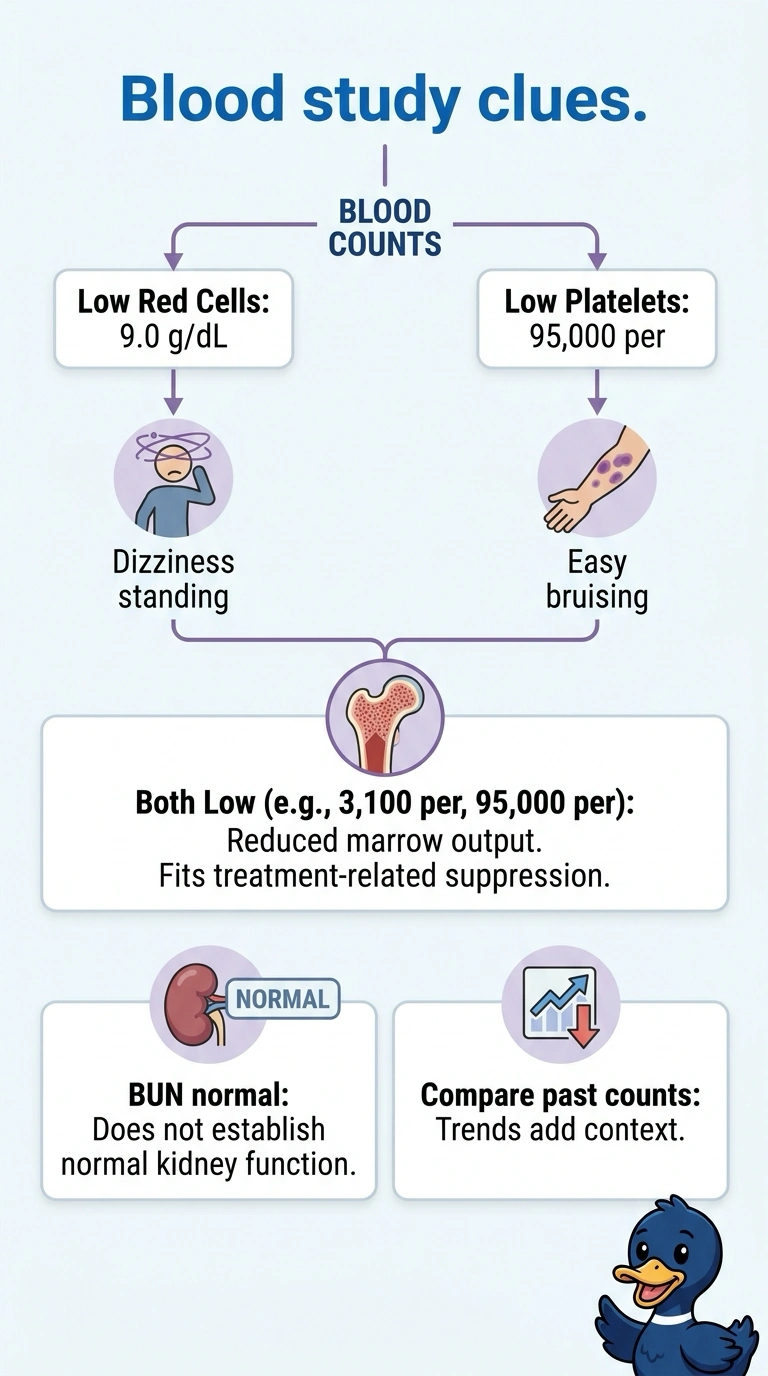
Your blood counts work like a team: low red cells can contribute to dizziness, while low platelets can lead to bruising. Together, they’re consistent with treatment-related marrow suppression.
Full Explanation
Blood study interpretation works on patterns rather than single values, because each cell line has a different role and symptoms can follow whichever line is low. Low red cells can reduce oxygen delivery and contribute to dizziness when the patient stands, while low platelets can impair clotting and contribute to easy bruising. Together, the results are consistent with reduced marrow output from treatment, though the counts alone do not prove the cause. Focusing only on red cells leaves the bruising unexplained, while focusing only on platelets leaves the dizziness unexplained. Low white cells raise a separate concern, such as infection risk, but do not account for both reported symptoms. A normal BUN alone does not establish normal kidney function or hydration status and does not explain these symptoms. Reference ranges vary between laboratories, and comparison with earlier counts can help interpret the results. Match each symptom to the relevant cell line and consider the patient's baseline and clinical context.