
While reconciling charts at the end of shift, you find a record showing a completed fraction, but you remember the beam stopped partway through and was re-delivered after an unplanned restart. Your department’s written policy requires documenting treatment variances in the record and filing a variance report before shift end. Which entry and reporting action follows that policy?
Select an answer to reveal the explanation.
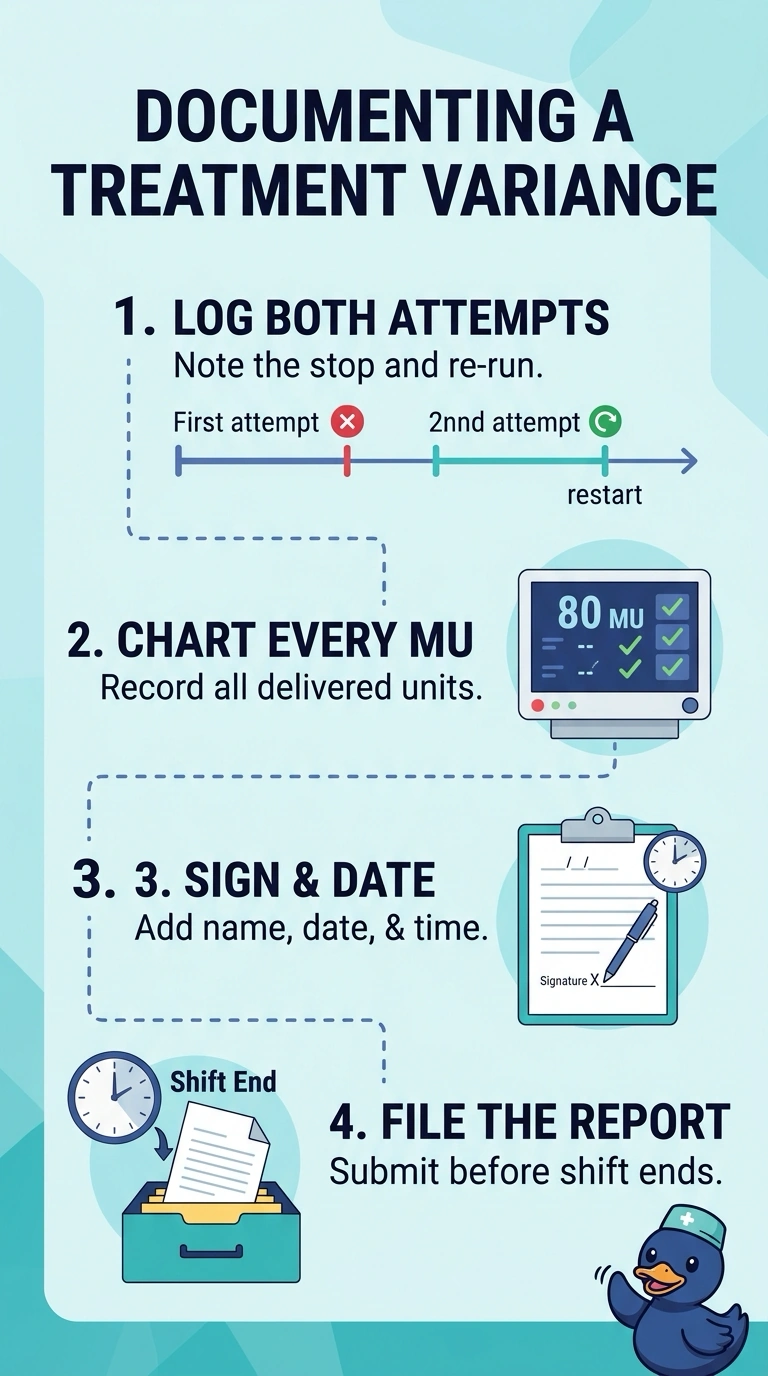
Short Explanation
You can keep the record traceable by documenting the interruption and each delivery segment, including the monitor units, date, time, and your signature, then filing the variance report before shift end. A complete note avoids combining the segments, delaying the report until the next shift, or making the required report depend on physician confirmation.
Full Explanation
The required approach creates a traceable account of the interrupted treatment: document the interruption and each delivery segment, including the delivered monitor units, date, time, and your signature, then file the variance report before shift end. Delaying the report until the next shift fails the policy’s explicit deadline, even if the record contains the treatment details. Recording the interruption and monitor units without separating the two delivery segments does not show the delivery sequence required by the scenario. Making the report conditional on physician confirmation also conflicts with the written policy, which requires reporting treatment variances; physician confirmation is not a condition for filing. Exam caveat: documentation requirements and reporting deadlines vary by institution, so follow the policy stated in the question rather than assuming a general workflow applies. Practical check: before closing the chart, verify that each segment and its monitor units, date, time, and signature are recorded, and confirm that the variance report was filed before shift end.