
During setup for an anterior neck field, the light-field edge falls 1 cm short of the skin mark in the side-to-side direction even though the jaw-defined field size and collimator angle match the plan. Which machine control should the therapist adjust first to place that edge on the mark?
Select an answer to reveal the explanation.
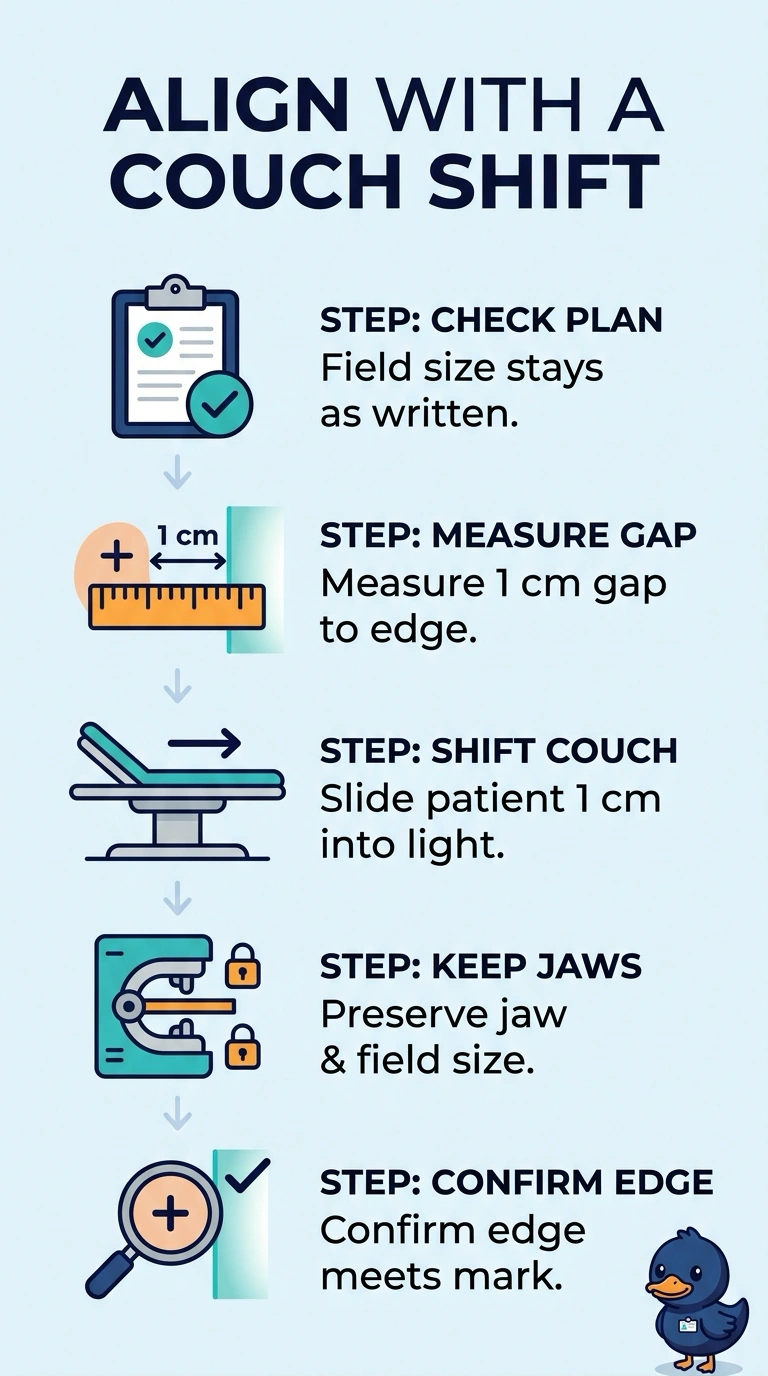
Short Explanation
The jaws define your prescribed field size, so changing them alters the treatment field. A lateral couch shift moves the patient relative to the beam while keeping the field size unchanged.
Full Explanation
The lateral couch shift is the appropriate first adjustment because the mismatch is side-to-side: moving the patient laterally relative to the beam brings the skin mark into alignment with the light-field edge while leaving the jaw-defined field size and collimator angle unchanged. Opening a jaw is a standard way to move a field edge when the planned field dimension needs adjustment, but here the jaw-defined size already matches the plan; opening it would make the field wider than prescribed. Rotating the collimator can reposition a jaw edge relative to the patient and may help with a planned orientation correction, but the angle is already correct, so rotation would introduce an unintended change to field orientation. A longitudinal couch shift is used to correct head-to-foot positioning, not a side-to-side displacement, and therefore does not address the stated mismatch. Exam caveat: couch-axis labels and displayed directions can vary with machine conventions and patient orientation, so interpret “lateral” and “longitudinal” in the room’s coordinate system rather than relying on a screen sign alone. As a practical check, after the lateral shift, recheck the mark against the light field and confirm the planned field dimensions and angle before treatment; use the prescribed imaging and setup-verification process as well.