
A patient with limited shoulder motion is scheduled for a chest treatment that was planned with both arms raised above the head. The therapist must keep the treatment volume aligned with the plan while the patient lies still for fifteen minutes. Which immobilization and positioning setup should be selected for the daily treatment?
Select an answer to reveal the explanation.
Short Explanation
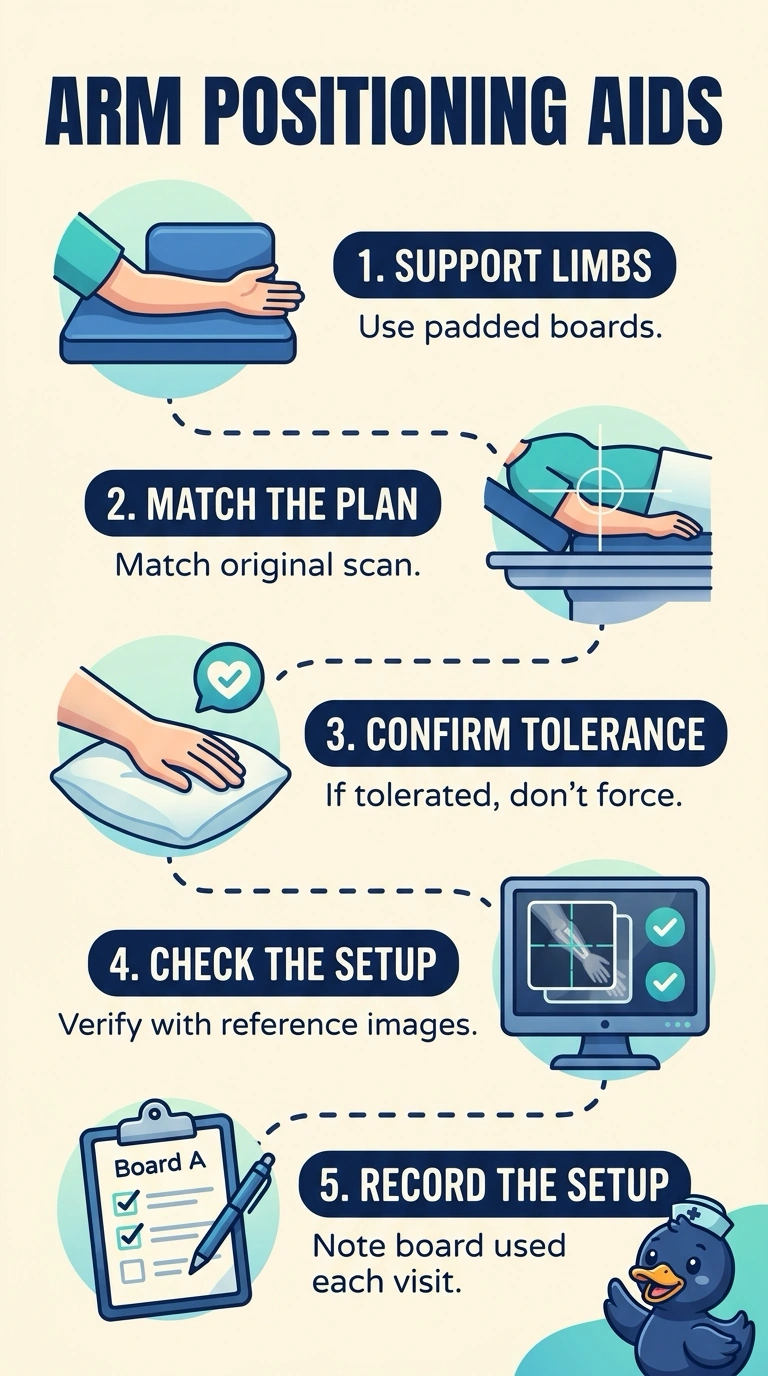
You’ll want your arms supported in the planned position so you can stay comfortable and keep the treatment aligned. Padded arm boards can help; verify the setup with reference images according to the treatment protocol.
Full Explanation
Padded arm boards support the planned arm position when shoulder motion permits, helping you maintain alignment and comfort while lying still for fifteen minutes. Verifying the setup with reference images as required by protocol confirms that the daily position matches the treatment plan, rather than relying only on external marks. Using an indexed breast board with one arm at the side changes the planned bilateral overhead arrangement; that altered geometry may change anatomy relative to the treatment volume and requires appropriate assessment and planning, not substitution during daily setup. Padded arm boards in the planned overhead position preserve the intended position, but relying on skin marks and room lasers without reference images does not meet the stated verification requirement. An indexed breast board with unpadded arm supports and reference imaging provides indexing and image guidance, but the unpadded supports may not accommodate limited shoulder motion or remain tolerable for fifteen minutes, increasing the chance of discomfort or movement. Exam caveat: being able to assume a position at setup does not establish that it is appropriate to reproduce an existing plan if the position has changed; follow local procedures to evaluate and manage a mismatch. Practical check: before treatment, confirm the patient can maintain the planned position comfortably, inspect support and indexing, and review required reference images for alignment.