
A patient with stainless steel surgical plates in his shoulder grows anxious during the planning visit. He asks why the CT simulation lasts longer than a routine scan, why small marks were drawn on his skin, and why he must lie in exactly the same position each day. Which explanation correctly addresses the implant, skin marks, and positioning concerns during the CT simulation?
Select an answer to reveal the explanation.
Short Explanation
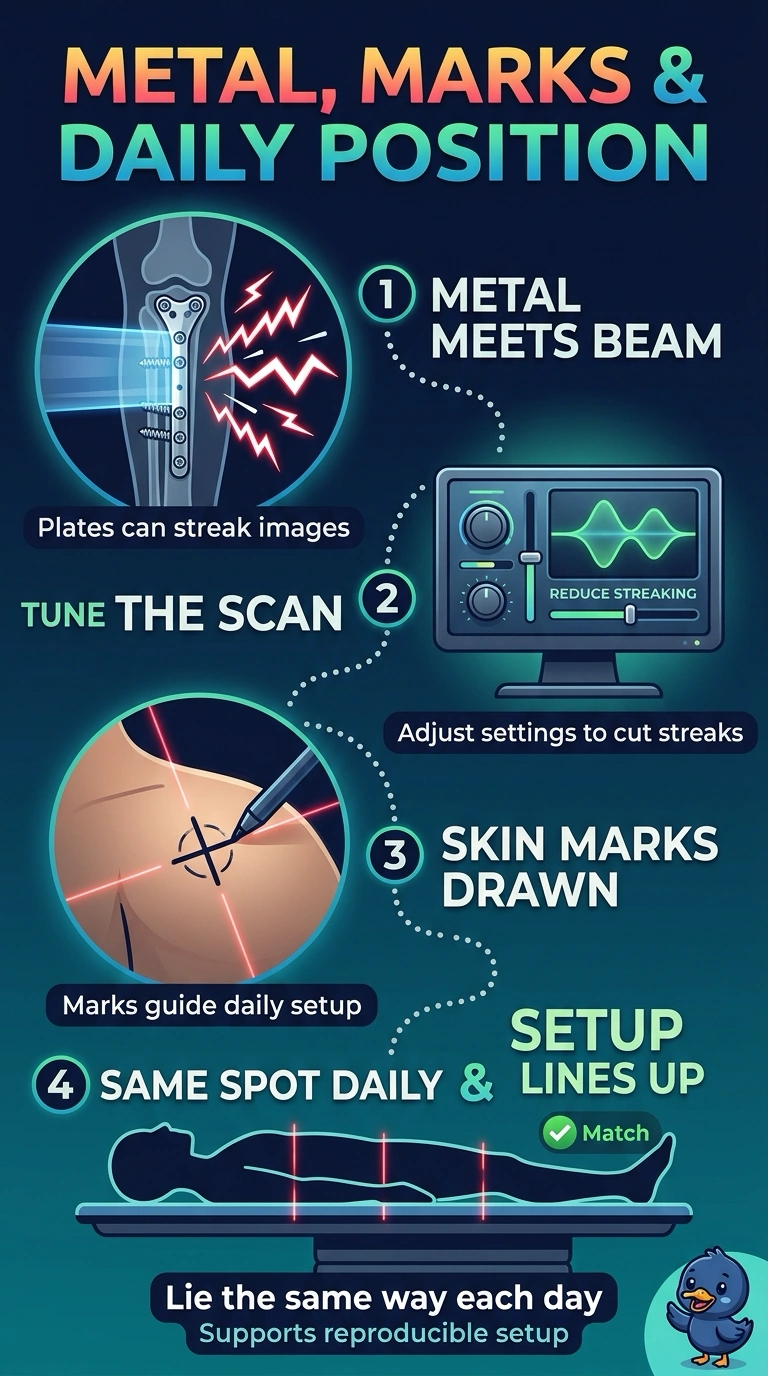
You're juggling three ideas at once, and it's easy to drop one. The plates throw streak artifacts across the image, so the scan setup is tuned to soften them, while your marks and identical position help keep every treatment aligned to the planned setup.
Full Explanation
Metal hardware in the beam path can harden and absorb photons unevenly, producing dark and bright streaks that may obscure the target and nearby critical structures. The simulation is acquired and reconstructed with settings chosen to reduce those streaks while still covering the full treatment region. Skin marks serve as fixed external references, and reproducing the same position each day helps make the patient's setup reproducible relative to those marks; it does not guarantee that internal anatomy is unchanged. The approach that outlines the tumor on every slice explains the marks and repeat position but never addresses why the implant changes the scan, so it misses the implant requirement. The approach that claims extra views keep the tumor still covers artifact handling and positioning yet leaves the skin marks unexplained, so the reference-point requirement is unmet. The approach that says the marks simply record where the treatment area lies covers the artifact issue and the marks but drops daily positioning, so reproducibility is not established. Artifact handling occurs at simulation, while setup reproducibility is assessed at each treatment fraction. Check that an explanation covers the hardware effect, the external reference, and the daily position.