
During acceptance testing, a physicist must verify the linear accelerator's absolute absorbed dose to water under reference conditions, using a measurement traceable to a standards laboratory. The physicist asks which detector from the instrument drawer should be used. Which detector best satisfies that measurement requirement?
Select an answer to reveal the explanation.
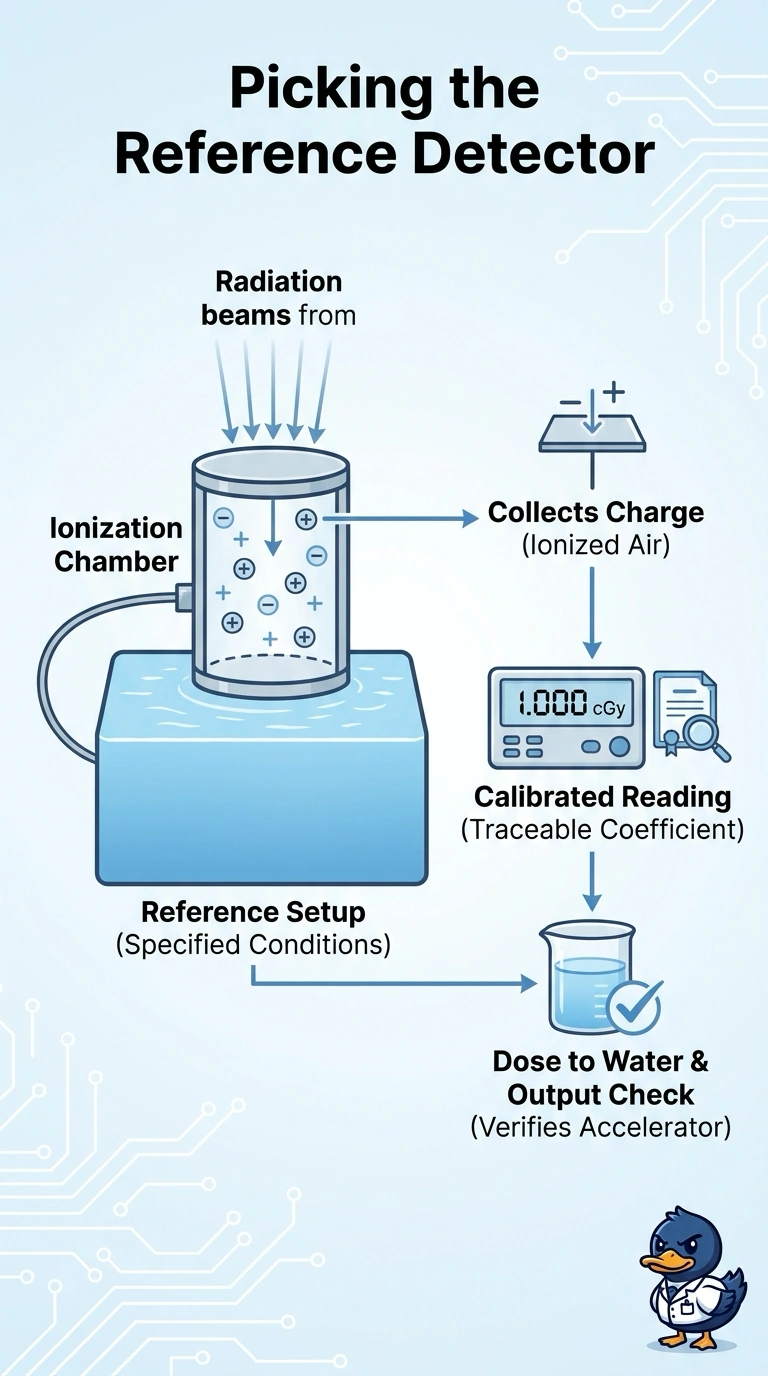
Short Explanation
Use a calibrated ionization chamber to measure the linac’s dose to water under reference conditions. Its traceable calibration coefficient works like a trusted ruler, linking your reading to a standards laboratory.
Full Explanation
The calibrated ionization chamber is the best choice because reference absorbed-dose-to-water measurements in a linac beam are conventionally made with a suitable chamber and a calibration coefficient traceable to a standards laboratory. Applying the relevant dosimetry protocol and correction factors links the chamber reading to absorbed dose to water under reference conditions. A Farmer chamber operated under reference conditions with an uncalibrated response factor lacks the required traceable calibration, even though the detector type and geometry are appropriate. A traceably calibrated TLD can be useful for dose measurements, but reading it at a non-reference depth does not establish the requested reference-condition result; its calibration does not make the measurement geometry equivalent. A chamber calibrated at another beam quality is also a plausible instrument, but using its coefficient without the required beam-quality correction fails to transfer that calibration appropriately to the linac beam. Exam caveat: a detector’s name alone does not determine suitability—calibration quantity, beam quality, geometry, and applicable corrections all matter. Practical check: verify the chamber’s calibration certificate and coefficient, including its quantity and beam quality, then confirm that the measurement setup and protocol corrections match the stated reference conditions.