
A pelvic tumour is treated with conventional fractionation, and follow-up imaging shows the central part regrowing while the outer part shrinks. The physicist explains the oxygen effect to the team. Which principle best accounts for the greater survival of the poorly oxygenated cells at the same dose?
Select an answer to reveal the explanation.
Short Explanation
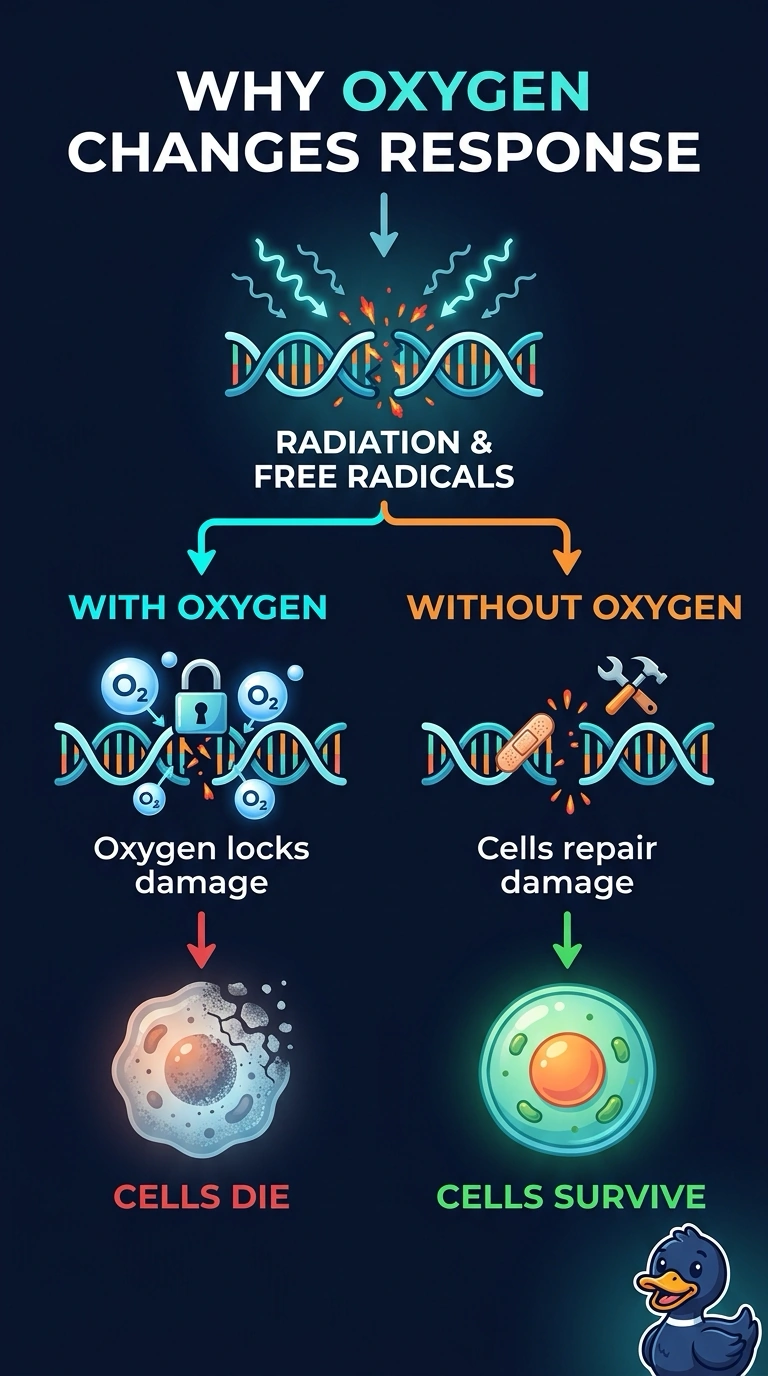
You've got it: oxygen behaves like fixer in a photographic bath, locking radiation damage into DNA. Without that step, known as oxygen fixation, the cell repairs much of the free radical damage on its own. It is the reason the hypoxic core survives a dose that clears a well-oxygenated rim.
Full Explanation
Low-LET photons create free radicals in DNA, and oxygen reacts with that damaged site to make the injury permanent, so oxygenated cells retain damage while hypoxic cells repair it and survive. This oxygen fixation underlies the oxygen enhancement ratio, which is largest for low-LET radiation and approaches unity as LET rises. The linear energy transfer explanation fails because LET belongs to the beam and its particles, not to the tissue they cross, so a cell's oxygenation cannot change how densely a photon track deposits energy. The absorbed dose explanation fails because dose is energy deposited per mass and is independent of the medium's chemistry; oxygen changes the biological effect, not the gray delivered. The repopulation explanation fails because faster proliferation between fractions alters control of rapidly dividing tumours overall, not the oxygen-dependent survival of cells within a single exposure. Expect the exam to ask for direction and mechanism rather than a numeric ratio, so avoid calculations. A quick practical check is to ask whether your answer changes the dose the patient receives or only the damage that dose leaves behind.