
A shielding sketch for a new room built for a linac that rotates a full circle around the patient lists four surfaces: the wall opposite the gantry, the floor beneath the couch, the ceiling above the treatment position, and the door at the far end of the entrance maze. Which surface needs only scatter-and-leakage shielding?
Select an answer to reveal the explanation.
Short Explanation
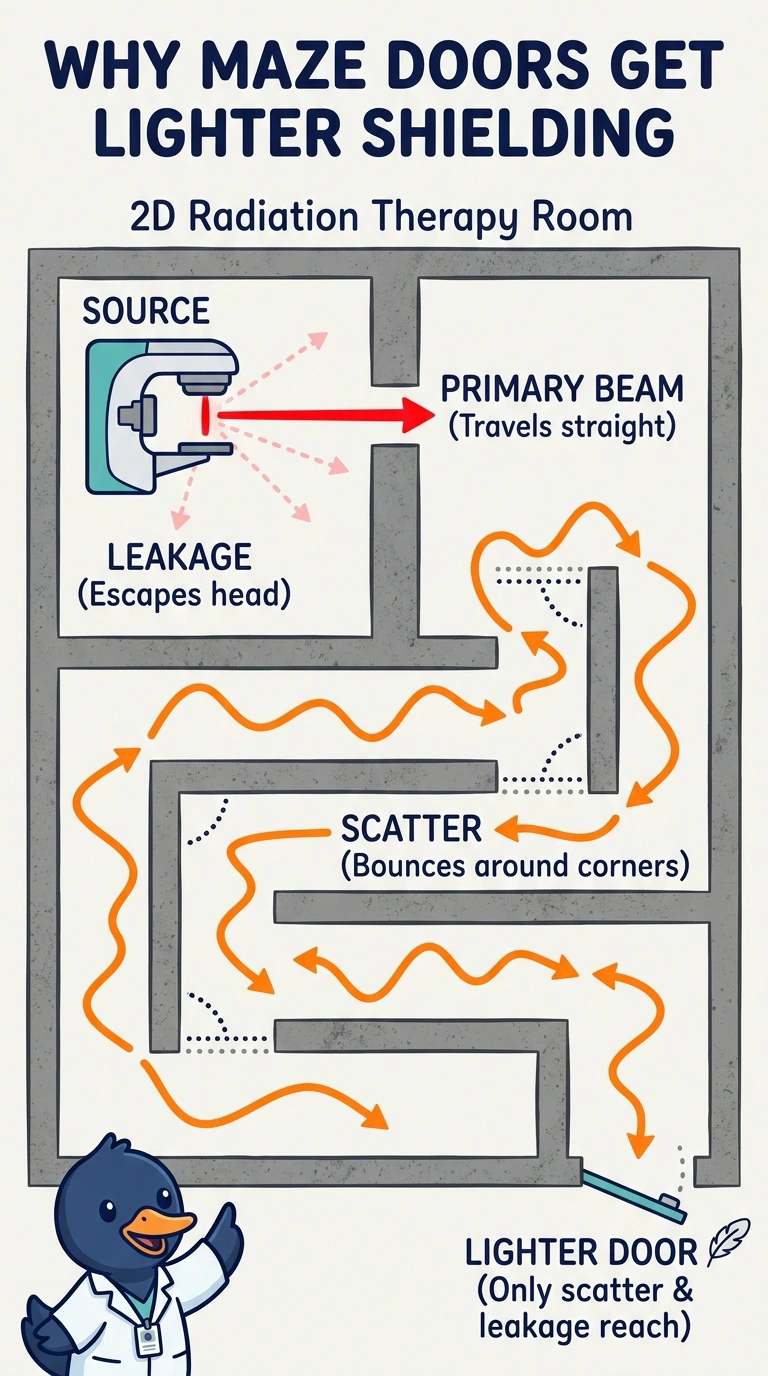
The maze blocks any straight shot, so the door only ever sees scatter and leakage. It's like a dogleg in a hallway — you can't get there without bouncing off a wall first.
Full Explanation
A primary barrier has to stop radiation that can travel in a straight line from the source, while a secondary barrier handles only what has scattered off the patient or the room and what leaks from the treatment head, and the maze door falls entirely in that second category because the dogleg blocks any direct path. The wall opposite the gantry fails the requirement, because a beam aimed across the room reaches it directly and makes it a primary barrier. The floor fails for the same reason, because a beam at gantry zero passes through the patient and keeps going down into it. The ceiling fails for the same reason, because a source under the table sends a posterior beam straight up into it. The exam caveat is that full rotation makes essentially every room surface a candidate for primary exposure, so barrier type depends on whether the direct beam can arrive. As a practical check, trace the beam at every gantry angle on the room plan and confirm that no straight line reaches the maze door.