
A spot survey in the vault anteroom while the machine is running reads 0.6 rem accumulated in one hour at 30 cm from the accessible surface. The space is observed only intermittently while therapists walk in and out for setups. Which requirements govern how this anteroom is posted, entered and monitored?
Select an answer to reveal the explanation.
Short Explanation
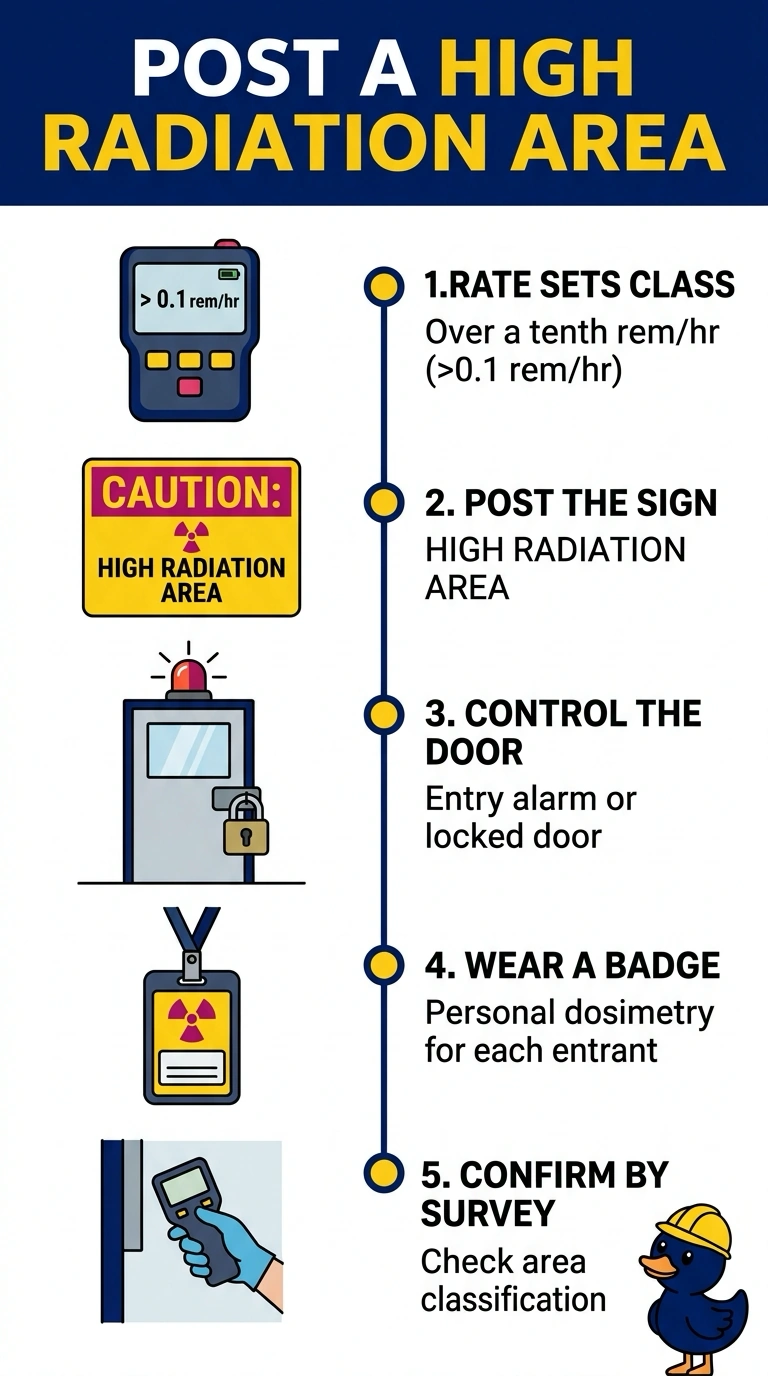
It's your survey number, not the traffic in the hallway, that sorts this space. Six tenths of a rem in an hour at 30 cm clears the high radiation threshold, so the sign, the entry control and the badge travel together. Handing each entrant a room meter instead of a badge is like locking the door and never recording who walked in.
Full Explanation
Area classification is based on the potential dose in one hour at thirty centimeters from an accessible surface. Six tenths of a rem at that distance exceeds the tenth-of-a-rem trigger for a high radiation area, so the space requires a High Radiation Area sign rather than a Radiation Area sign. Because it is watched only intermittently, each entrance also needs an access control such as an entry alarm or a locked door. Individual monitoring is required for anyone entering a high radiation area. Posting a Radiation Area sign fails the classification requirement, because the trigger is the measured level at the stated distance rather than how busy the corridor is. Depending on intermittent observation fails the access control requirement, since occasional watching is not continuous surveillance. A handheld meter reading does not replace individual monitoring, because the meter reports the room while a personal dosimeter monitors the individual. The exam caveat is that classification follows the potential dose at thirty centimeters, so where you hold the probe matters as much as the reading. A practical check is to survey, classify, and confirm each entrant wears assigned dosimetry before the machine runs.