
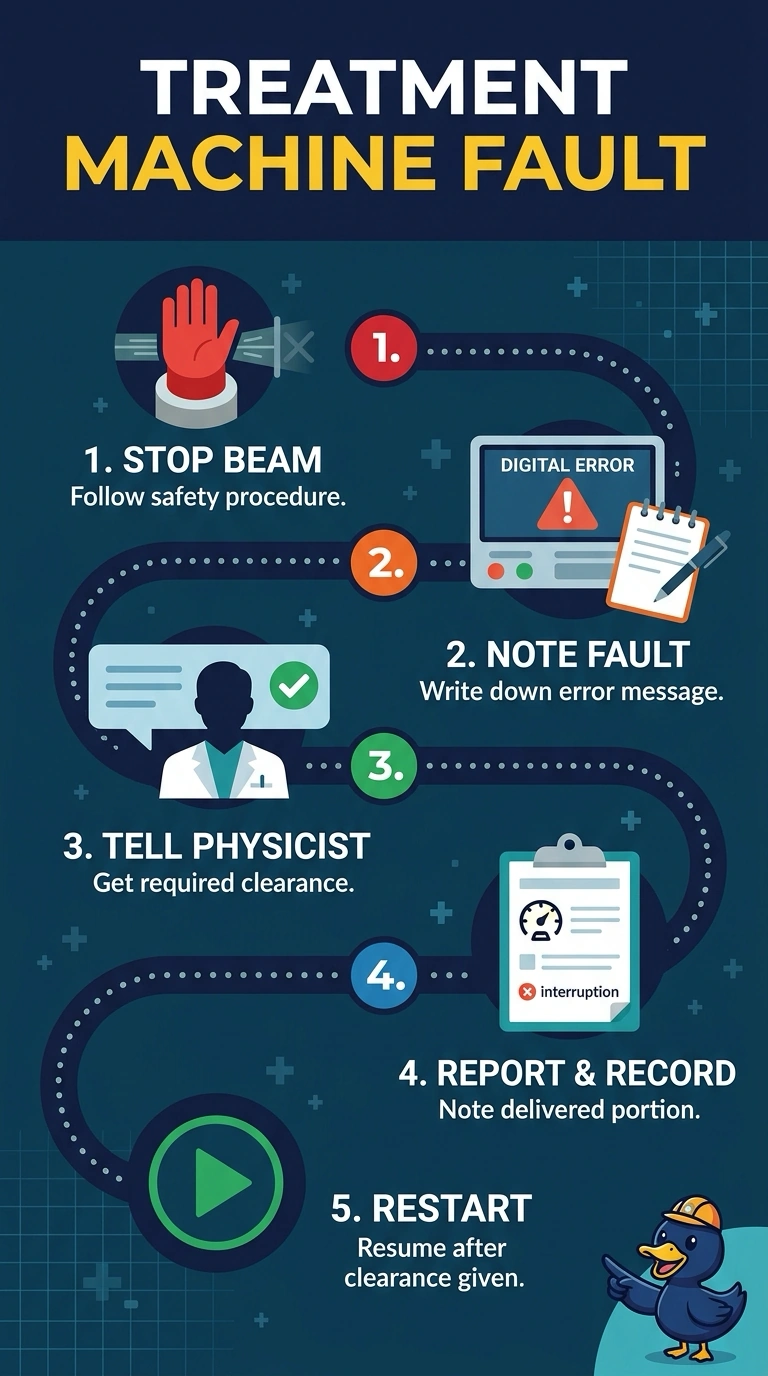
During a fraction a service error stops the linear accelerator partway through an arc, leaving the patient positioned on the couch while the console shows the fault message. Policy allows the beam to restart only after the physicist clears the unit, and the treatment record must show what actually delivered. Which response completes the equipment malfunction procedure?
Select an answer to reveal the explanation.
Short Explanation
Once the physicist clears the unit, report the fault and record the interruption and the portion delivered in the treatment record before restarting. You can think of that record as a receipt: it should show exactly what happened during the fraction.
Full Explanation
The correct response is to wait for the physicist to clear the unit, report the fault, and record both the interruption and the portion actually delivered in the treatment record. This preserves an accurate clinical record of the fraction and ensures that restarting follows the stated equipment-safety procedure. Recording those details only in the machine event log supports equipment troubleshooting but does not replace documentation in the patient’s treatment record. Documenting the interruption time in the treatment record is also insufficient by itself: without the delivered portion, the record does not establish what treatment the patient received. Recording both details in the treatment record but restarting after a senior therapist verifies the unit still fails to meet the procedure, because a therapist’s check cannot substitute for the physicist’s required clearance. Exam caveat: distinguish machine-service documentation from the patient treatment record, and do not assume an operational check authorizes restart when policy specifies a clearance authority. Practical check: before resuming, confirm physicist clearance, review the console’s delivered-dose information, and verify that the treatment record states both the interruption and the portion actually delivered.