
A patient with newly diagnosed Hodgkin lymphoma has biopsy-proven involvement of a right cervical node and of the mediastinal nodes. PET-CT shows disease confined to lymphatic tissue, entirely above the diaphragm. Which Ann Arbor stage applies to this pattern of nodal spread?
Select an answer to reveal the explanation.
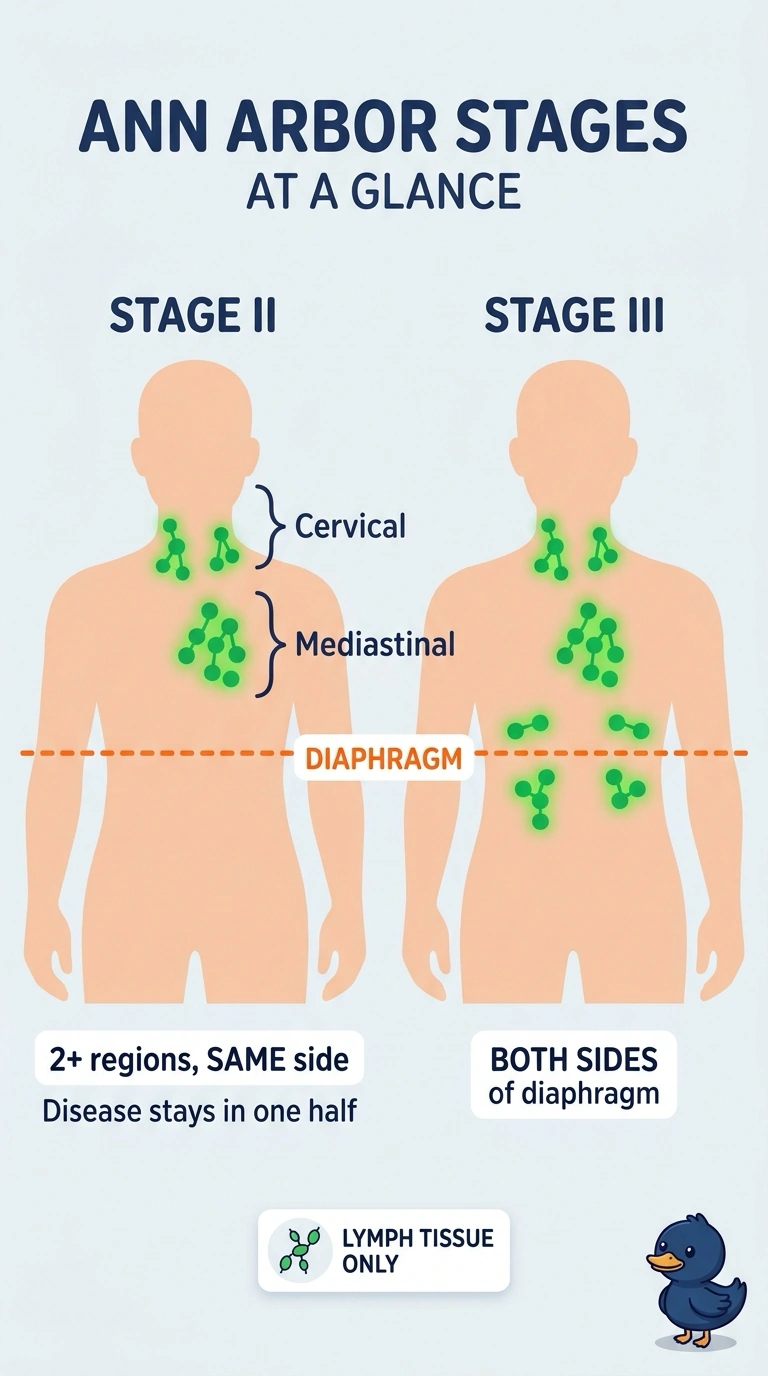
Short Explanation
Two nodal regions on one side of the diaphragm is the classic signature of Ann Arbor stage II, and your workup shows exactly that. Cervical and mediastinal chains are both lymphatic tissue, so nothing pushes the number any higher. It's like counting rooms on one floor of a house instead of walking down the stairs to another level.
Full Explanation
Ann Arbor was built for the lymphomas because tumor burden in lymphoma travels through a predictable lymphatic map rather than through a simple local-to-distant sequence. Stage I means one lymph node region, stage II means two or more regions confined to one side of the diaphragm, stage III means nodal regions on both sides, and stage IV involves disseminated extralymphatic organ disease. A cervical chain plus a mediastinal chain, both above the diaphragm with disease confined to lymphatic tissue, therefore lands squarely in stage II. The suffix E applies to contiguous extension into adjacent extralymphatic tissue, not to a mediastinal node chain. Treating the same findings as stage I overlooks the second region, while reading them as stage III ignores the diaphragm as the dividing landmark. Exam caveat: watch the modifier letters, which add information without changing the Arabic number. Practical check: list every involved region, then find the diaphragm before assigning any stage.