
During a quarterly review, the radiation safety officer finds that a therapist's whole-body dosimeter reported zero dose even though the therapist covered treatment-assist shifts in the room every day. The badge had been kept inside a lead apron pocket, and the officer wants the therapist to monitor occupational exposure during these duties. Which personnel monitoring practice should the therapist follow when wearing the apron?
Select an answer to reveal the explanation.
Short Explanation
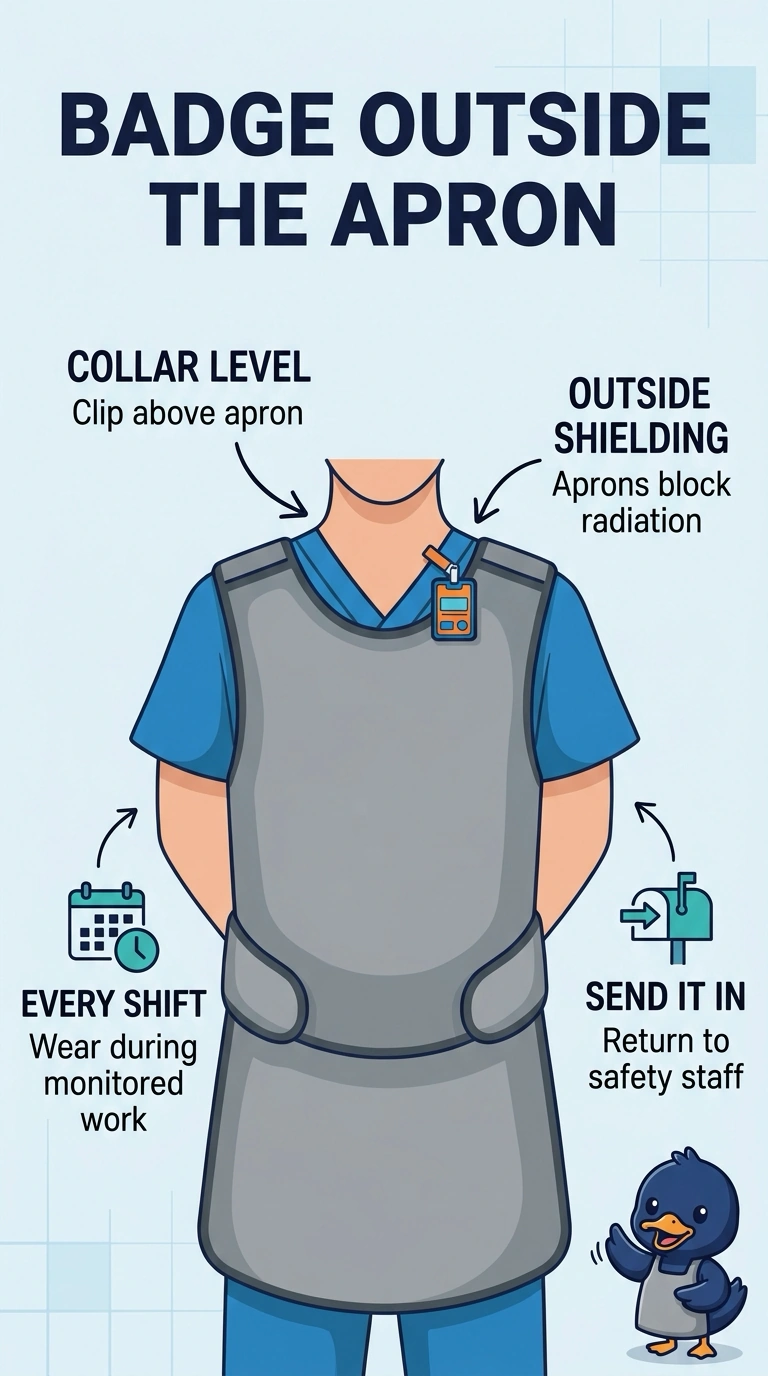
Lead can attenuate radiation reaching a dosimeter inside an apron, affecting its reading. Follow your radiation safety program’s instructions for wearing and positioning your badge.
Full Explanation
The correct practice places the dosimeter outside the lead apron at collar level for the occupational exposure period, as directed by the radiation safety program. The apron attenuates radiation reaching a badge worn underneath, so that badge would not represent exposure at an unshielded location such as the head and neck. A single under-apron badge at waist level can be an accepted method for estimating protected torso dose, but it does not meet the stated outside-apron, collar-level monitoring requirement here. Wearing the collar badge only during treatment-room assists also falls short: personal monitoring should cover the occupational exposure period, not just one task or location, when the program requires that coverage. A two-badge arrangement is commonly used in some settings, with an under-apron waist badge and an outside-apron collar badge; placing the outside badge at the waist misses the specified collar-level placement and may not characterize exposure to the head and neck as intended. Exam caveat: badge number and placement can depend on local regulations, apron use, exposure geometry, and the radiation safety program, so do not generalize a single-badge or dual-badge rule to every workplace. Practical check: confirm the assigned badge’s placement and wear period with the radiation safety officer, and verify that it is worn correctly whenever the monitored duties are performed.