
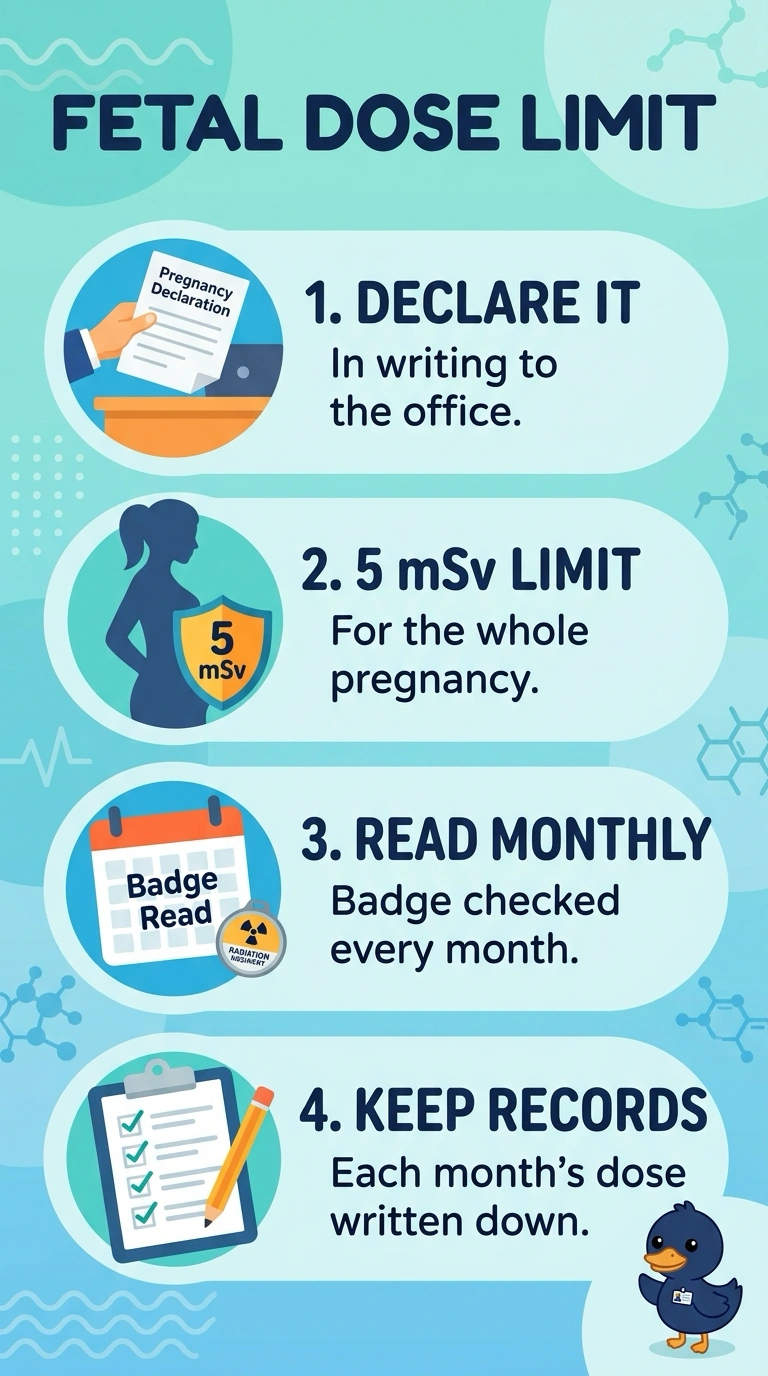
A radiation therapist declares her pregnancy in writing to the radiation safety officer, and her monthly badge readings will be reviewed for the rest of the pregnancy. The department must apply the correct limit to the embryo or fetus. Which dose limit governs the fetal exposure for a declared pregnancy?
Select an answer to reveal the explanation.
Short Explanation
Once the pregnancy is declared in writing, you are done with the adult occupational numbers and a tighter federal dose limit for the embryo or fetus takes over. It works like a smaller bucket: that ceiling fills up far sooner than the yearly number allowed for an adult worker.
Full Explanation
Once a pregnancy is declared in writing, radiation protection rules replace the adult occupational numbers with a specific embryo and fetus limit of 5 mSv for the whole gestational period, which is far less than the 50 mSv a working adult may receive in a year. The department puts that limit to work by reviewing the wearer's badge every month, so cumulative fetal dose stays visible and can be compared with the ceiling long before it is approached. The single-year occupational approach applies the 50 mSv annual ceiling to the fetus, but that value protects an adult across a full year and is not the fetal limit. The public-limit approach borrows the 1 mSv yearly figure for people who never work with radiation, and it is neither the occupational value nor the declared-pregnancy value. The long-term-average approach uses the five-year occupational average, which is a workforce monitoring rule and says nothing about a pregnancy in progress. Exam caveat: institutions often set a monthly action level well beneath the total, so follow your program's review policy. Practical check: confirm the declaration is documented, appropriate fetal monitoring is in place, and every monthly result is reviewed and filed.