
A radiation oncology team reviews the staging workup for a newly diagnosed follicular lymphoma. PET-CT shows disease in two contiguous lymph node regions on the same side of the diaphragm, with no marrow or extranodal involvement and no B symptoms. Which staging description correctly classifies this patient's disease?
Select an answer to reveal the explanation.
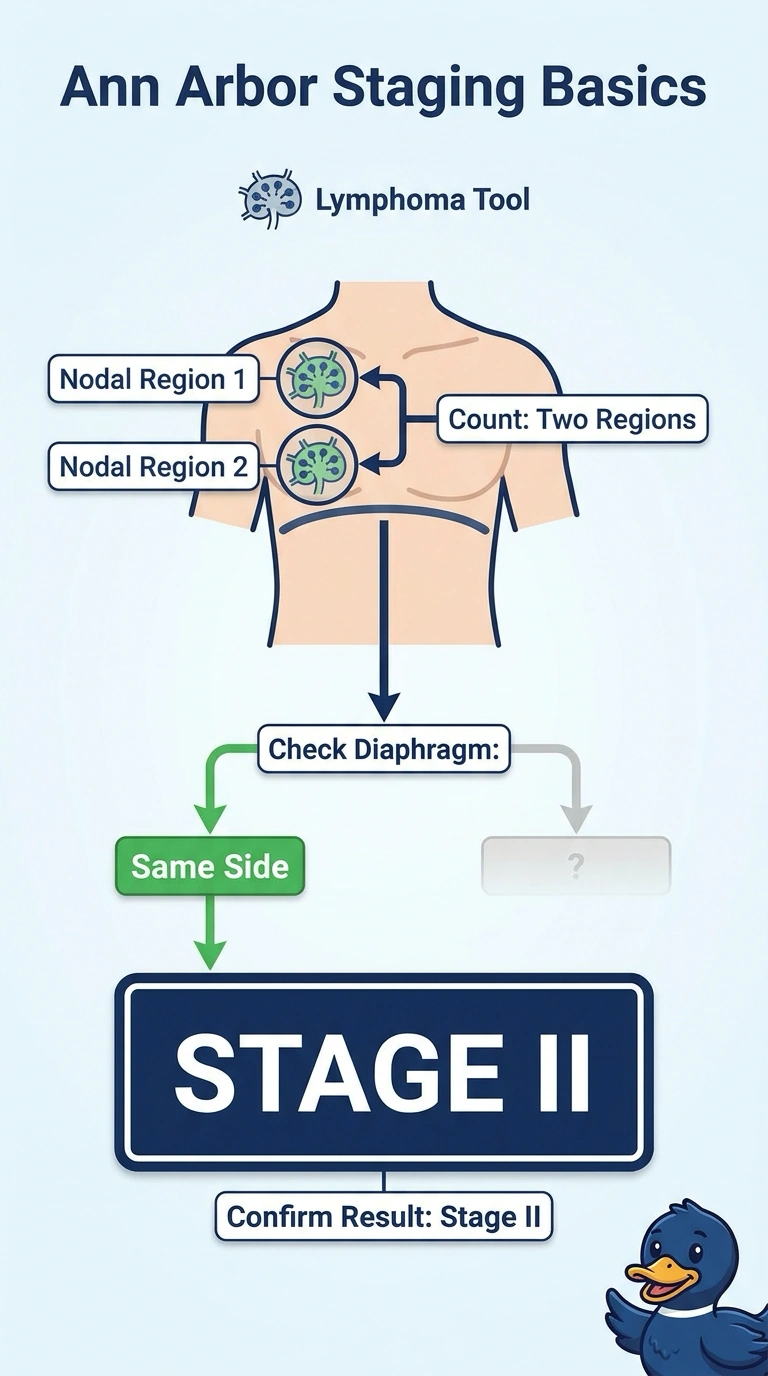
Short Explanation
You classify this as Ann Arbor stage II because two or more lymph node regions on the same side of the diaphragm meet the definition. The diaphragm acts like a dividing line: involvement on both sides would indicate a different stage.
Full Explanation
Ann Arbor stage II is correct because the disease involves two nodal regions on the same side of the diaphragm. The absence of marrow or extranodal involvement and B symptoms does not alter that nodal-stage assignment; it means there is no basis to add an extranodal or B designation. Stage IIE would require contiguous extension into a nearby extranodal site, which the workup specifically excludes. The bulky stage II designation requires a qualifying bulky mass; no such mass is reported, so that suffix cannot be assigned from the information given. Stage IIB requires qualifying lymphoma-related B symptoms, which are explicitly absent. These are legitimate staging descriptors in the appropriate circumstances, but each adds a feature not present in this case. Exam caveat: staging conventions and the notation used for bulky disease can vary between Ann Arbor/Cotswolds and Lugano presentations, so distinguish the stage number from its modifiers. Practical check: verify the number and distribution of nodal regions, diaphragm relationship, extranodal extension, bulk measurement, and B symptoms before assigning any suffix.