
A patient is treated isocentrically at SAD 100 cm with a whole-brain field matched to a posterior spine field. Both fields have a half-beam blocked edge at the junction, and the physicist marked the projected junction line on the skin. The therapist checks the light field before the first fraction. Which check confirms that the projected field edges align at the skin mark?
Select an answer to reveal the explanation.
Short Explanation
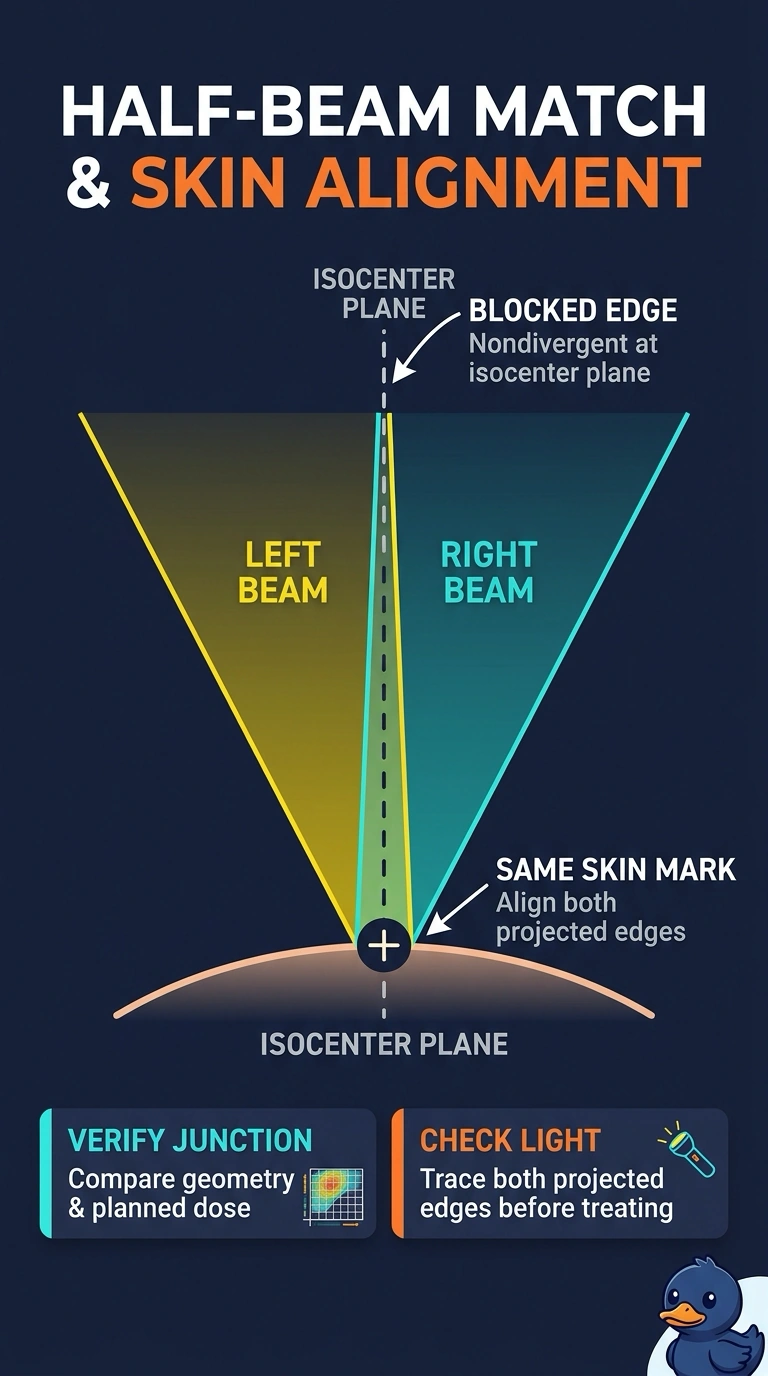
A half-beam block gives you a straight, nondivergent edge at the isocenter plane, like a ruler edge. To check that the field edges meet at your skin mark, line up the blocked edges of both light fields there; this confirms surface alignment, not dose uniformity.
Full Explanation
A half-beam block creates a nondivergent field edge at the isocenter plane, which permits matching field edges there without the divergence that would occur with two unblocked edges. Aligning both projected blocked edges on the same skin mark checks their alignment at the surface. It does not, by itself, prove the exact gap or dose distribution at a junction plane that lies at depth; those depend on the treatment geometry and plan. Leaving a fixed gap at the skin would not be the appropriate check for the specified blocked-edge match. Measuring each field width at the isocenter plane checks field size, not junction alignment. Measuring 100 cm from the collimator to the skin applies an SSD distance check, not the stated SAD setup. Confirm the setup and junction plane against the treatment plan before treatment.