
Yesterday a linac fault stopped treatment partway through the fraction; the beam was restored under departmental policy and the remaining monitor units were delivered, but the treatment note says only that the fraction was completed. Which entry best documents this interrupted fraction?
Select an answer to reveal the explanation.
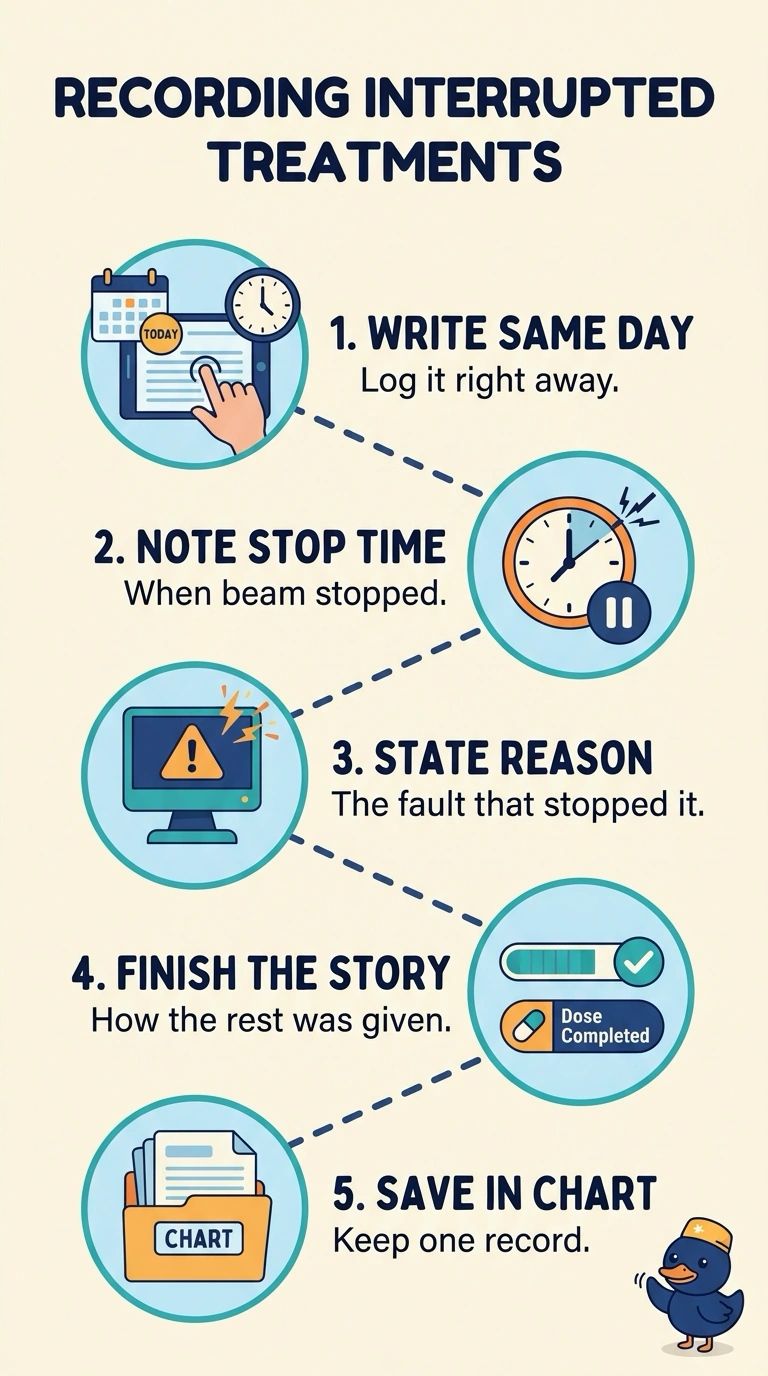
Short Explanation
Your record has to tell the whole story of the fraction, not just how it ended. A note that only says the dose was finished hides an event the physician and physicist may need to review. You can't recreate a restart time you never wrote down, so document the interruption when it happens.
Full Explanation
A treatment record must show what the patient actually received, so when a machine fault ends a fraction early and the beam later restarts, the entry needs the time of the stop, the reason, and how the remainder was delivered under departmental policy. Those details let the physician and physicist judge whether the delivered dose and the equipment behavior were acceptable, and they support any later review of the plan. Recording the fault only in the maintenance system fails the patient-record requirement, because a service entry is invisible to the clinician reading the chart. Deferring the note to the next treatment misses the contemporaneous requirement, because restart times and fault codes fade quickly from memory. Saying the fraction was completed as planned satisfies the dose fact while hiding the interruption, which is exactly the event the reader needs to see. On exam day, documentation items usually turn on completeness and timing rather than on tone. A quick practical check: read your draft and ask whether someone absent from the room could reconstruct the interruption from it alone.