
A daily CBCT is acquired for a pelvic treatment, and the automatic match proposes a large longitudinal shift. The sagittal view alone looks convincing, but the axial slices show the femoral heads rotating out of alignment. Which verification confirms that the registration is valid before the beam is delivered?
Select an answer to reveal the explanation.
Short Explanation
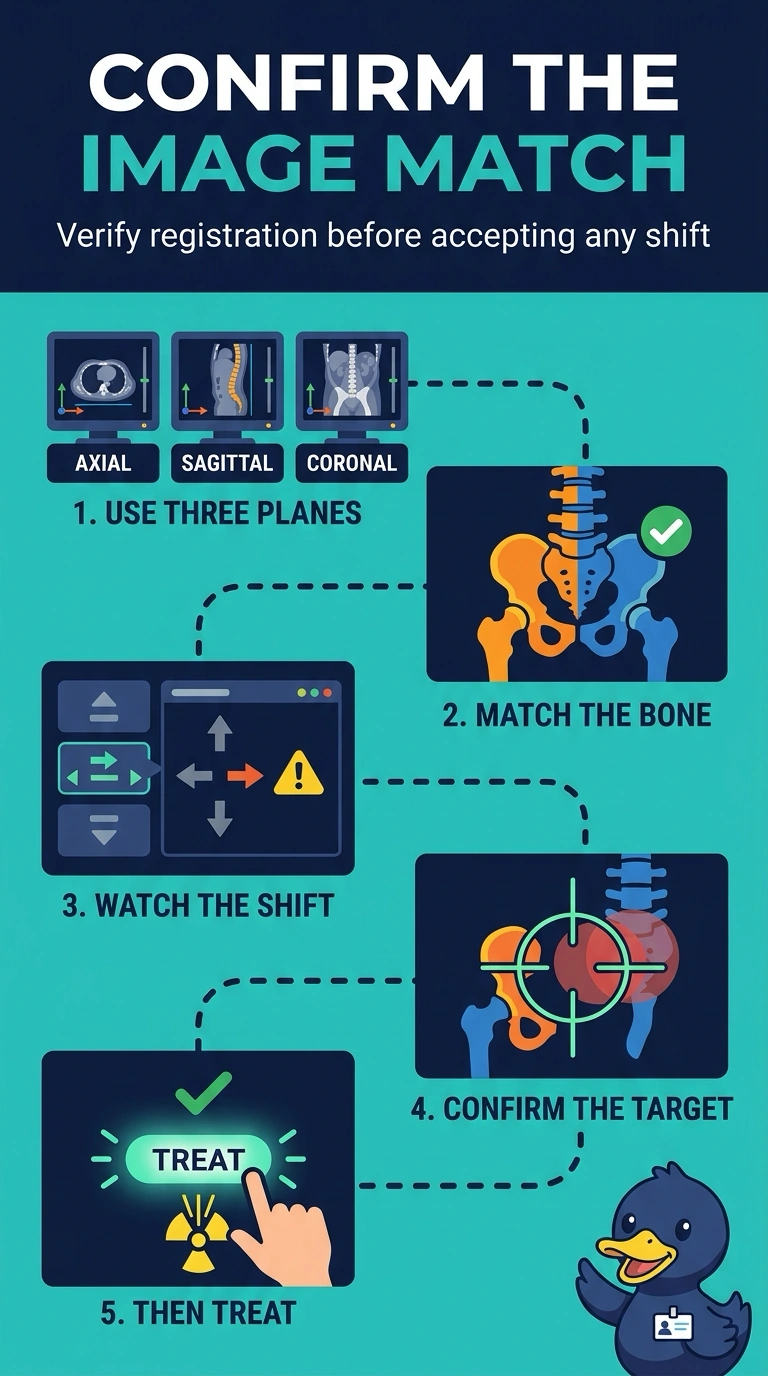
You're the last check before the beam, so one view is never enough to trust a proposed shift. Read the match on all three planes against the bony anatomy and only then accept it, because software can line up surfaces while the target sits somewhere else.
Full Explanation
The registration is valid only when the patient anatomy supports the proposed shift across the full three-dimensional image set. Matching bony landmarks on axial, sagittal, and coronal views checks for translation and rotation that may be hidden when one view appears convincing. Here, the sagittal match is not sufficient: the axial slices show the femoral heads rotating out of alignment, so the discrepancy must be resolved before treatment rather than accepting the automatic shift. Checking pelvic bony landmarks in only axial and sagittal views omits the coronal plane, leaving an important part of the three-dimensional registration unverified. A second clinician reviewing sagittal and coronal views adds useful independent oversight, but still misses the axial mismatch explicitly shown in this case; a second reviewer cannot compensate for an omitted plane. Matching target soft tissue on all three planes checks spatial agreement, but it substitutes a different registration reference for the bony anatomy needed to assess the pelvic rotation described. Exam caveat: a large proposed shift is not automatically wrong, but disagreement between planes is a reason to investigate, not a reason to accept the match. Practical check: inspect the relevant bony landmarks in all three orthogonal views, resolve any rotational or translational inconsistency, and follow local escalation and approval procedures before beam delivery.