
A student is puzzled that raising the source-to-surface distance from 100 cm to 150 cm for a lung field lowers the dose rate even though field size and beam energy are unchanged. The physicist asks the student to name the governing principle. Which physics principle explains the reduced intensity at the greater distance?
Select an answer to reveal the explanation.
Short Explanation
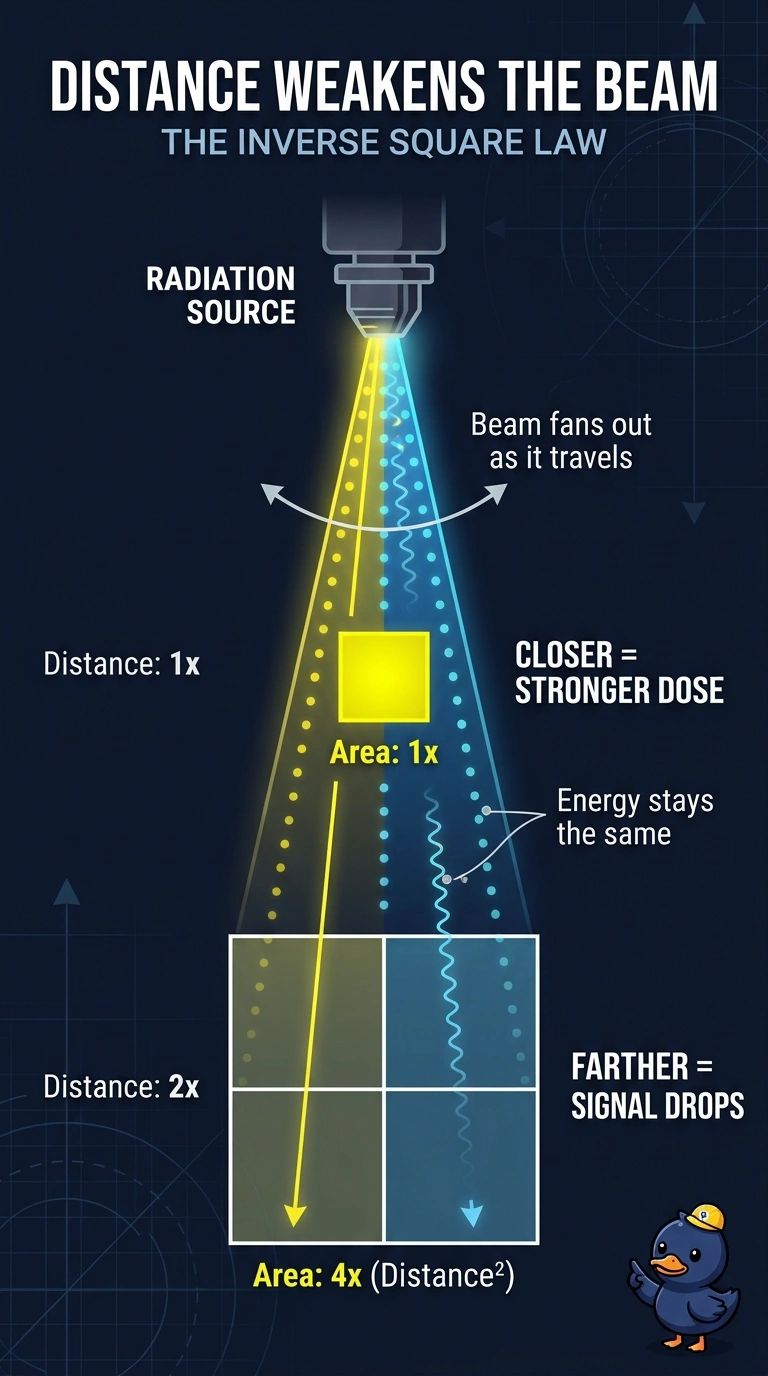
The dose rate drops because the same photons have to cover a larger area as you move away from the source. It's the classic inverse-square law at work, like a flashlight beam spreading over a bigger wall.
Full Explanation
Photons leave the source and travel in straight lines, so the fluence crossing any given area falls with the square of the distance from the source; moving from 100 cm to 150 cm therefore lowers the dose rate even though nothing about the beam itself changed. Filtration and beam hardening describe how the spectrum shifts when material filters the beam, but the stated energy here is unchanged and no filter was added, so half-value-layer reasoning does not apply to this setup. Air absorption along a longer path is a genuine process, yet the extra column of air removes far too few photons to account for a drop of this size, so attenuation reasoning mistakes a minor contributor for the governing cause. Patient scatter reaching a point at the surface depends on field size and phantom geometry rather than on source distance, so scatter reasoning misses the geometry change being tested. Be aware that the exam pairs a distance change with an unchanged field size, which signals that geometry rather than absorption is the focus of the question. A practical check: measure output at the distance you plan to use and compare it with the value predicted by the inverse square calculation before treating.