
A patient with a mid-rectal tumor finishes chemoradiation and is booked for a posterior pelvis course. The target covers the mesorectum plus the nodal drainage that runs beside the pelvic sidewall vessels. Which lymphatic chain should be outlined as the nodal target for this site?
Select an answer to reveal the explanation.
Short Explanation
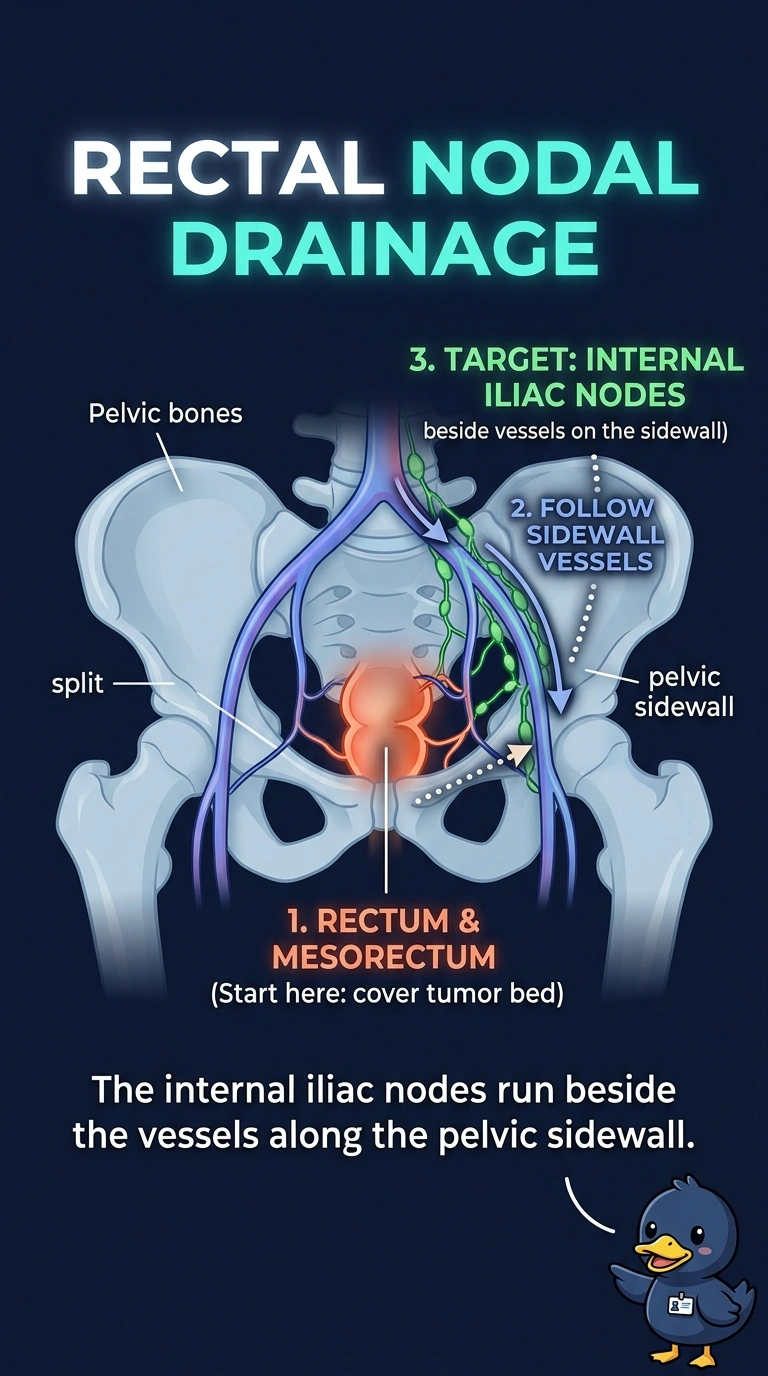
For a mid-rectal tumor, you’ll cover the mesorectum and the internal iliac nodes running beside the pelvic sidewall vessels. Think of them as the next streets along the route where lymph can travel.
Full Explanation
The internal iliac chain is the appropriate nodal target: for a mid-rectal primary, elective pelvic coverage includes the mesorectum and regional internal iliac nodes, which track along vessels on the pelvic sidewall. The external iliac chain also follows vessels along the sidewall, but it is not the usual regional drainage basin for an otherwise mid-rectal tumor; its inclusion is generally driven by a different primary site or specific involvement. The superior rectal chain is a plausible rectal drainage pathway, but it follows vessels toward the inferior mesenteric artery rather than running beside the pelvic sidewall vessels specified here. Inguinal coverage is appropriate in selected tumors involving the anal canal, but that extension is not part of this mid-rectal scenario. Exam caveat: rectal nodal coverage varies with tumor level, suspected nodal disease, and the treatment protocol, so the vessel clue identifies the requested chain rather than defining every structure that must be treated. Practical check: review the MRI-defined tumor extent and the radiation-planning atlas or institutional contouring protocol, then confirm the intended nodal volume against the relevant vessel anatomy on axial imaging.