
The radiation safety officer reviews dose records for individuals who hold no occupational assignment. One person waits in the uncontrolled public lobby on a regular schedule, carries no occupational dosimetry badge, and has no declared pregnancy. Which annual effective dose limit applies to this person's recorded exposure?
Select an answer to reveal the explanation.
Short Explanation
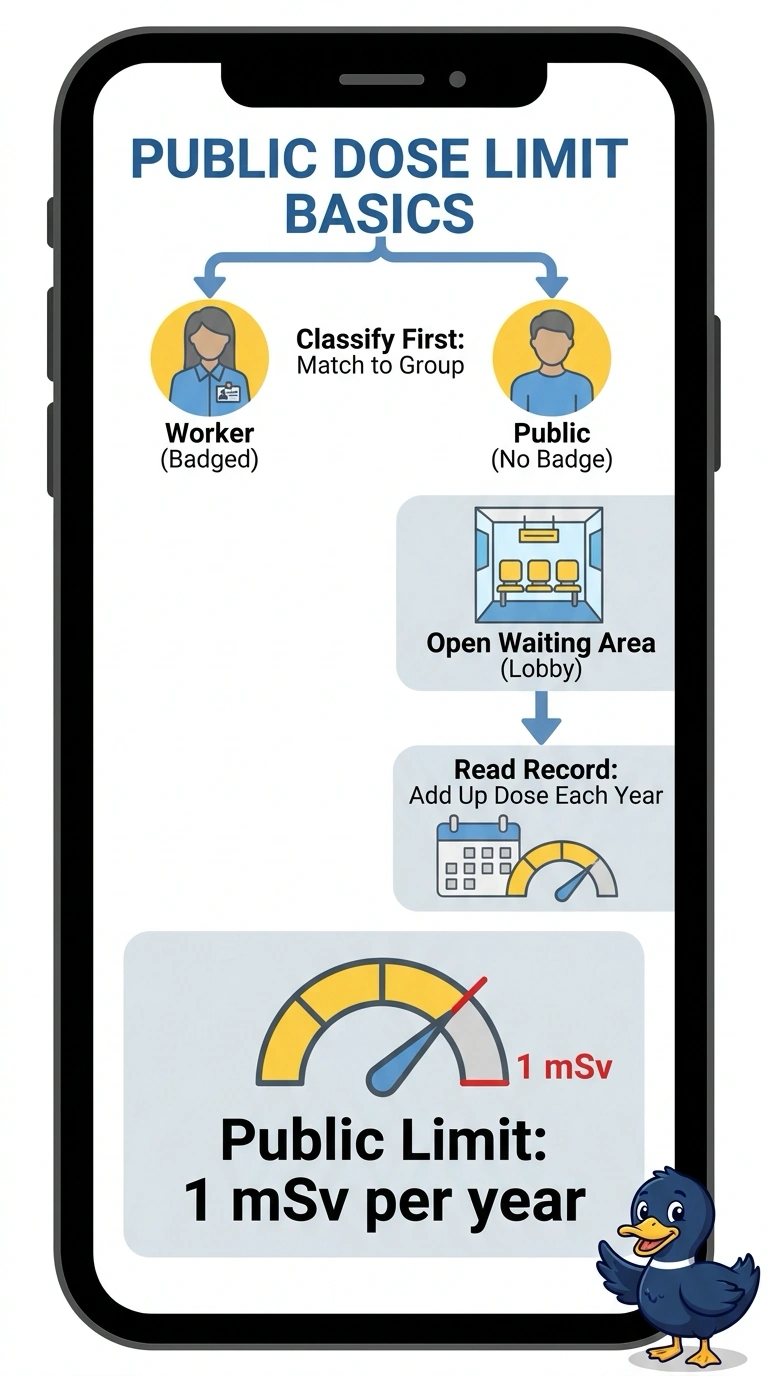
Since you’re in an uncontrolled public area and don’t have an occupational assignment, your annual dose limit is 1 mSv—the public limit, like a lower speed limit for shared spaces. The other limits apply to occupational exposure or a declared pregnancy.
Full Explanation
The 1 mSv per year limit applies because the person has no occupational assignment and is exposed in an uncontrolled public area. Radiation limits are selected by exposure category and location: routine presence or a regular schedule alone does not make someone an occupationally exposed worker, so the public annual effective dose limit governs the recorded exposure. The 50 mSv per year figure is the occupational limit for total effective dose equivalent; it fails here because it applies to occupational exposure, not a member of the public in an uncontrolled area. The 5 mSv figure is the limit on dose to the embryo or fetus over the entire pregnancy of a declared pregnant worker; it is not a general annual public limit, and this person has not declared a pregnancy. The 500 mSv per year figure is the occupational limit for skin or extremities, a different tissue-dose measure and exposure category, rather than the applicable annual effective dose limit. Exam caveat: distinguish the public limit from occupational limits, and distinguish effective dose from skin/extremity dose and the pregnancy-specific cumulative limit. Practical check: verify the person’s occupational status, whether the location is controlled or uncontrolled, the dose quantity and monitoring record, and the period over which the dose is reported before comparing it with the applicable limit.