
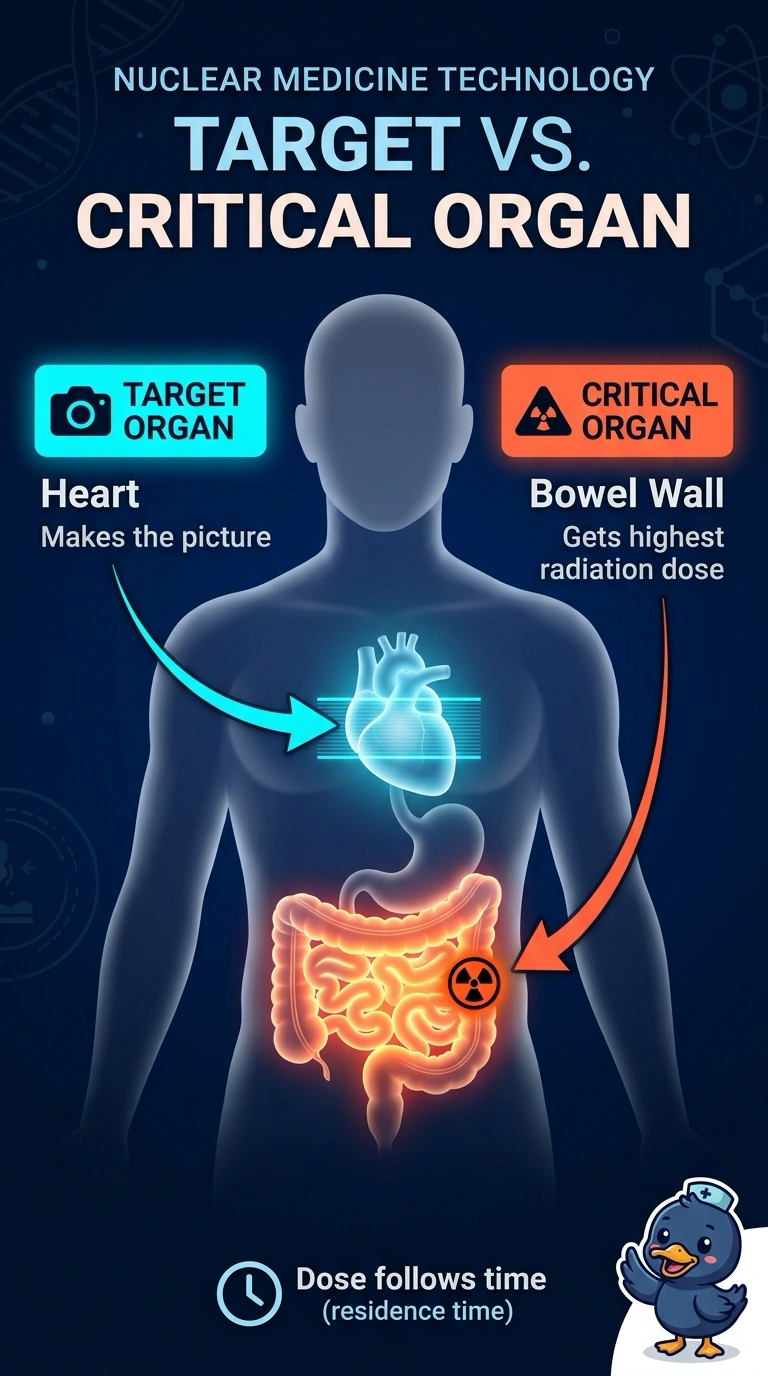
A myocardial perfusion tracer concentrates in the heart for imaging and is cleared through the bowel. For this agent, dosimetry shows that the bowel wall receives the highest absorbed dose of any organ. Which organ is the critical organ, and what makes it so?
Select an answer to reveal the explanation.
Short Explanation
Your heart is the imaging target, but the critical organ is the bowel wall because it receives the highest radiation dose. It’s a bit like a spotlight: the heart is where you’re aiming, while the bowel gets the most exposure.
Full Explanation
The critical organ is identified by dosimetry: it is the organ receiving the largest absorbed dose from the administered radiopharmaceutical. In this scenario, the supplied dose ranking identifies the bowel wall as receiving the highest dose, even though the heart is the diagnostic imaging target. The organ with the greatest activity during imaging is not necessarily the organ with the greatest absorbed dose; dose depends on factors including activity distribution and residence time. The bowel's being a route of excretion alone does not establish its dose ranking. For a specific radiopharmaceutical, consult its dosimetry data rather than infer the critical organ from the imaging target or excretion pathway.