
A patient with Crohn's disease has persistent low-grade fever, and a deep pelvic abscess is suspected. Autologous cells are ready for labeling, the team wants images on each of the next two days, and a deep focus may hide on flat views. Which labeling agent and imaging schedule best plans this abscess study?
Select an answer to reveal the explanation.
Short Explanation
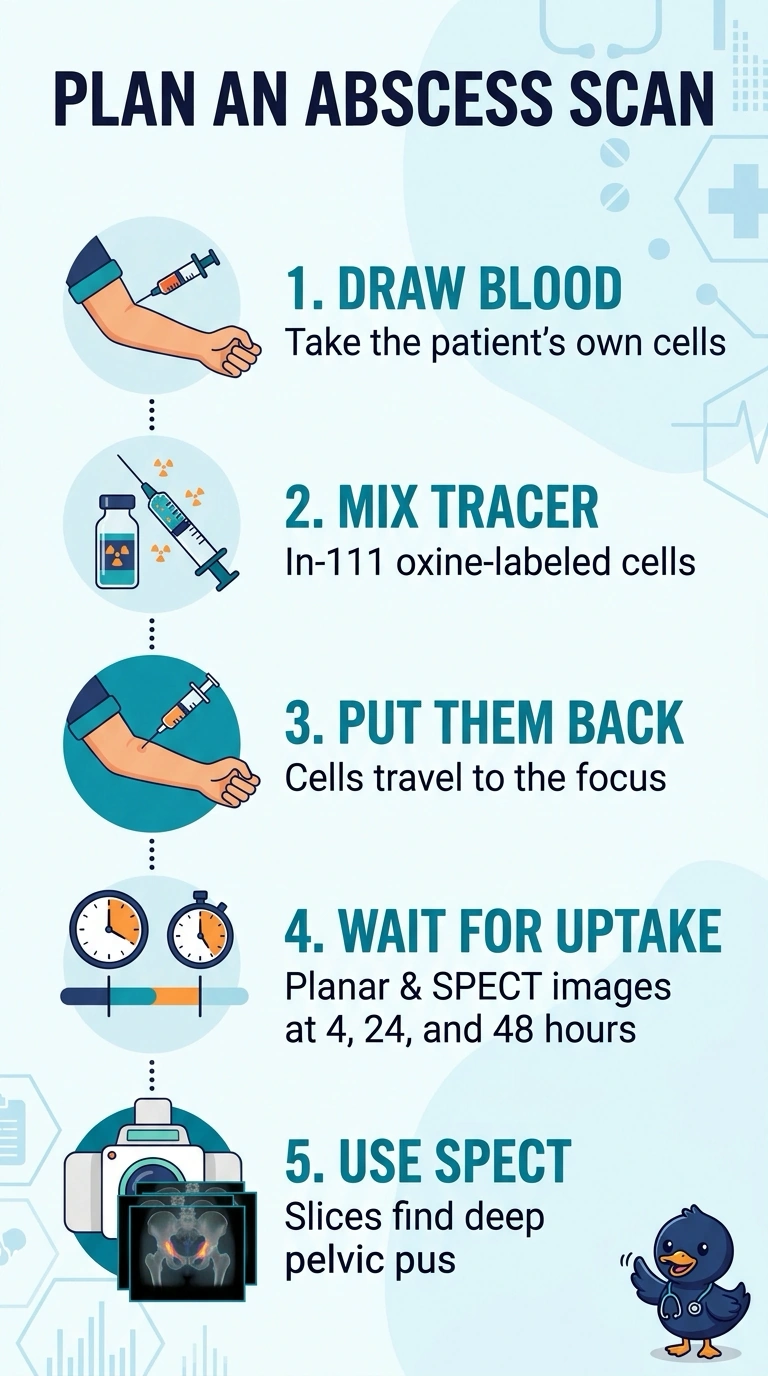
You need a label that can support delayed imaging and a view that adds depth, so In-111 oxine-labeled cells are the best fit. SPECT can help localize a pelvic focus that is difficult to see on planar views.
Full Explanation
Autologous leukocyte labeling keeps the tracer inside the patient's own white cells, which migrate to a focus of infection. In-111 oxine is suitable for delayed imaging at 24 and 48 hours, while SPECT can improve localization of a deep pelvic focus. Planar-only imaging provides less depth information and may make localization more difficult. Tc-99m HMPAO-labeled cells are generally used for earlier imaging, so they are a poor choice for the requested second-day images. Gallium citrate is not a white-cell labeling agent and cannot be used to label the prepared sample. Agent choice depends on the clinical question, with early abdominal imaging often favoring Tc-99m HMPAO. Confirm the labeling, reinjection, and acquisition times on the schedule.