
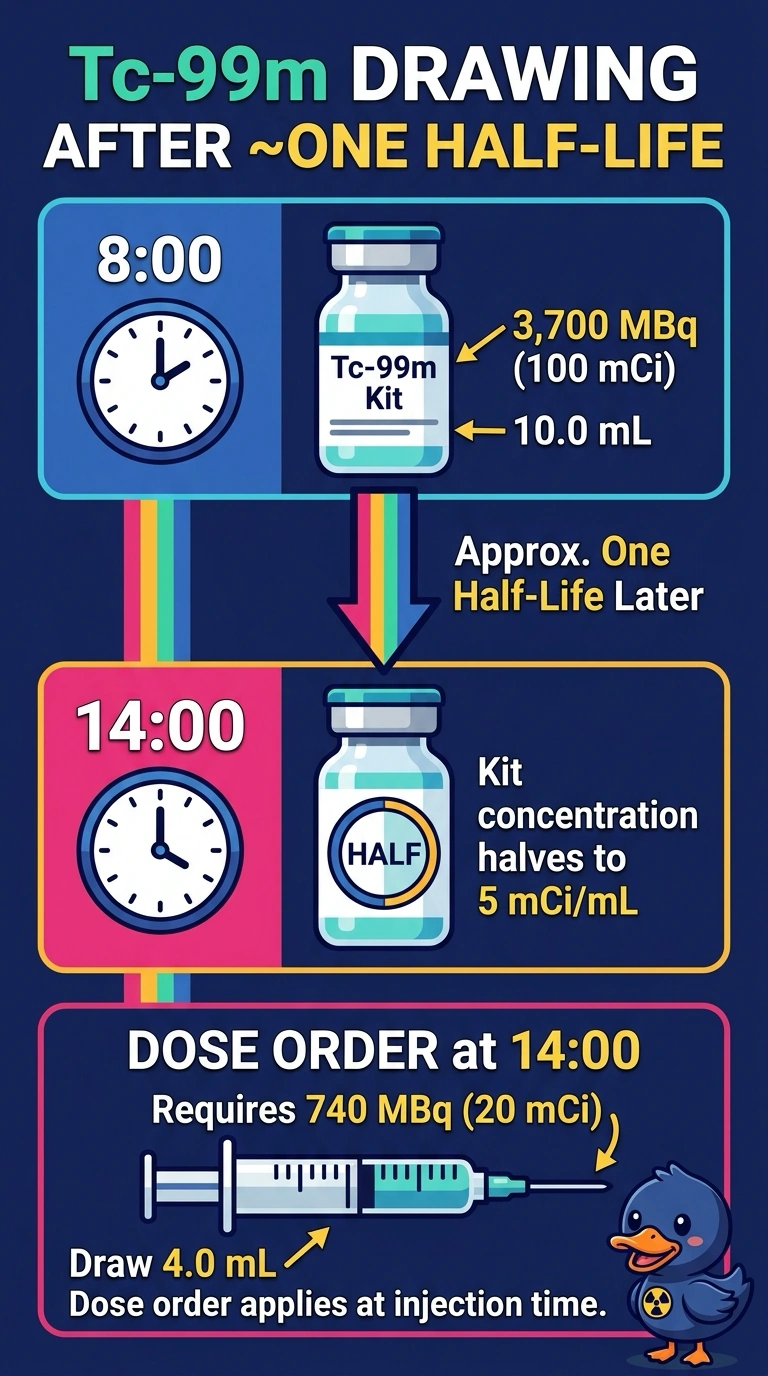
A Tc-99m kit holds 3,700 MBq (100 mCi) in 10.0 mL at its 8:00 calibration time. A bone scan patient is injected at 14:00, and the order specifies 740 MBq (20 mCi) at injection time, with plenty of kit volume left to draw from. What volume must be drawn at 14:00 to deliver the ordered activity?
Select an answer to reveal the explanation.
Short Explanation
You've got two moving parts to track: the clock and the syringe. Approximately one Tc-99m half-life passes between calibration and injection, so the concentration is cut in half before you draw. Like a soda going flat, the bottle stays the same size while each milliliter carries less fizz.
Full Explanation
Physical decay acts on everything in the vial at once, so both the total activity and the concentration fall together; after six hours, roughly one Tc-99m half-life, the 100 mCi sitting in 10.0 mL becomes about 50 mCi still sitting in 10.0 mL. Because the prescribed 20 mCi must exist in the syringe at the moment of injection, you divide by the concentration that is actually present at 14:00, giving 4.0 mL. Using the calibration-time concentration fails by concept because it performs no decay correction at all and would deliver double the ordered activity. Taking half the kit volume fails because a volume-fraction heuristic confuses what remains in the vial with what was ordered for the patient, landing five milliliters above the target. Counting two half-lives fails because it doubles the delay in the arithmetic and yields a concentration the timeline never produces. Exam caveat: half-life values and unit conversions are stable, but calibration windows and elution times are not, so always work from the stated times. Practical check: divide the ordered activity by the concentration at injection, then sanity-check that the volume fits the vial and the syringe.