
During a whole-body bone scan, an adult with Parkinson's disease struggles to hold position because of resting tremor. A colleague proposes a padded strap fastened across the chest and thighs, while you prefer sandbags supporting the arms and a pillow beneath the knees. The patient is alert, follows directions, and can lift away any support that simply rests on the body. Which device choice correctly applies the ethical and legal distinction between restraints and positioning aids?
Select an answer to reveal the explanation.
Short Explanation
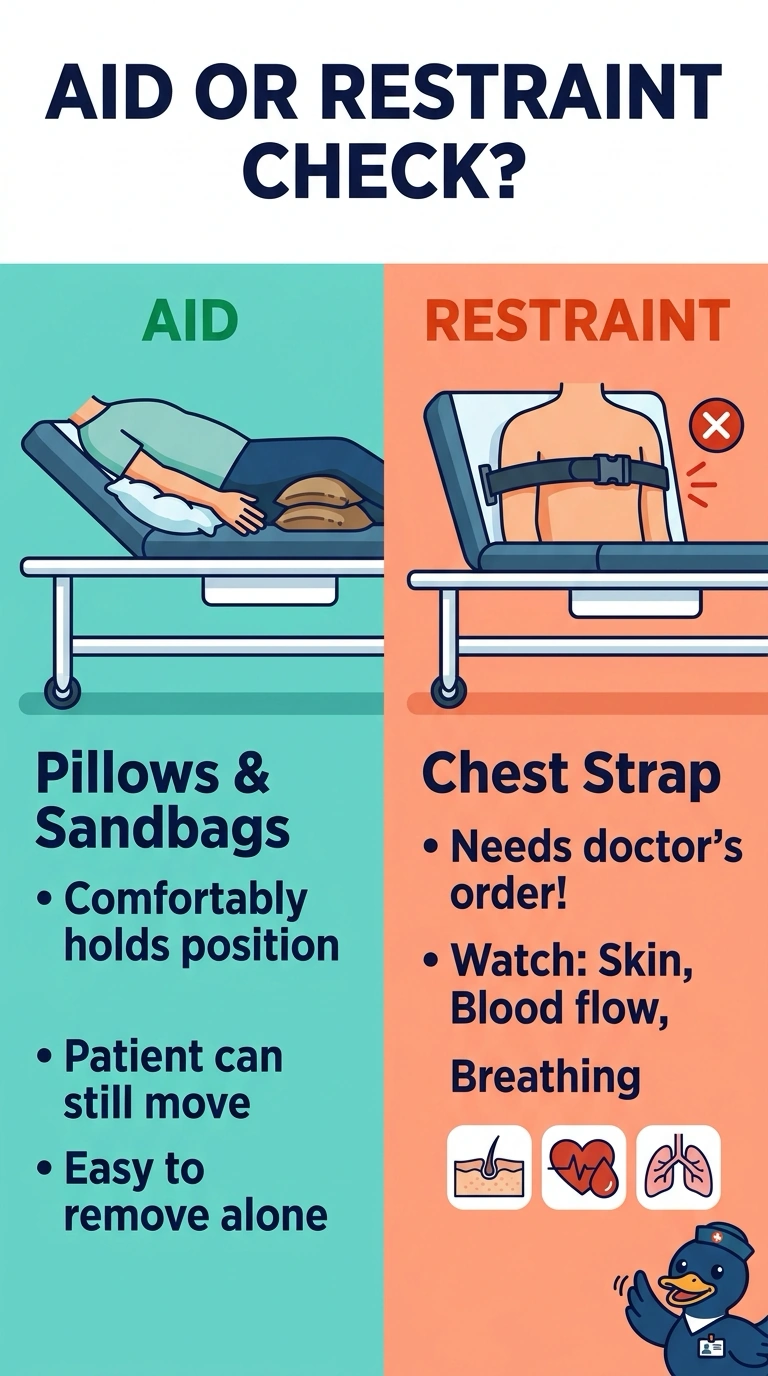
Here's the test you can apply: if the patient can undo the device themselves and it just keeps them comfortable, it's an aid. If it takes away freedom of movement, it's a restraint no matter how soft or brief it is. Sandbags and a pillow pass that test, while a fastened chest strap fails it, so the strap needs an order and checks.
Full Explanation
The distinction rests on function, not on comfort or duration. A positioning aid such as a sandbag, rolled towel, or pillow supports alignment and eases discomfort while the patient stays free to move or take it away, so it is covered by the consent already given for the scan. A padded strap fastened across the chest and thighs meets the definition of a restraint because it prevents free movement, and that classification brings the usual safeguards: an order from a licensed practitioner, an assessment of the patient's condition, ongoing monitoring, and the least restrictive method that works. Agreeing to the strap on the basis of the patient's verbal agreement misapplies informed consent, because agreeing to a device does not turn a restrictive device into an unrestricted one. Removing the strap as soon as the static images are finished misapplies the timing rule, since classification follows what the device does while it is on rather than how long it stays. Documenting sandbags under restraint policy applies the rule in the wrong direction and burdens an aid the patient can remove freely. Exam caveat: examiners almost always hinge the item on whether the patient could remove the device alone, so weigh that feature first. Practical check: before fastening anything, ask whether the patient could undo it while you step out; if not, get the order and assessment first.