
Six weeks after a total thyroidectomy for intermediate-risk papillary carcinoma, a patient is booked for I-131 remnant ablation in three days. A contrast-enhanced CT was done last week, and the patient is of childbearing age. Which readiness checks must be documented before the activity is administered?
Select an answer to reveal the explanation.
Short Explanation
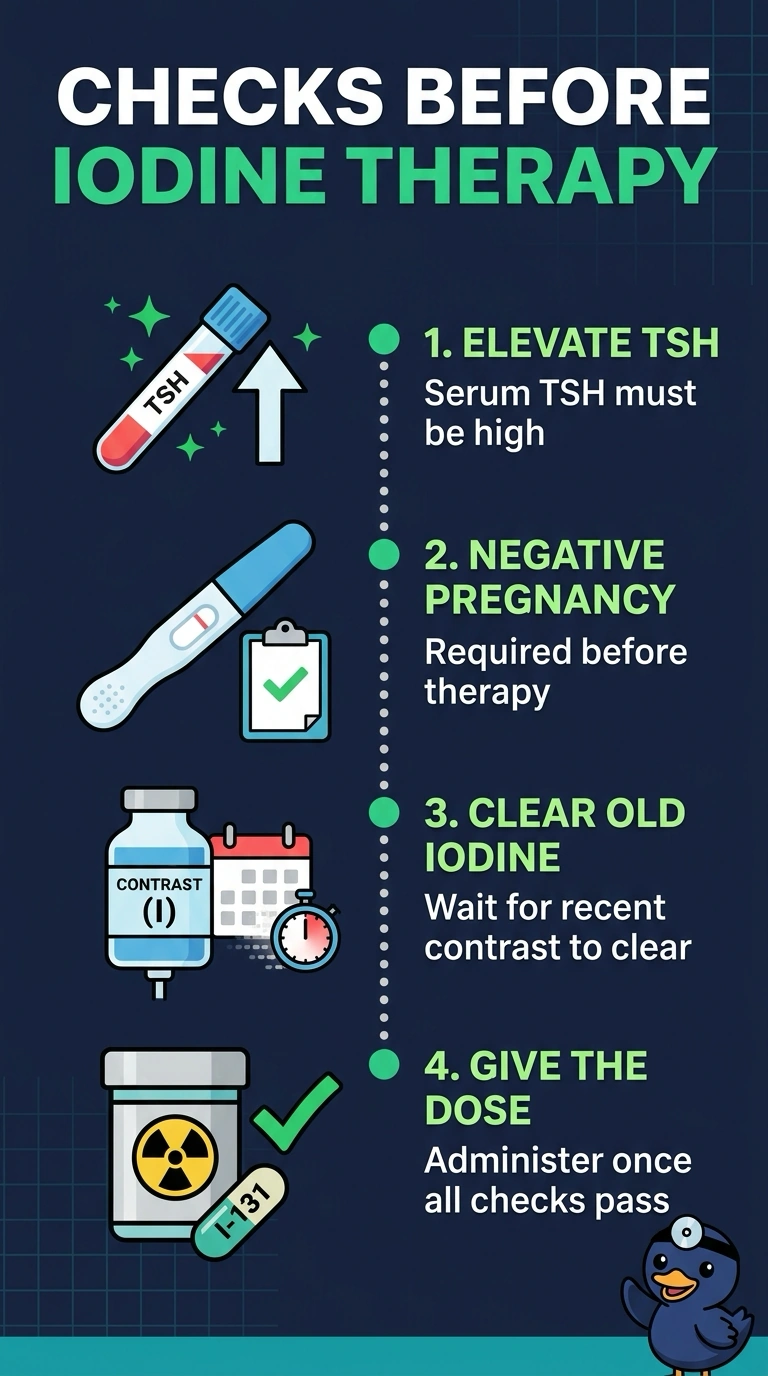
Before I-131, make sure your elevated serum TSH and negative pregnancy test are documented, and wait until iodine from your recent contrast has cleared. That iodine can compete with treatment like cars vying for the same parking spot, reducing how much I-131 your thyroid tissue takes up.
Full Explanation
Ablation depends on the thyroid remnant actively trapping iodine, and that trapping is stimulated by TSH, so document that the patient has achieved the required TSH stimulation before the activity is administered. Excluding pregnancy matters because administered radioiodine crosses the placenta and exposes the fetus, so a screen is required rather than an assumption from history. Recent iodinated contrast delivers a stable-iodine load that can reduce radioiodine uptake, so treatment should be delayed until the iodine load has cleared. Treating on the booked date while hydrating and prompting voiding handles radiation safety but leaves that iodine load competing with the dose. Confirming the patient is not breastfeeding covers lactation yet skips the pregnancy screen a patient of childbearing age still needs. Signed consent documents permission but says nothing about thyroid stimulation, so it fails the biological requirement for uptake. Caveat: some departments use recombinant TSH while the patient stays on thyroid hormone, so TSH stimulation can be achieved in more than one way. Practical check: before you draw the dose, put the TSH result, the pregnancy screen and the contrast date in front of you together.