
Within a few weeks of a high-activity therapy infusion, a patient develops a temporary drop in blood counts. Separately, a technologist with 25 years of handling unsealed sources has no symptoms, but the department tracks the worker's dose to estimate long-term health risk. Which classification fits both the patient's count change and the worker's long-term risk?
Select an answer to reveal the explanation.
Short Explanation
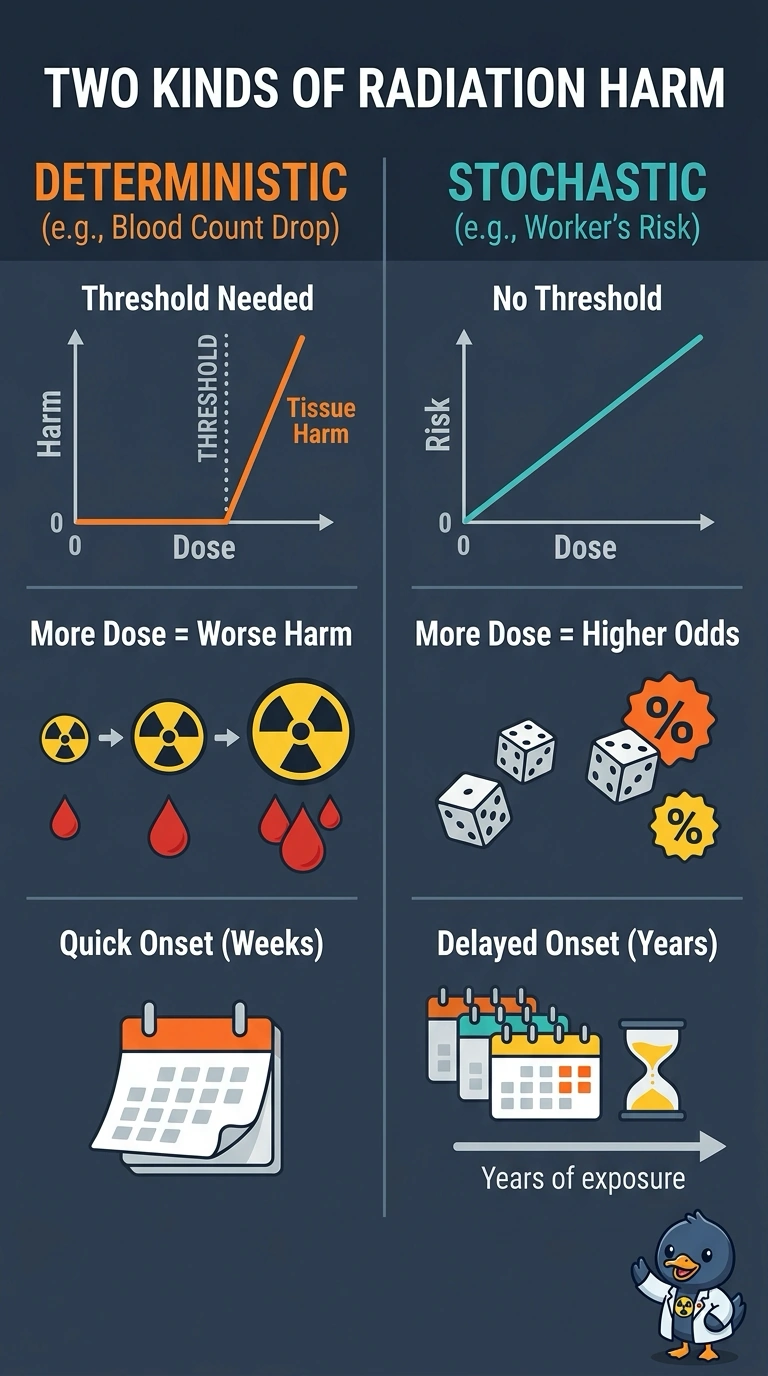
For your patient, the blood-count drop is an acute deterministic effect: it has a dose threshold, and greater doses can make it more severe. Your worker’s long-term risk is stochastic—like odds changing rather than the harm getting worse—with no assumed threshold.
Full Explanation
Tissue reactions (traditionally called deterministic effects) have a dose threshold in the standard teaching model; above it, greater dose generally produces greater severity. A temporary blood count drop within weeks of radionuclide therapy is consistent with an acute tissue reaction. Stochastic effects, such as the long-term cancer risk used in radiation-protection models, are described as having no threshold: dose changes the probability of harm, not its severity. Calling the blood count change stochastic misses its dose-dependent severity and threshold behavior. Calling the worker's long-term risk a tissue reaction confuses a change in the probability of future harm with an observable injury. Treating the blood count fall as chronic misses the time course given in the question. Some tissue reactions, such as lens changes, can be recognized after prolonged exposure, so timing alone does not define every tissue reaction. A useful distinction is whether dose affects severity or probability, and whether the effect is an injury or a risk estimate.